Zinc Plating Explained: A Surface Finishing Manufacturer's Perspective
- Share
- Issue Time
- Jan 17,2026
Summary
SOMI explains zinc plating as a surface finishing expert: sacrificial corrosion resistance, cost-effective finishes, versatile types including zinc-nickel, and reliable barrel/rack methods for industrial applications.

As an experienced surface finishing manufacturer, we understand the critical role that various metal finishing techniques play in enhancing product durability, performance, and aesthetic appeal. Among the many options available, zinc plating stands out as a consistently reliable and cost-effective solution for corrosion protection. We've dedicated ourselves to mastering sophisticated processes to ensure our clients receive the best possible outcomes for their components.
The relentless battle against corrosion is a challenge that costs industries in the United States around $276 billion each year. At our core, we believe in providing solutions that not only meet but exceed expectations, and zinc plating is often our go-to recommendation for its versatility and proven track record. This article will explore the 'how' and 'why' behind zinc plating from a surface finishing manufacturer's comprehensive perspective.
What is Zinc Plating? A Surface Finishing Manufacturer's Definition
From a manufacturer's viewpoint, zinc plating is a highly effective and economical surface finishing method that involves electrochemically applying a thin layer of zinc onto a metal substrate, most commonly steel or iron. The primary purpose is to create a protective barrier that shields the base metal from environmental elements like moisture and oxygen, which are the main drivers of rust and corrosion. This process is not just about applying a coating; it's a precise science that enhances the longevity and reliability of metal components across countless industries.
The Electroplating Process: Laying the Foundation
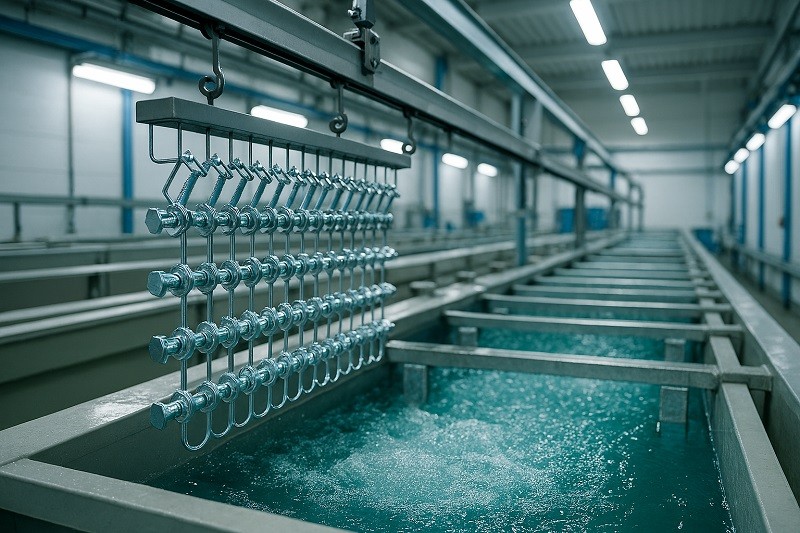
The core of zinc plating is a process called electrodeposition. It begins with meticulous surface preparation, where the metal part is rigorously cleaned to remove all oils, dirt, and rust, ensuring perfect adhesion of the zinc layer.
Once cleaned, the component is submerged in a chemical solution known as an electrolyte bath, which is rich in zinc ions. The part to be plated acts as the cathode (negative electrode), while a zinc anode (positive electrode) is also placed in the bath. When a direct electrical current (DC) is introduced, zinc ions from the anode are dissolved into the solution, travel through the electrolyte, and are deposited evenly onto the surface of the cathode part. This electrochemical reaction forms a smooth, uniform, and adherent layer of zinc, fundamentally transforming the surface properties of the original part.
Sacrificial Protection: Zinc's Key Role in Surface Finishing
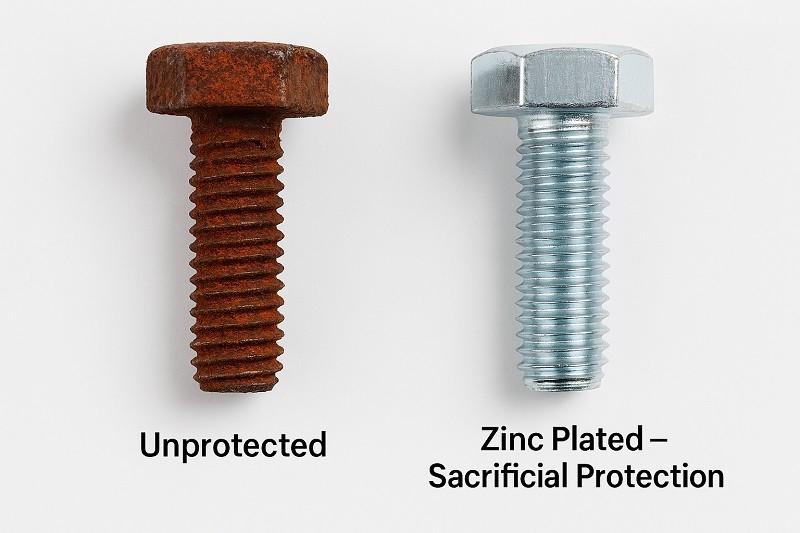
Zinc plating provides more than just a simple physical barrier against corrosion. Its most critical function is offering "sacrificial protection," a concept rooted in electrochemistry. Zinc is a more reactive (or less "noble") metal than iron and steel. This means when a zinc-plated part is exposed to a corrosive environment, a galvanic cell is formed, and the zinc coating will corrode preferentially to protect the steel substrate underneath.
Even if the coating gets scratched or damaged, exposing the base metal, the surrounding zinc continues to sacrifice itself, preventing rust from forming on the steel. As the zinc corrodes, its byproducts form a stable, protective film, further shielding the steel from the environment. This dual action—acting as both a physical shield and a sacrificial anode—is what makes zinc plating an incredibly robust and reliable method for extending the service life of metal components.
The Critical Benefits of Zinc Plating for Our Clients, as Observed by a Surface Finishing Manufacturer
As manufacturers, we don't just see a finished part; we see the sum of its properties and its potential to perform under pressure. Zinc plating consistently delivers a host of tangible benefits that directly translate to improved product quality, longevity, and value for our clients.
Unmatched Corrosion Resistance: Extending Product Lifespan
The primary and most significant advantage of zinc plating is its exceptional ability to prevent corrosion. By providing both a physical barrier and sacrificial protection, the zinc layer shields the underlying steel or iron from moisture and oxygen. This dramatically slows the onset of rust, even in harsh environmental conditions. Standard industry tests, like the salt spray test (ASTM B117), are used to measure this resistance. Depending on the thickness of the zinc and the type of post-treatment applied, zinc-plated parts can withstand hundreds of hours in a salt spray chamber before showing signs of red rust (corrosion of the base metal). For example, a quality zinc plating with a trivalent chromate passivate can often exceed 120 hours before white rust appears and significantly longer before red rust, effectively prolonging the functional life of the component.
Cost-Effectiveness: A Practical Surface Finishing Solution
In the world of manufacturing, performance must always be balanced with cost. Zinc plating excels in this regard. Zinc is an abundant and relatively inexpensive metal, making the raw material costs lower than for other protective metals like cadmium or nickel. The electroplating process itself is well-established, efficient, and suitable for high-volume production, which helps keep processing costs down. When you consider the extended product life and reduced maintenance requirements that result from superior corrosion resistance, the overall return on investment becomes clear. For many applications, zinc plating provides an unbeatable combination of protection and affordability compared to alternatives like stainless steel or more complex alloy coatings.
Enhanced Aesthetics and Versatility in Colors
While functionality is paramount, the visual appearance of components is also crucial for many products. Basic zinc plating provides a bright, clean, metallic finish that is often desirable. However, the versatility of zinc plating truly shines through the use of post-treatment passivation, also known as chromate conversion coatings. These treatments not only boost corrosion resistance but also offer a range of colors. Common options include:
- Clear/Blue Zinc: Offers a shiny, silver-blue appearance that is aesthetically pleasing and provides a base level of enhanced corrosion protection.
- Yellow Zinc: Provides a golden-yellow, iridescent finish and offers a higher level of corrosion resistance, making it very popular in the automotive industry.
- Black Zinc: Delivers a sleek matte or semi-gloss black finish, often used for aesthetic reasons in automotive trim or electronics, while also providing good corrosion protection.
- Olive Drab/Green Zinc: A non-reflective, dull green finish primarily used for military and outdoor applications where camouflage and high corrosion resistance are needed.
This ability to color-code parts can also serve functional purposes, such as identifying different components during assembly.
Improved Durability and Wear Resistance
Although the zinc layer is thin, it contributes to the overall durability of the part. The coating enhances surface hardness and provides a level of resistance against abrasion, scratches, and impacts. This is particularly important for components that are handled frequently or are part of a moving assembly. While not as hard as specialized hard coatings, zinc plating offers a significant improvement in wear resistance over an untreated surface, helping parts maintain their integrity and appearance for longer. The ductility of the zinc layer also means it adheres well and doesn't easily crack or flake when the underlying part is bent or formed, maintaining its protective properties.
Compatibility with Post-Treatments and Coatings for Comprehensive Surface Finishing
Zinc plating serves as an excellent foundation for a variety of subsequent finishing processes. Its surface is highly receptive to passivates and sealers, which are crucial for maximizing corrosion resistance. Passivation creates a chemical conversion coating that seals the zinc and delays the formation of "white rust" (zinc oxide). Sealers, which can be organic, inorganic, or wax-based, are then applied over the passivate to add another layer of barrier protection, further enhancing durability and potentially achieving over 300-500 hours of salt spray resistance to white or red rust.
Furthermore, the zinc-plated surface provides excellent adhesion for paints, e-coats, and powder coatings. This makes it an ideal undercoat, ensuring that the final decorative or functional topcoat bonds securely to the component, preventing chipping and peeling while benefiting from the underlying corrosion protection of the zinc. This multi-layer approach is a cornerstone of modern, high-performance surface finishing.
Diverse Types of Zinc Plating: Tailoring Solutions as a Surface Finishing Manufacturer
Not all zinc plating is created equal. As a specialized surface finishing manufacturer, we know that the "best" process depends entirely on the client's specific needs—from the part's geometry and end-use environment to budget and aesthetic requirements. Selecting the right type of zinc plating is crucial for achieving optimal performance.
Alkaline vs. Acid Zinc Plating: Understanding the Nuances
The chemistry of the electrolyte bath is a fundamental choice in the zinc plating process, primarily falling into two categories: alkaline and acid. Each has distinct characteristics that make it suitable for different applications.
Alkaline Zinc Plating: This process uses an electrolyte solution with a high pH (typically above 12). Alkaline baths are renowned for their excellent "throwing power," which is the ability to deposit a very uniform and consistent coating, even on parts with complex shapes, deep recesses, and threaded areas. This superior distribution ensures comprehensive corrosion protection across the entire component. The resulting deposit is also highly ductile. While the plating speed is generally slower than acid zinc, and it may require heating, the stability of the bath and the high-quality, uniform finish make it ideal for precision components where consistent coverage is critical.
Acid Zinc Plating: This process uses an acidic electrolyte with a lower pH (usually 4-6). Its main advantages are high efficiency and a much faster deposition rate, making it a cost-effective choice for high-volume production of simpler parts. Acid zinc typically produces a brighter, more lustrous finish directly from the bath, which can be an aesthetic advantage. However, its primary drawback is poorer throwing power, which can lead to uneven thickness on complex parts. The acidic nature of the bath is also more corrosive to equipment.
Here is a comparative table to summarize the key differences:
| Feature | Alkaline Zinc Plating | Acid Zinc Plating |
|---|---|---|
| Coating Uniformity | Excellent, superior "throwing power" | Fair, poorer "throwing power" |
| Deposition Speed | Slower | Faster |
| Finish Appearance | Semi-bright to matte (can be brightened) | Bright and lustrous |
| Adhesion | Superior on complex parts | Good, especially on simple geometries |
| Corrosion Resistance | Excellent due to uniform, dense coating | Moderate, can be less than alkaline |
| Hydrogen Embrittlement | Lower risk | Higher risk |
| Ideal Applications | Complex parts, precision components, high-corrosion areas | High-volume, simple parts, decorative finishes |
Barrel vs. Rack Plating: Optimizing for Part Size and Geometry
Beyond the chemistry, the physical method of handling parts during electroplating is another critical decision. The choice between barrel and rack plating depends on the part's size, shape, durability, and the required finish quality.
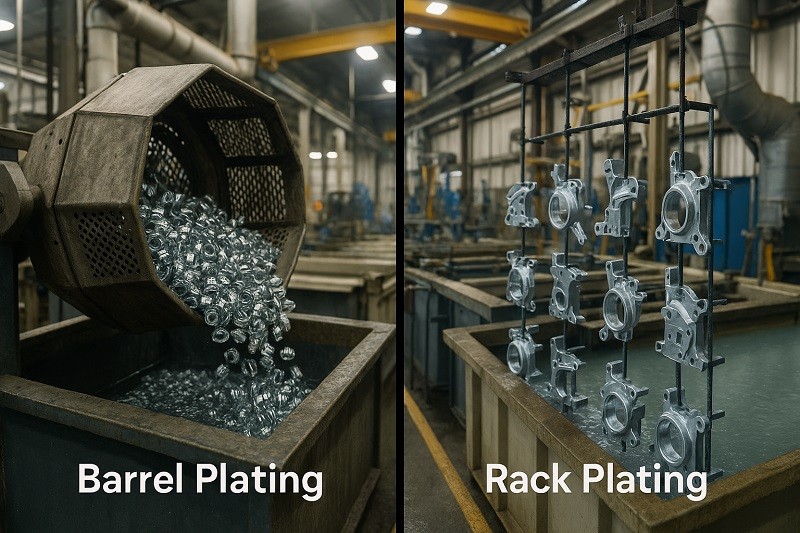
Barrel Plating: This method is the go-to for processing large quantities of small, durable parts like screws, nuts, bolts, and stampings. The components are placed inside a perforated barrel that slowly rotates as it is submerged in the plating solution. This tumbling motion ensures that all surfaces of the parts are exposed to the electrolyte, resulting in a generally uniform finish across the batch. Barrel plating is highly efficient and cost-effective for high-volume orders. However, it's not suitable for large, complex, or delicate parts that could be damaged by the tumbling action.
Rack Plating: This method is used for parts that are too large, heavy, complex, or fragile for barrel plating. Each part is individually attached to a metal rack using hooks or wires. The entire rack is then submerged in the plating bath. Since the parts remain stationary and do not contact each other, this method provides a superior cosmetic finish, prevents damage, and allows for more precise control over the coating thickness on specific areas. Rack plating is more labor-intensive and therefore more expensive per part, but it is essential for achieving the highest quality finish on delicate or aesthetically critical components.
Specialized Finishes: Yellow, Blue/Clear, and Black Zinc Plating
The final passivate, or chromate conversion coating, defines both the appearance and a significant portion of the corrosion resistance of the finished part.
Yellow/Gold Zinc Plating: This finish is created by applying a yellow chromate coating after plating, resulting in a distinctive golden, iridescent appearance. It offers excellent corrosion resistance, often withstanding 72 to 120 hours or more in salt spray tests, making it a very popular choice for automotive and industrial applications where both durability and appearance are important.
Blue/Clear Zinc Plating: Often called blue-bright or just clear zinc, this finish has a shiny, silvery-blue hue that retains the metallic look of zinc. It provides a moderate level of corrosion protection, typically in the range of 12-72 hours to white rust in salt spray tests. It's widely used for fasteners, hardware, and electronics where a clean appearance is desired and the corrosive environment is not extreme.
Black Zinc Plating: This finish provides a sleek and durable black appearance, ranging from a matte to a semi-gloss sheen. It is achieved by applying a black chromate conversion coating. Black zinc is sought after for its aesthetic qualities, low light reflectivity, and solid corrosion protection, which is often comparable to yellow zinc. Common applications include automotive components, firearms, electronics, and hardware.
Zinc-Nickel Plating: Advanced Corrosion Protection for Demanding Applications
For the most demanding environments where standard zinc plating may not suffice, we utilize zinc-nickel (Zn-Ni) alloy plating. This is an advanced surface finishing process where a layer of zinc and nickel (typically 10-15% nickel content) are co-deposited onto the substrate.
Zinc-nickel offers drastically superior corrosion resistance compared to conventional zinc. While standard zinc plating may last around 120 hours in a neutral salt spray test before showing red corrosion, zinc-nickel coatings can often withstand 500 to 1,000 hours or more under the same conditions. This makes it an ideal choice for components in the automotive, aerospace, marine, and energy sectors, where parts are exposed to high temperatures, road salts, and extreme humidity. It provides better wear resistance and hardness than zinc alone and is an excellent, environmentally safer alternative to the now-restricted cadmium plating. While more costly than standard zinc, the extended service life and reliability justify the investment for critical applications. Looking at various Surface Finishing Cases, the adoption of zinc-nickel for high-stakes components is a growing trend.
Our Process: How a Surface Finishing Manufacturer Ensures Quality Zinc Plating
Achieving a high-quality zinc plated finish that provides maximum corrosion resistance and durability is not a matter of chance. It is the result of a meticulously controlled, multi-stage process honed through years of manufacturing experience. A defect at any stage can compromise the entire finish. Here’s a look at our comprehensive approach to ensuring excellence.
Thorough Surface Preparation: The Foundation of Adhesion
The single most critical factor for a successful plated finish is the condition of the substrate. Proper adhesion is impossible without a flawlessly clean and active metal surface. Any residual oils, grease, dirt, or oxides will prevent the zinc from bonding correctly, leading to defects like peeling, blistering, or flaking down the line. Our process begins with a rigorous multi-step cleaning and preparation sequence:
- Alkaline Cleaning: Parts are first immersed in a hot alkaline detergent solution. This bath is designed to saponify fats and oils and use surfactants to displace and emulsify soils, effectively stripping away grease, manufacturing lubricants, and other organic contaminants.
- Rinsing: After the alkaline bath, parts are thoroughly rinsed with clean water. This step is crucial to remove any lingering detergent solution that could contaminate subsequent baths.
- Acid Pickling: Next, the parts are moved to an acid bath, typically containing hydrochloric or sulfuric acid. This "pickling" process removes any inorganic materials, such as rust, scale, and surface oxides, that may have formed on the metal during storage or previous manufacturing steps. This activates the surface by exposing the pure base metal, making it ready for plating.
- Final Rinsing: A final, thorough rinse ensures that all acid residues are removed before the part enters the plating bath, preventing contamination of the expensive electrolyte solution.
Precision Electroplating: Controlled Deposition for Optimal Results
With the parts perfectly clean and activated, they move to the core of the operation: the electroplating bath. Achieving a uniform, dense, and consistent zinc deposit requires precise control over numerous variables. Our technicians and automated systems continuously monitor and manage these critical parameters:
- Bath Chemistry: The chemical composition of the electrolyte—including the concentration of zinc metal, additives, brighteners, and pH level—is regularly analyzed and adjusted. Maintaining this delicate balance is essential for the quality and appearance of the final coating.
- Current Density: The amount of electrical current applied per unit of surface area directly influences the plating speed and structure of the zinc deposit. We carefully regulate the DC current from the rectifier to ensure it is optimal for the part's geometry and the bath chemistry, preventing issues like "burning" (a rough, dark deposit from too much current) or thin spots.
- Temperature: The temperature of the plating bath affects the efficiency of the process and the properties of the deposit. Our baths are maintained at their ideal operating temperature to ensure consistent and predictable results.
- Time: The duration for which the parts are in the plating bath determines the final thickness of the zinc layer. This is precisely calculated and controlled to meet the client's specifications and the required service condition standard (e.g., ASTM B633).
- Agitation: Proper solution agitation, whether mechanical or through air sparging, ensures a fresh supply of zinc ions reaches all surfaces of the part, which is key to achieving a uniform coating.
Post-Treatment and Quality Assurance: Guaranteeing Performance
The process doesn't end when the parts leave the plating tank. The post-treatment and quality assurance stages are what lock in the performance and verify that the finish meets all specifications.
- Post-Treatment Application: After another rinse, parts are typically immersed in a passivate (chromate) solution to vastly improve corrosion resistance and, if desired, add color. For even greater protection, a sealer or topcoat can be applied over the passivate. Each of these steps is performed under controlled conditions to ensure proper application and performance.
- Drying: Parts are thoroughly dried to prevent water spots and ensure the coatings are properly cured and hardened.
- Quality Control and Testing: A finished batch is not approved until it passes our stringent quality checks. We employ a range of testing methods to validate the finish, including:
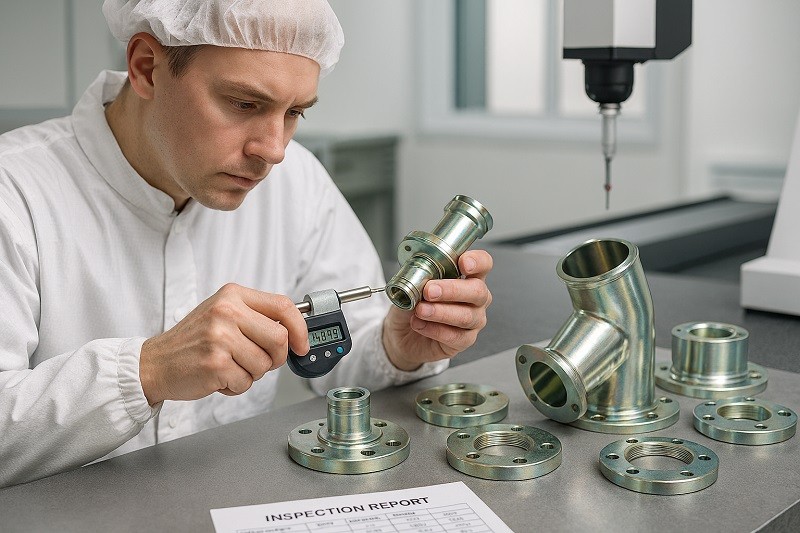
- Thickness Testing: We use non-destructive methods like X-Ray Fluorescence (XRF) or magnetic gauges to verify that the zinc coating thickness meets the specified range (e.g., 5, 8, 12, or 25 microns per ASTM B633).
- Adhesion Testing: Various tests, such as the bend test, file test, or tape pull test (as described in ASTM B571), are performed to ensure the zinc coating is securely bonded to the base metal.
- Corrosion Resistance Testing: We conduct salt spray (or salt fog) testing in-house according to ASTM B117 standards. This accelerated corrosion test exposes parts to a saline mist to confirm they meet the required hours of resistance to white and red rust.
- Visual Inspection: Every part is visually inspected for any cosmetic defects, ensuring a uniform and appealing finish.
This commitment to a controlled, end-to-end process guarantees that our clients receive a zinc plated finish that is not only aesthetically pleasing but also robust, reliable, and built to last.
Applications Across Industries: Where Our Surface Finishing Expertise Shines with Zinc Plating
The versatility, reliability, and cost-effectiveness of zinc plating make it an indispensable surface finishing process across a vast array of industries. From the high-stakes environments of aerospace to the everyday hardware in our homes, our expertise ensures components are protected and perform as intended.
Automotive and Aerospace: Meeting Rigorous Demands
The automotive and aerospace industries operate under some of the most stringent performance and safety standards. Components in these sectors are constantly exposed to fluctuating temperatures, moisture, road salts, and mechanical stress. Zinc plating, particularly high-performance zinc-nickel alloys, is critical for protecting a wide range of parts.
In the automotive sector, zinc plating is essential for everything from under-the-hood components to chassis hardware. Brake pipes, brake calipers, power steering components, and fuel system hardware all rely on zinc or zinc-nickel coatings to resist corrosion and ensure long-term, reliable function. Fasteners—the nuts, bolts, and screws that hold a vehicle together—are almost universally zinc-plated to prevent rust, which could otherwise compromise structural integrity. Yellow and black zinc finishes are especially common for their enhanced corrosion resistance and ease of identification.
In the aerospace industry, the stakes are even higher. Safety and reliability are non-negotiable. Zinc and zinc-nickel plating are used on fasteners, connectors, and structural components to provide robust corrosion protection without adding significant weight. These coatings must endure extreme environmental conditions and prevent galvanic corrosion, which can occur when different metals are in contact, a common situation in complex aerospace assemblies. By protecting these critical parts from degradation, zinc plating plays a vital role in maintaining the structural integrity and safety of aircraft.
Construction and Hardware: Durability for the Everyday
Step into any hardware store, and you will be surrounded by zinc-plated products. The construction and hardware industries rely heavily on zinc plating to provide durable and long-lasting protection for metal components that are often exposed to the elements. Everything from structural bolts and nuts to screws, washers, brackets, and door hardware benefits from a zinc coating.
This protective layer acts as a frontline defense against atmospheric corrosion, preventing the rust that can weaken structures and shorten the lifespan of building materials. While hot-dip galvanizing is used for larger structural steel, zinc electroplating is ideal for fasteners and hardware where maintaining precise thread tolerances is crucial for a secure fit. The affordability of zinc plating makes it a practical solution for the high volume of components required in construction, offering a reliable balance of performance and economy.
Electronics and Telecommunications: Protection for Critical Components
In the electronics and telecommunications industries, performance goes beyond just corrosion resistance. Components in these fields also require electrical conductivity and protection from electromagnetic interference (EMI). Zinc plating is uniquely suited to meet these needs.
Metal enclosures, chassis, and racks used to house sensitive electronic equipment are often zinc-plated. The zinc coating provides excellent corrosion protection, ensuring the longevity of the housing. More importantly, the conductive nature of the zinc layer is essential for EMI/RFI shielding. A properly designed and plated enclosure acts as a Faraday cage, preventing external electromagnetic signals from disrupting the sensitive components inside and stopping the device's own emissions from interfering with other nearby electronics. Zinc-plated surfaces also provide reliable grounding points for internal circuits. The process is widely used for everything from server racks in data centers to the small metal components and connectors within consumer electronics, providing a cost-effective solution for shielding, conductivity, and durability.
Conclusion: Your Partner for High-Performance Zinc Plating
As a dedicated surface finishing manufacturer, we continually strive to provide the most effective and innovative solutions for our clients. Zinc plating, with its remarkable balance of superior corrosion protection, cost-effectiveness, and aesthetic versatility, remains a cornerstone of our offerings. From selecting the right chemistry—be it alkaline for complex parts or acid for high-speed production—to choosing the optimal finishing process like a high-performance zinc-nickel alloy for harsh environments, we are committed to helping you implement the ideal zinc plating solution for your specific needs.
Ultimately, the decision to utilize zinc plating for your components is a smart one, but choosing the right manufacturing partner to execute it is paramount. Our deep expertise, rigorously controlled quality processes, and comprehensive understanding of zinc plating’s multifaceted benefits ensure that your products will not only meet but exceed performance and aesthetic expectations. We are here to ensure your components are finished for success, delivering the durability and reliability your applications demand.