Your Ultimate Guide to Choosing the Right SLA 3D Printing Parts Supplier
- Share
- Issue Time
- Jan 10,2026
Summary
Choose the best SLA 3D printing supplier with expert guidance on quality, materials, lead time, post-processing, and ISO-certified production for prototypes and low-volume manufacturing

Stereolithography (SLA) 3D printing has revolutionized rapid prototyping and on-demand manufacturing, offering unparalleled precision, intricate detail, and exceptionally smooth surface finishes. However, the success of your project doesn't just hinge on the technology itself, but on the expertise and reliability of your chosen parts supplier. Selecting the right partner is a critical decision that can impact your timeline, budget, and the quality of your final product. This comprehensive guide will walk you through the essential factors to consider when choosing an SLA 3D printing service provider.
What is SLA 3D Printing and Why Choose It?
SLA is an additive manufacturing process that uses a UV laser to cure liquid photopolymer resin layer by layer into a solid object. This method is renowned for its ability to produce parts with extremely fine details and a finish that closely resembles injection-molded plastic. Its key advantages include high accuracy, smooth surfaces, and the availability of specialized materials like clear or flexible resins. These characteristics make it ideal for concept models, functional prototypes, medical devices, and intricate patterns for casting.
The Critical Role of a Parts Supplier in Your Project's Success
While owning a 3D printer is an option, partnering with a professional service provider offers significant benefits. A top-tier supplier provides access to industrial-grade machines, a wide array of materials, and a team of experts who can optimize your design for manufacturability (DFM). They manage the entire process, from file preparation to post-processing and quality assurance, allowing you to focus on innovation. A reliable supplier is more than a vendor; they are a strategic partner in your product development journey.
Key Criteria for Evaluating SLA Part Suppliers
When comparing potential suppliers, it's crucial to look beyond just the price. A holistic evaluation will ensure you find a partner that aligns with your quality standards and project goals. Here are the essential criteria to assess:
- Technological Capabilities: Do they operate modern, well-calibrated industrial SLA machines? Enquire about their printers (e.g., 3D Systems, Stratasys Neo, Formlabs) and build volume capacity.
- Material Selection: A broad material portfolio is a sign of a versatile supplier. They should offer resins with diverse mechanical properties to suit various applications.
- Proven Expertise: Look for a supplier with a strong track record and positive customer testimonials. Case studies relevant to your industry are a great indicator of experience.
- Quality Management: Ask about their quality management system. ISO 9001 certification is a strong indicator of a commitment to quality and consistency.
- Customer Support: Responsive communication and expert support are invaluable. A good partner will offer design feedback and guidance throughout the process.
Understanding SLA Materials: Beyond the Basics
Selecting the right material is fundamental to the functional success of your part. A knowledgeable supplier will help you navigate their offerings to find the perfect match for your application, whether you need strength, flexibility, or transparency. The choice directly impacts the mechanical properties, durability, and performance of the final component.
| Resin Type | Key Properties | Common Applications |
|---|---|---|
| Standard Resin | High resolution, smooth surface finish, rigid | Concept models, aesthetic prototypes, figurines |
| Tough/Durable Resin | High impact resistance, shatter-resistant | Functional prototypes, jigs, fixtures, enclosures |
| Flexible Resin | Rubber-like, pliable, absorbs impact | Handles, grips, gaskets, wearables |
| Clear Resin | Optically transparent after post-processing | Lenses, fluidics, light guides, transparent housings |
| High-Temp Resin | High heat deflection temperature (HDT), stable | Molds, inserts, hot air and fluid flow components |
| Castable Resin | Burns out cleanly with no ash | Jewelry casting, dental patterns |
Assessing Print Quality and Dimensional Accuracy
SLA is known for precision, but the final quality still depends on the supplier's process control. Request a sample part or review their portfolio to assess surface finish and feature detail. Ask for their stated dimensional tolerances, which are often in the range of ±0.1 to ±0.2 mm. A reputable provider will be transparent about their accuracy standards and quality control measures.
Speed and Lead Time: How Fast Can You Get Your Parts?
In the world of rapid prototyping, speed is often critical. Most online 3D printing services offer instant quotes and clear lead time estimates. Turnaround can range from a few days to over a week, depending on part complexity, volume, and the supplier's current capacity. Discuss your timeline upfront to ensure the provider can meet your deadlines without compromising quality.
Post-Processing and Finishing Options
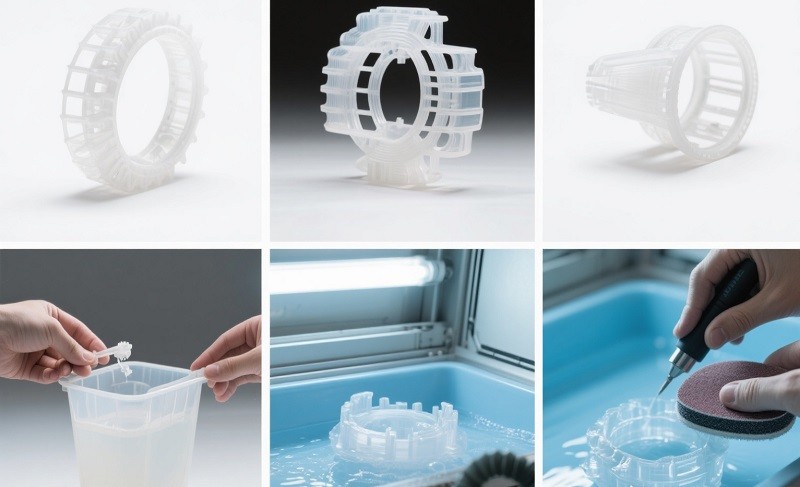
Raw SLA parts require several post-processing steps, including washing to remove excess resin, UV post-curing to achieve final material properties, and support structure removal. Leading suppliers offer a range of additional finishing services to enhance aesthetics and function, such as:
- Sanding and polishing for an ultra-smooth or optically clear surface
- Painting and color matching
- Priming for pre-production prototypes
- Plating for a metallic finish and added durability
The Importance of Strong Communication and Customer Support
Exceptional customer support is a hallmark of a trustworthy supplier. A good partner provides clear, prompt communication from the quoting stage through delivery. They should have engineers available to answer technical questions, offer design-for-manufacturability (DFM) feedback, and help resolve any issues that arise. This level of support can prevent costly errors and delays.
Comparing Costs: Getting a Quote and Understanding Pricing
While cost should not be the only factor, it is an important consideration. Reputable services provide transparent, all-inclusive quotes without hidden fees. Pricing is typically determined by the volume of material used, the machine time required, and the labor involved in post-processing. Use instant quoting tools from multiple providers like Xometry, Protolabs, and RapidDirect to compare costs, but weigh the price against their stated quality, speed, and material options.
Quality Control and Assurance Processes
A robust quality control (QC) process ensures that every part you receive meets your specifications. This begins with file verification and extends to in-process monitoring, and final inspection. Ask potential suppliers about their QC procedures. Do they use CMMs or laser scanners for dimensional verification? How do they ensure material traceability and machine calibration? A supplier committed to quality will have a well-documented process to guarantee consistency.

Navigating Large-Scale Production with SLA
SLA is not just for one-off prototypes. Many service providers, such as Unionfab, are equipped for low-volume production and batch jobs, making them a cost-effective option for manufacturing hundreds or even thousands of parts. When scaling up, work with a supplier that has demonstrated capacity, a streamlined workflow, and a rigorous quality management system to ensure part-to-part consistency.
Partnering for Success: Making Your Final Choice
Choosing the right SLA 3D printing parts supplier is a strategic decision that enables innovation and accelerates your time to market. By evaluating providers based on their technology, material variety, quality systems, and customer support, you can build a reliable partnership. Define your project requirements clearly, do your research, and select a supplier that not only delivers high-quality parts but also acts as a trusted advisor for your manufacturing needs.