Your Guide to Selecting a CNC Machined Parts Manufacturer for Precision, Quality, and Speed
- Share
- Issue Time
- Feb 11,2026
Summary
Find the right CNC machined parts manufacturer for precision, quality & speed. Expert guide to vetting capabilities, materials, certifications & quoting efficiency.
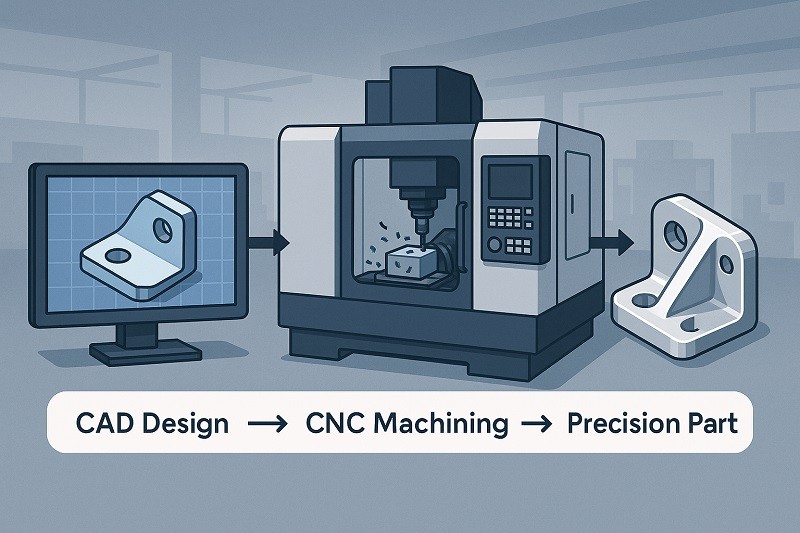
In today's competitive landscape, partnering with the right CNC machined parts manufacturer is more than a procurement decision—it's a strategic move that impacts your product's quality, time-to-market, and bottom line. Computer Numerical Control (CNC) machining is a subtractive manufacturing process that uses computer-guided tools to create high-precision components from a solid block of material. For industries from aerospace to medical, the accuracy and reliability of a CNC manufacturer are paramount. This comprehensive guide will walk you through the essential considerations for selecting a manufacturing partner that aligns with your needs for precision, quality, and efficiency.
What is CNC Machining and Why is it Critical?
CNC machining is a subtractive manufacturing process where computer-controlled machines precisely remove material from a workpiece to create a custom-designed part. It starts with a Computer-Aided Design (CAD) file, which is translated into G-code that directs the machine's every move. This method is renowned for its ability to produce parts with extremely tight tolerances and excellent repeatability, making it indispensable for creating everything from simple brackets to complex aerospace components. Unlike additive processes like 3D printing, CNC machining works by cutting material away, offering superior strength and material properties inherent to the bulk material.
The Core Services of a Top-Tier CNC Manufacturer
A capable CNC machined parts manufacturer should offer a suite of services to handle diverse project requirements. Understanding these core processes will help you identify a partner with the right capabilities for your designs.
- CNC Milling: This process uses rotating multi-point cutting tools to remove material from a stationary workpiece. It's ideal for creating flat surfaces, pockets, and complex 3D contours. Advanced manufacturers utilize 3-axis, 4-axis, and 5-axis milling machines to produce highly intricate geometries in a single setup, which increases accuracy and reduces lead times.
- CNC Turning: Used to create cylindrical parts, turning involves rotating a workpiece while a single-point cutting tool moves along its surface. Lathes and turning centers can produce parts with features like slots, tapers, and threads with high precision.
- Electrical Discharge Machining (EDM): For extremely hard metals or complex shapes that are difficult to achieve with traditional cutting tools, EDM uses electrical sparks to erode material. This is a crucial service for industries like tool and die making.
- Grinding: A finishing process that uses an abrasive wheel to achieve exceptionally smooth surface finishes and ultra-fine tolerances.
From CAD File to Finished Component: The Manufacturing Workflow
Understanding the journey from a digital design to a physical part highlights a manufacturer's efficiency and transparency. While workflows vary slightly, a typical process includes:
- CAD File Submission & Analysis: It starts when you upload a CAD file to the manufacturer's platform. Advanced services provide instant Design for Manufacturability (DfM) feedback, identifying potential issues that could increase cost or production time.
- Instant Quoting: Modern manufacturers leverage powerful software to provide instant quotes based on your design, material selection, quantity, and required lead time. This transparency and speed accelerates the procurement process.
- Programming & Setup: Once an order is placed, machinists program the toolpaths based on the G-code and set up the CNC machine with the appropriate workpiece and cutting tools.
- Machining: The automated CNC machine executes the program, cutting the part to the exact specifications.
- Quality Inspection: After machining, parts undergo rigorous inspection using tools like Coordinate Measuring Machines (CMMs), micrometers, and calipers to ensure they meet all dimensional and tolerance requirements.
- Finishing & Shipping: If required, parts receive surface treatments like anodizing or plating before being packaged and shipped.
Material Selection: Finding the Right Properties for Your Part
A versatile CNC manufacturer will offer a wide range of materials, from common metals and plastics to specialized alloys. The choice of material is critical as it dictates the part's strength, weight, chemical resistance, and cost.
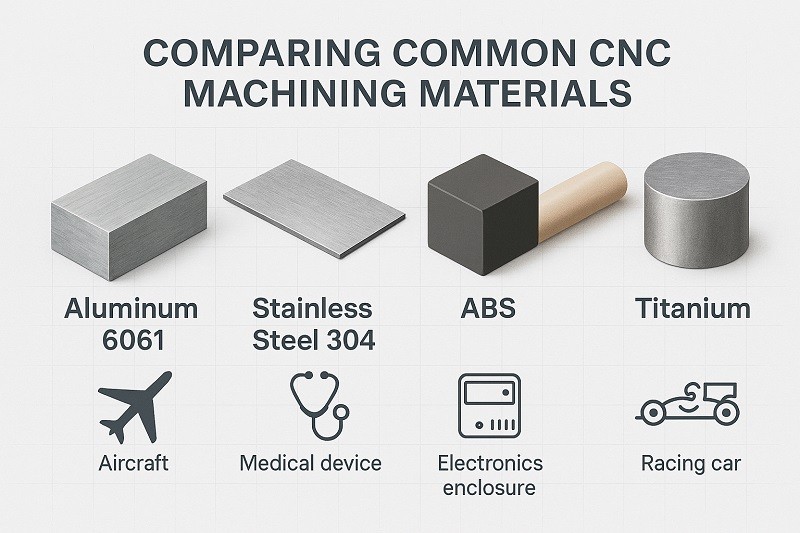
Common CNC Machining Materials
| Material | Key Properties | Common Applications |
|---|---|---|
| Aluminum 6061 | Excellent strength-to-weight ratio, high corrosion resistance | Aerospace components, consumer electronics, fixtures |
| Stainless Steel 304 | High corrosion resistance, good formability | Medical devices, kitchen equipment, automotive parts |
| ABS Plastic | High impact resistance, good machinability, low cost | Prototypes, enclosures, consumer goods |
| PEEK | High-performance thermoplastic, excellent thermal and chemical resistance | Aerospace components, medical implants, high-wear parts |
| Titanium | Very high strength-to-weight ratio, exceptional corrosion resistance | Aerospace, medical implants, high-performance automotive |
The Critical Role of Quality Assurance and Certifications
Quality Assurance (QA) is the foundation of reliable manufacturing. It’s a proactive approach designed to prevent defects, as opposed to Quality Control (QC), which focuses on identifying them. A manufacturer's commitment to quality is often demonstrated by their Quality Management System (QMS) and industry certifications. When evaluating a potential partner, look for key certifications like ISO 9001, which is the global standard for quality management. For specific industries, additional certifications are vital, such as AS9100 for aerospace and ISO 13485 for medical devices.
A robust QA process includes regular equipment calibration, in-process monitoring, and final inspection using advanced metrology equipment like CMMs.
Unlocking Efficiency with Instant Quoting Platforms
The traditional Request for Quote (RFQ) process can be slow and inefficient. Modern CNC machining services have revolutionized this with online, instant quoting platforms. By simply uploading a CAD model, customers can receive real-time pricing, lead time options, and DfM feedback in minutes. This offers several advantages:
- Speed: Get quotes in seconds, not days, allowing for faster decision-making.
- Transparency: See how changes in material, quantity, or lead time directly impact cost.
- Efficiency: Streamline your procurement process and free up engineering resources for more critical tasks.
Understanding Tolerances in CNC Machining
Tolerance refers to the permissible limit of variation in a physical dimension. CNC machining is valued for its ability to hold very tight tolerances, often as precise as ±0.025 mm. However, specifying unnecessarily tight tolerances can significantly increase the cost of a part. A good manufacturer will work with you to understand the critical dimensions of your design and apply tolerances appropriately, ensuring functionality without excessive cost.
Why Surface Finish Matters
Surface finish, or roughness, is a measure of the fine-scale texture of a surface. It can be critical for aesthetic, functional, or technical reasons, such as reducing friction or creating a better seal. CNC manufacturers offer a range of finishing processes, including:
- As-Machined: The standard finish, which typically has visible tool marks.
- Bead Blasting: Creates a uniform matte or satin finish.
- Anodizing: (For aluminum) Adds a hard, corrosion-resistant, and often colored, ceramic layer.
- Polishing: Creates a smooth, reflective surface.
Choosing the Right Manufacturing Partner
Selecting a CNC machined parts manufacturer is a critical decision. Look for a partner who offers a combination of technical capability, a commitment to quality, industry experience, and modern, efficient processes. A manufacturer that provides a seamless online quoting experience, transparent communication, and engineering support can become a valuable extension of your team, helping you innovate faster and build better products.
Your Next Step in Precision Manufacturing
Ready to bring your designs to life? A top-tier CNC machining partner should make it easy to get started. Look for a platform where you can upload your CAD files, explore material options, and receive an instant quote today. This access to on-demand manufacturing empowers you to move from prototype to production with confidence and speed, securing your supply chain and giving you a competitive edge in the market.