What is the Process of Die Casting? A Comprehensive Overview
- Share
- Issue Time
- Jan 7,2026
Summary
Die casting is a manufacturing method celebrated for its precision and efficiency in creating metal parts, critical across industries from automotive to electronics. The process involves injecting molten metal into a steel mold (die) under high pressure.
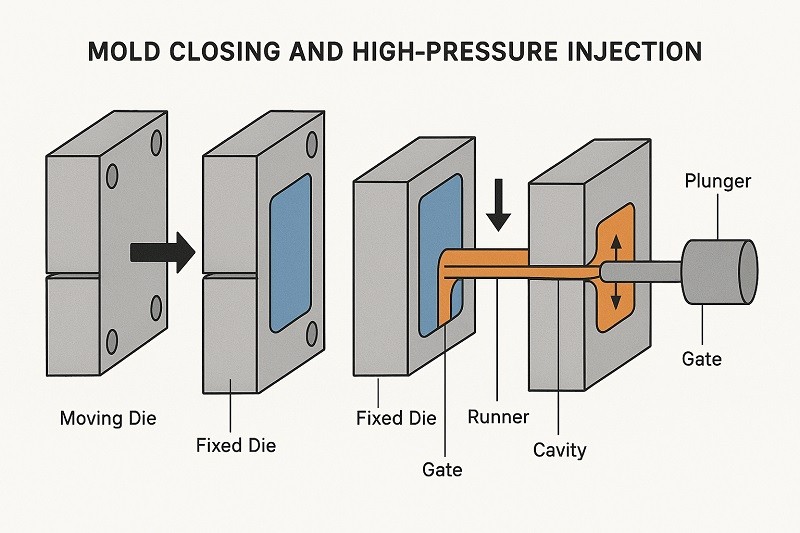
Die casting is an essential manufacturing process that showcases both precision and efficiency in creating metal parts. It has become a vital part of industries from automotive to electronics. This method is celebrated for its capacity to produce large quantities of components with high dimensional accuracy and a smooth surface finish, making it a cornerstone of modern production.
Join me as I explore the comprehensive process of die casting, from its foundational principles to its diverse applications and advantages. We will delve into the step-by-step mechanics, compare different techniques, examine the materials used, and see how it stacks up against other manufacturing methods.
Understanding the Fundamental Process of Die Casting
To truly appreciate the impact of die casting, it's crucial to first understand what it is and the core mechanics that drive it. This process is a marvel of engineering that transforms molten metal into intricate, durable parts with remarkable speed and consistency.
What Exactly is Die Casting?
At its core, die casting is a metal casting process defined by the use of a mold cavity, often just called a die. The process involves forcing molten metal into this die under high pressure. These dies are typically crafted from hardened tool steel, machined into the precise shape of the desired part, and function similarly to an injection mold. Once the molten metal is injected, it cools and solidifies, taking on the exact shape of the mold. The result is a metal part with a high degree of precision and an excellent surface finish.
This technique is primarily used for non-ferrous metals, which are metals that do not contain a significant amount of iron. The most common materials include alloys of aluminum, zinc, magnesium, copper, lead, and tin. The choice between different die casting methods often depends on the melting point of the metal being used.
The Core Mechanics of the Die Casting Process
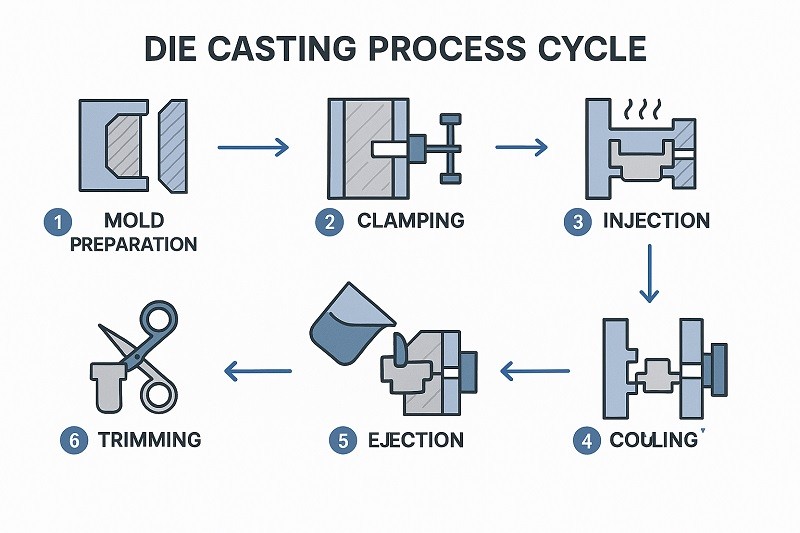
The traditional die casting process, also known as high-pressure die casting, can be broken down into four fundamental steps: die preparation, filling (or injection), ejection, and shakeout (trimming).
Preparation: The process begins by preparing the two halves of the die, the "cavity" and the "core," which are typically made from high-strength steel. A lubricant is sprayed onto the internal surfaces of the mold. This lubricant serves two essential functions: it helps control the temperature of the die and aids in the easy removal of the finished casting.
Injection (Filling): After lubrication, the two halves of the die are securely closed. Molten metal is then injected into the die cavity under immense pressure, which can range from 1,500 to over 25,000 pounds per square inch (psi). This high pressure ensures the molten metal rapidly fills every tiny detail and crevice of the mold.
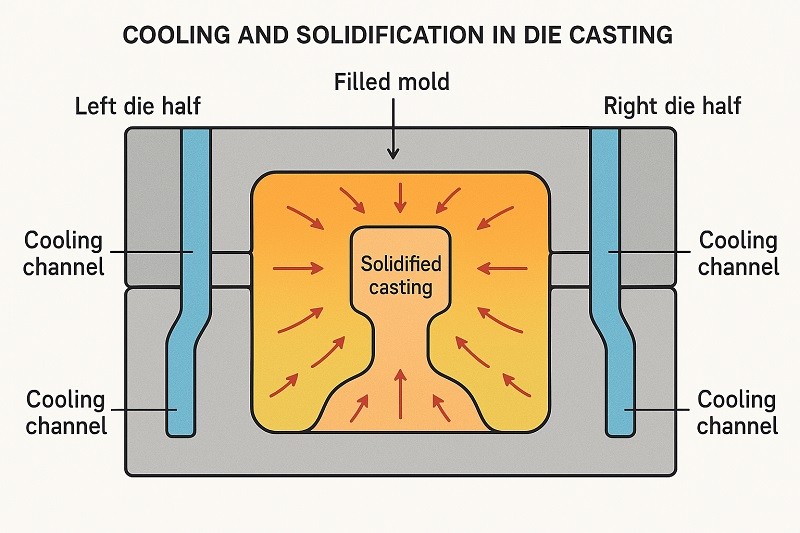
Cooling and Solidification: The pressure is maintained on the die until the molten metal cools and solidifies into the final shape. The die is designed with internal cooling channels to help regulate the temperature and speed up this solidification process.
Ejection: Once the casting has hardened, the die is opened. An ejection mechanism, usually consisting of several ejector pins, pushes the casting out of the mold cavity. This cycle, from injection to ejection, is incredibly fast, sometimes taking just a few seconds to complete, which makes the process highly efficient for mass production.
Exploring the Step-by-Step Process of Die Casting
To fully grasp the ingenuity behind die casting, let's break down the journey from a digital design to a finished metal component. Each stage is meticulously planned and executed to ensure the final product meets exacting standards of quality and precision.
Step 1: Mold Design
The entire die casting process begins long before any metal is melted. The first and arguably most critical stage is the meticulous design of the mold, or die. The quality, precision, and longevity of the final product are all determined at this foundational step. The journey starts with a concept, which engineers and designers translate into a detailed digital blueprint using sophisticated Computer-Aided Design (CAD) software.
Modern CAD/CAM (Computer-Aided Manufacturing) systems are indispensable, allowing designers to create intricate 3D models of the final part. These tools enable the simulation of the entire casting process, helping to predict how the molten metal will flow, cool, and solidify. This simulation is crucial for identifying potential defects like air pockets (porosity) or incomplete filling before the expensive and time-consuming process of machining the physical mold begins.
Several key factors must be considered during mold design to ensure success:
- Draft Angle: This is a slight taper applied to the surfaces of the mold cavity. It is essential for allowing the solidified casting to be smoothly ejected from the die without damage. Inner walls typically require a larger draft angle than outer walls because the metal tends to shrink onto the core as it cools.
- Parting Line: This is the line where the two halves of the mold meet. The precise location of the parting line is critical to minimize visible seams on the final part and to prevent excess material, known as "flash," from seeping out.
- Runners and Gates: These are the channels through which molten metal travels from the injection system into the mold cavity. Their design must be optimized to ensure a smooth, uniform fill.
- Cooling Channels: These are passages within the die through which a liquid coolant flows to regulate the mold's temperature. Efficient cooling is vital for controlling solidification, reducing cycle times, and preventing warping.
- Ejection System: The design must incorporate pins or other mechanisms that will push the finished part out of the mold once it has cooled.
Once the design is finalized and validated through simulation, the physical mold components are crafted with extreme precision from high-grade tool steel capable of withstanding immense heat and pressure. This is typically done using advanced machining techniques like CNC (Computer Numerical Control) milling and EDM (Electrical Discharge Machining).
Step 2: Metal Preparation
With the mold ready, the focus shifts to preparing the casting material itself. This stage is crucial because the quality and composition of the molten alloy directly influence the final part's mechanical properties and integrity.
The process begins by selecting the appropriate alloy—typically based on aluminum, zinc, or magnesium—and loading it into a specialized furnace in the form of ingots. The furnace heats the metal to a precise temperature, transforming it from a solid into a liquid state ready for injection. Controlling the temperature is vital; overheating can alter the alloy's chemical makeup or introduce unwanted gases, while underheating can lead to poor fluidity and incomplete mold filling.
Furnaces used in die casting can be categorized in several ways:
- Melting vs. Holding Furnaces: Some facilities use a large central furnace for melting large quantities of metal ingots, which is then transferred to smaller "holding" furnaces located next to each die casting machine. These holding furnaces keep the metal at the optimal temperature, ensuring a consistent supply for continuous operation.
- Heating Method: Furnaces can be heated by electricity (resistance or induction) or gas. Induction furnaces are known for fast melting speeds and reducing oxidation, making them ideal for high-melting-point metals.
Throughout the melting process, great care is taken to maintain the purity and chemical composition of the alloy. Impurities can weaken the final casting, and the interaction between the hot liquid metal and the surrounding atmosphere can lead to oxidation or gas absorption. For this reason, the melt may be treated with fluxes to remove impurities, and the process is carefully monitored to produce a clean, homogenous liquid metal. The specific melting temperature depends on the alloy; for example, common aluminum alloys melt between 580°C and 630°C, while zinc alloys have a much lower melting point of around 380-420°C.
Step 3: Injection
The injection stage is where the transformation from liquid to solid form truly begins. This is a high-speed, high-force event that defines the die casting process.
In what is known as high-pressure die casting (HPDC), the prepared molten metal is forced into the sealed die cavity at extremely high speeds and pressures. This pressure can range from 1,500 psi to over 25,000 psi (10 to 175 MPa). This intense force is necessary to ensure that the metal fills the mold completely and rapidly, capturing every intricate detail of the design, including complex geometries and thin walls. The entire injection process often happens in milliseconds.
How the metal gets to the die depends on whether a hot-chamber or cold-chamber machine is used.
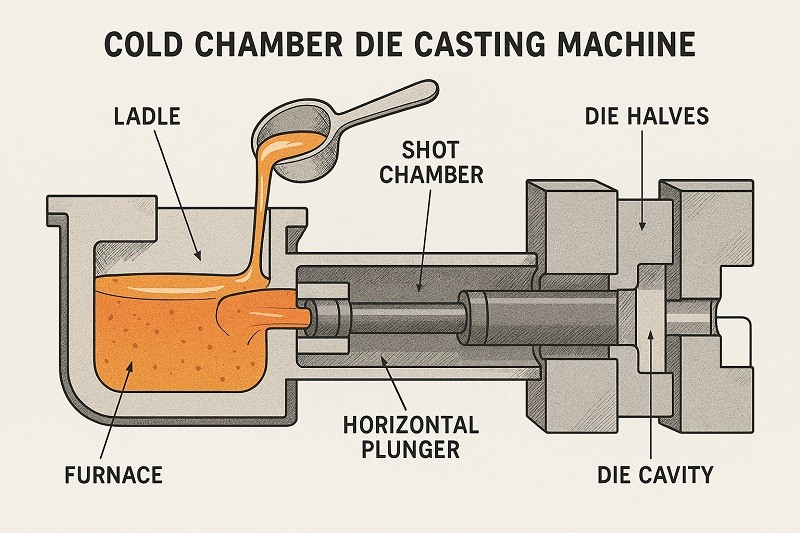
- Cold-Chamber Process: Molten metal is ladled from a separate holding furnace into a "shot sleeve." A hydraulic-powered plunger then travels down the sleeve, forcing the metal into the die. This method is used for alloys with high melting points, such as aluminum and copper.
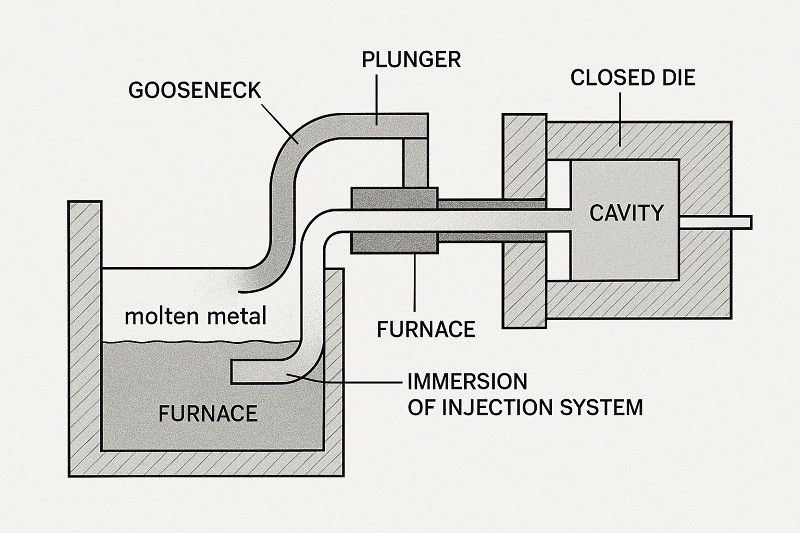
- Hot-Chamber Process: The injection mechanism, including the shot sleeve and plunger, is submerged within the molten metal bath. This allows for faster cycle times because the metal doesn't need to be transferred for each shot. This method is suited for alloys with lower melting points, like zinc and magnesium.
The injection process is often multi-phased:
- Slow Shot Phase: The plunger begins by moving slowly to push air out of the shot sleeve and gently introduce the metal into the runner system.
- Fast Shot Phase: The plunger's velocity is dramatically increased to rapidly fill the part cavity.
- Intensification: After the cavity is filled, an even higher pressure is applied. This "squeeze" phase compresses the metal, compensates for any shrinkage that occurs as it begins to cool, and minimizes porosity (gas bubbles).
This precise control over speed and pressure is critical for creating dense, strong parts with a flawless surface finish.
Step 4: Cooling and Solidification
Once the molten metal has been injected and fills the die cavity, the critical cooling and solidification phase begins. This step is where the liquid metal transforms into a solid, high-strength component, taking on the final shape of the mold. The control of this process is paramount to the quality and mechanical properties of the finished part.
The die acts as a heat exchanger, rapidly drawing thermal energy away from the molten alloy. This process is actively managed by a network of cooling channels built into the mold itself. A liquid coolant, typically water or oil, circulates through these passages to maintain a consistent die temperature and facilitate uniform solidification of the casting. The rate of cooling has a profound impact on the final product:
- Rapid Cooling: A fast cooling rate leads to a finer grain structure in the metal, which generally enhances its strength and hardness. However, if cooling is too rapid, it can cause defects such as internal stresses, cracks, or incomplete filling of the mold, where parts of the metal solidify prematurely.
- Slow Cooling: A slower cooling process can result in a coarser grain structure and may lead to defects like shrinkage porosity—small voids that form as the metal shrinks during solidification.
The goal is to achieve a controlled, uniform cooling rate across the entire part. This minimizes internal stresses, prevents warping or distortion, and ensures dimensional accuracy. The time it takes for a part to cool and solidify can range from a few seconds for small, simple components to a few minutes for larger, more complex parts with thick walls. This cooling time is a significant portion of the overall die casting cycle and is carefully calculated during the mold design phase to optimize both part quality and production efficiency.
Specialized cooling techniques, such as spray cooling or the use of baffles and bubblers within the cooling channels, can be employed to target specific hot spots in the mold and achieve more effective and uniform heat extraction.
Step 5: Ejection and Trimming
The final steps in the die casting cycle involve freeing the newly formed part from the mold and giving it its finished shape. These processes happen in quick succession to maintain the rapid production rate that die casting is known for.
Ejection After the molten metal has completely solidified within the die, the clamping unit of the die casting machine releases, and the two halves of the mold are pulled apart. This reveals the solid casting. To remove the part from the die cavity, a series of ejector pins built into the movable half of the die are activated. These pins push forward, applying a controlled force that releases the casting from the mold. The placement and force of these pins are carefully designed to eject the part without causing damage or distortion. Small indentations, known as ejector pin marks, are often visible on the finished part where the pins made contact. Designers typically try to place these pins on non-cosmetic or non-functional surfaces of the part.
Trimming The ejected casting is not yet a finished product. It is still attached to the excess metal from the runners, gates, sprue, and overflows. Additionally, a very thin layer of excess metal, called flash, may have formed along the parting line or around ejector pins where the die halves meet. All this extra material must be removed.
This removal process is called trimming or deflashing. There are several methods used:
- Manual Trimming: For smaller production runs or complex parts, operators may manually break off or file down the excess material.
- Trim Press: For high-volume production, the most common method is using a trim die in a hydraulic or pneumatic press. The cast part (often called a "shot") is placed in the trim die, which is built to the exact profile of the part. The press then shears off all the flash and runner material in a single, swift motion.
- Vibratory Deburring: Parts can be placed in a tumbler with abrasive media that vibrates, wearing away the flash and smoothing edges.
- Cryogenic Deflashing: This specialized process involves freezing the parts with liquid nitrogen, which makes the thin flash brittle and easy to break off through tumbling, without affecting the main body of the part.
After trimming, the unwanted metal is typically collected and remelted, making the die casting process highly efficient with minimal material waste. The finished part may then move on to secondary operations like machining, painting, or assembly.
Variations in the Die Casting Process: Hot-Chamber vs. Cold-Chamber
While all high-pressure die casting involves injecting molten metal into a steel mold, the method of getting the metal into that mold creates two distinct variations: the hot-chamber process and the cold-chamber process. The choice between them is primarily dictated by the melting point and corrosive properties of the alloy being cast.
The Hot-Chamber Die Casting Process
The hot-chamber process, sometimes called gooseneck casting, is characterized by its integrated design. The injection mechanism, including the cylinder, piston (or plunger), and gooseneck, is submerged directly in the bath of molten metal held within the machine's furnace.
Here’s how it works:
- Chamber Filling: The cycle begins with the plunger in its raised position, which uncovers an intake port. Molten metal from the surrounding pot flows through this port and fills the injection cylinder, or "gooseneck."
- Injection: A hydraulically powered piston then moves downward, sealing the port and forcing the molten metal out of the gooseneck, through a nozzle, and into the die cavity under pressure.
- Solidification and Retraction: The metal is held under pressure until it solidifies in the die. The plunger then retracts, allowing the remaining molten metal to flow back into the pot and clearing the channel for the next cycle.
Advantages and Suitable Materials: The primary advantage of the hot-chamber process is its speed. Because the furnace is integral to the machine, the time required to move metal into the injection chamber is eliminated, leading to very fast cycle times—often up to 15 cycles per minute or more. This makes it extremely efficient for high-volume production. Other benefits include lower porosity, longer die life, and a more automated process.
However, this method is limited to metals with low melting points that are not corrosive to the machine's steel components. Constant immersion in high-temperature, aggressive metals like aluminum would quickly damage the injection system. Therefore, hot-chamber die casting is primarily used for zinc, magnesium, tin, and lead-based alloys.
The Cold-Chamber Die Casting Process
The cold-chamber process is designed to overcome the limitations of the hot-chamber method. By separating the melting furnace from the injection system, it can safely handle metals with high melting points and corrosive properties.
Here is the step-by-step process:
- Melting and Transfer: The metal alloy is melted in a separate furnace. A precise amount of molten metal needed for a single shot is then transferred, usually via an automated or manual ladle, into the "cold chamber" or shot sleeve.
- Injection: A hydraulically operated plunger, which is not submerged in molten metal, moves forward to seal the pouring hole. It then pushes the molten metal at high speed and pressure from the shot sleeve into the die cavity.
- Solidification and Retraction: After the metal solidifies, the die opens, the part is ejected, and the plunger retracts to its starting position, ready for the next ladle of molten metal.
Advantages and Suitable Materials: The main advantage of cold-chamber casting is its ability to cast high-melting-point alloys that would damage a hot-chamber machine. This includes aluminum, which is the most widely used material in die casting, as well as magnesium, copper, and brass alloys. The resulting parts are often stronger and denser due to the high pressures used.
The tradeoff is a slower production cycle. The additional step of ladling the metal for each cycle means that the process is not as rapid as hot-chamber casting.
Comparison Table: Hot-Chamber vs. Cold-Chamber Die Casting
| Feature | Hot-Chamber Die Casting | Cold-Chamber Die Casting |
|---|---|---|
| Injection System | Integrated with the furnace; immersed in molten metal. | Separate from the furnace; metal is ladled in. |
| Suitable Metals | Low melting point alloys (Zinc, Magnesium, Lead, Tin). | High melting point alloys (Aluminum, Copper, Brass). |
| Cycle Speed | Very fast; continuous operation. | Slower due to the ladling step. |
| Component Wear | Higher wear on injection components due to constant immersion. | Lower wear on injection components. |
| Metal Contamination | Higher risk of iron pickup from submerged parts. | Lower risk of contamination as metal is transferred per shot. |
| Typical Applications | Small, intricate parts, hardware, electronic components. | Larger, structural parts, automotive components, housings. |
Materials Used in the Die Casting Process
The choice of material is a critical decision in the die casting process, as it directly determines the mechanical properties, weight, corrosion resistance, and cost of the final component. Die casting is predominantly used with non-ferrous alloys, each offering a unique set of characteristics suitable for different applications.
Aluminum in the Die Casting Process
Aluminum is the most widely used metal in die casting, prized for its excellent combination of light weight and strength. Because of its high melting point, aluminum alloys are processed exclusively using the cold-chamber method.
Key Properties and Advantages:
- Lightweight: Aluminum has a fantastic strength-to-weight ratio, making it ideal for applications in the automotive and aerospace industries where reducing weight is critical for fuel efficiency and performance.
- Corrosion Resistance: Aluminum naturally forms a protective oxide layer that shields it from corrosion, making it suitable for parts exposed to harsh weather or environmental conditions.
- High Thermal and Electrical Conductivity: Its ability to dissipate heat effectively makes aluminum a top choice for electronic housings, heat sinks, and LED lighting fixtures. It also possesses good electrical conductivity.
- Complex Geometries: Aluminum alloys flow well in a molten state, allowing them to fill intricate molds and create complex parts with thin walls, sometimes less than 1.5 mm thick.
- Recyclability: Aluminum is 100% recyclable without any loss of quality, which makes the manufacturing process more sustainable and cost-effective.
Common Aluminum Alloys: The most popular aluminum alloy for die casting is A380. It is considered the workhorse of the industry because it offers a great balance of castability, mechanical properties (like strength and hardness), and thermal conductivity. It contains silicon to improve molten fluidity and copper to enhance strength. Other common alloys include A360, which offers higher corrosion resistance and strength at elevated temperatures, and A383 (or ADC12), which is often used as an alternative for intricate components requiring better die-filling characteristics.
Because of these attributes, aluminum die-cast parts are found everywhere, from engine blocks and transmission housings in cars to the frames of power tools and furniture.
Delving into Zinc Alloys for the Die Casting Process
Zinc alloys are exceptionally well-suited for the die casting process and are praised for being one of the easiest materials to cast. Thanks to their low melting point (around 390°C), they are almost exclusively used in the highly efficient hot-chamber die casting process. This combination allows for extremely rapid production cycles, minimal die wear, and the creation of parts with remarkable precision.
Key Properties and Advantages:
- Superior Castability: Zinc alloys have excellent fluidity, which allows them to fill molds with very thin walls and intricate, complex details with ease.
- High Strength and Ductility: Compared to other common die casting materials like aluminum, zinc alloys offer higher impact strength and ductility, making them tougher and more resistant to fracture.
- Excellent Surface Finish: Zinc castings inherently have a very smooth surface finish, which makes them ideal for secondary finishing operations like painting, powder coating, and especially electroplating for a decorative chrome finish.
- Dimensional Stability: Parts made from zinc alloys are dimensionally stable and hold tight tolerances over the long term.
- Longer Tool Life: The low casting temperature of zinc puts less thermal stress on the steel dies, leading to a significantly longer tool life—often lasting for millions of cycles—which reduces the overall cost per part in high-volume production.
- Faster Production: The use of the hot-chamber process with zinc alloys can result in cycle rates that are 150-200% faster than those for aluminum.
Common Zinc Alloys (Zamak): The most widely used family of zinc alloys for die casting is known as Zamak, a name derived from the German acronym for its primary alloying elements: Zink (zinc), Aluminum, Magnesium, and Kupfer (copper).
- Zamak 3 (ZnAl4): As the most common zinc alloy in North America, Zamak 3 is the industry standard. It provides an excellent balance of physical and mechanical properties, superb castability, and long-term dimensional stability. Its ductility makes it ideal for parts that may be subject to secondary forming operations like crimping.
- Zamak 5 (ZnAl4Cu1): This alloy is similar to Zamak 3 but includes about 1% copper. The addition of copper increases tensile strength and hardness but slightly reduces ductility. It is often chosen when higher strength is a key requirement.
Due to these advantages, zinc die castings are found in a vast array of applications, including automotive components, intricate furniture hardware, zippers, plumbing fixtures, and electronic connectors.
Magnesium in the Die Casting Process
Magnesium is a remarkable material in the world of die casting, known primarily for being the lightest of all structural metals. This characteristic makes it highly sought after in industries where weight reduction is a top priority, such as automotive, aerospace, and portable electronics.
Magnesium alloys can be processed using either hot-chamber or cold-chamber machines, although hot-chamber is often preferred for its faster cycle times when possible.
Key Properties and Advantages:
- Extremely Lightweight: Magnesium is 75% lighter than steel and 33% lighter than aluminum, offering an exceptional strength-to-weight ratio that is unmatched by other common die casting materials.
- Excellent Machinability: Magnesium is the easiest of all structural metals to machine, which can significantly reduce the time and cost of post-casting finishing operations.
- Vibration and Shock Absorption: Magnesium has superior vibration-dampening capabilities, about 25 times better than aluminum. This makes it ideal for components like steering wheel frames and electronic housings, where it can reduce noise and improve user comfort.
- EMI/RFI Shielding: Magnesium provides excellent shielding against electromagnetic interference (EMI) and radio-frequency interference (RFI), a critical feature for the housings of laptops, mobile phones, and other electronic devices.
- Complex, Thin-Walled Castings: Its good fluidity allows for the production of parts with very thin walls and complex designs, while maintaining tight tolerances.
Common Magnesium Alloys:
- AZ91D: This is the most widely used magnesium alloy for high-pressure die casting. It offers a great combination of castability, mechanical strength, and corrosion resistance. The 'D' denotes that it is a high-purity alloy with very low levels of impurities like iron, copper, and nickel, which significantly improves its resistance to corrosion.
- AM60B: This alloy is chosen for applications requiring higher ductility and energy absorption, such as automotive steering wheels and seat frames, where safety and impact resistance are critical.
The use of magnesium provides engineers with the ability to create strong, durable, and highly precise components that are also incredibly lightweight, pushing the boundaries of performance and efficiency.
Advantages and Applications of the Die Casting Process
The die casting process has become an indispensable manufacturing method across a multitude of industries, valued for its ability to produce high volumes of complex metal parts with speed, precision, and cost-effectiveness. Its unique combination of benefits makes it a superior choice for many applications compared to other production techniques.
Key Benefits of the Die Casting Process
High-Speed Production: As a highly automated process, die casting is incredibly fast. With cycle times often measured in seconds, it is one of the most efficient methods for producing large quantities of identical parts, making it extremely cost-effective for high-volume runs.
Excellent Dimensional Accuracy and Consistency: The high pressure used in the injection process ensures the molten metal fills the entire mold cavity, capturing every detail with high fidelity. This results in parts with tight tolerances and exceptional consistency from one part to the next.
Complex and Intricate Geometries: Die casting excels at producing complex shapes with thin walls that would be difficult or impossible to achieve with many other manufacturing methods. This allows for the consolidation of multiple parts into a single, stronger component, reducing assembly time and costs.
Superior Strength and Durability: Die-cast parts are stronger than plastic injection moldings of the same dimensions. The rapid cooling creates a fine-grained microstructure, especially at the surface, which contributes to the strength and durability of the finished product.
Smooth Surface Finish: Parts emerge from the die with a very smooth surface finish. This reduces or eliminates the need for secondary machining or finishing operations, saving time and money. The smooth surface is also an ideal base for a wide range of coatings and decorative finishes.
Material Versatility and Minimal Waste: The process is suitable for a variety of non-ferrous alloys, allowing designers to select the best material for a part's specific needs. Additionally, excess material from the casting process (runners, flash) can be easily recycled and remelted, contributing to a more sustainable and environmentally friendly manufacturing cycle.
Where the Die Casting Process Shines: Industrial Applications
The unique advantages of die casting make it a preferred manufacturing process across a wide range of industrial and commercial sectors. Its ability to efficiently produce strong, lightweight, and precise metal parts is invaluable.
1. Automotive Industry The automotive sector is the largest consumer of die-cast components. The drive for improved fuel efficiency and performance has led to a significant demand for lightweight parts without compromising strength and safety. Die casting is critical for producing:
- Engine Components: Items like engine blocks, cylinder heads, and pistons are often made from aluminum alloys for their strength and heat dissipation properties.
- Transmission Systems: Transmission cases, housings, and gearbox components are die-cast to achieve complex shapes and high durability.
- Structural and Interior Parts: Brackets, steering wheel frames, seat frames, and instrument panels are made using lightweight magnesium and aluminum alloys.
- Electronic Housings: Casings for sensors, ECUs (Electronic Control Units), and infotainment systems are die-cast to provide durability and EMI/RFI shielding.
2. Consumer Electronics Modern electronic devices demand components that are lightweight, durable, and aesthetically pleasing. Die casting delivers on all fronts, making it ideal for:
- Housings and Chassis: The bodies of laptops, smartphones, tablets, and digital cameras are often die-cast from magnesium or aluminum to provide a strong, protective shell that also helps dissipate heat.
- Connectors and Ports: Intricate connectors for USB, HDMI, and other ports are precision-cast from zinc alloys.
- Heat Sinks: The excellent thermal conductivity of aluminum makes it perfect for creating heat sinks that cool processors and other high-performance electronic components.
3. Home Appliances and Consumer Goods From the kitchen to the living room, die-cast parts are everywhere. The process is used to create:
- Kitchenware: Housings for blenders, mixers, and other appliances benefit from the strength and finish of die casting.
- Hardware: Faucets, door handles, knobs, and locks are often made from zinc alloys, which can be easily plated for a decorative and corrosion-resistant finish.
- Furniture: Components like chair bases, brackets, and decorative hardware are die-cast for durability and design flexibility.
4. Aerospace Industry In aerospace, every gram matters. Die casting is used to produce lightweight components that meet stringent safety and performance standards. Applications include brackets, housings, and various fittings where reducing weight is critical without sacrificing strength.
5. Industrial Equipment Die casting is also used to produce robust components for industrial machinery, such as pumps, valve bodies, and enclosures for motors and tools. These parts benefit from the strength, durability, and pressure tightness that the process can achieve.
Comparing the Die Casting Process with Other Casting Methods
While high-pressure die casting is a dominant force in manufacturing, it is just one of several methods used to cast metal. Understanding how it compares to other techniques like investment casting and gravity die casting helps clarify its specific strengths and best-use scenarios. Each process has its own unique set of advantages and limitations regarding cost, complexity, material choice, and production volume.
Die Casting vs. Investment Casting
Investment casting, also known as precision or lost-wax casting, is a much older method renowned for its ability to produce highly detailed and complex parts. The process involves creating a wax pattern of the part, covering it in a ceramic shell, melting the wax out to create a mold, and then pouring molten metal into the ceramic cavity.
Key Differences:
- Tooling and Molds: The most significant difference lies in the mold. Die casting uses durable, reusable steel dies, while investment casting uses a new, disposable ceramic mold for every single part.
- Production Volume and Speed: Die casting is built for speed and high-volume production, with automated cycles that can produce thousands of parts per hour. Investment casting is a much slower, more labor-intensive process, making it suitable for low- to medium-volume runs.
- Cost: Die casting has a very high initial tooling cost (a steel die can cost anywhere from $10,000 to over $100,000), but the cost per part becomes very low in high-volume production. Investment casting has a much lower upfront tooling cost, but a higher cost per part, making it more economical for smaller batches or prototypes.
- Material Choice: Die casting is limited to non-ferrous metals with relatively lower melting points, such as aluminum, zinc, and magnesium. Investment casting offers virtually unlimited material freedom, capable of casting both non-ferrous and ferrous metals, including stainless steel, titanium, and other high-temperature superalloys.
- Part Complexity and Size: While both processes can create complex shapes, investment casting has greater design freedom for features like undercuts and internal cavities because the mold is broken away after casting. Die casting is generally better for parts with thin walls.
| Feature | Die Casting | Investment Casting |
|---|---|---|
| Mold Type | Reusable Steel Die | Disposable Ceramic Shell |
| Production Speed | Very Fast (High Volume) | Slow (Low to Medium Volume) |
| Tooling Cost | Very High | Low to Moderate |
| Cost Per Part | Low (in high volume) | High |
| Material Options | Non-ferrous alloys only | Ferrous and non-ferrous alloys |
| Design Freedom | Good, but limited by die ejection | Excellent, allows for complex internal features |
| Surface Finish | Excellent | Excellent |
When to Choose Which:
- Choose Die Casting for high-volume production runs (typically over 20,000 units) of complex parts made from aluminum, zinc, or magnesium where speed and low per-part cost are critical.
- Choose Investment Casting for lower-volume runs, prototypes, or parts that require materials like stainless steel or have extremely complex geometries that a reusable die cannot produce.
Die Casting vs. Gravity Die Casting
Gravity die casting, also known as permanent mold casting, stands in contrast to the high-pressure method. As its name implies, this process relies solely on the force of gravity to fill the mold. Molten metal is simply poured from a ladle into the top of a reusable metal die, filling the cavity from the bottom up.
Key Differences:
- Filling Mechanism: This is the most fundamental difference. Die casting uses high-pressure injection (1,500 - 25,400 psi), while gravity casting uses only the natural force of gravity.
- Production Speed: High-pressure die casting is a highly automated and rapid process, making it ideal for high-volume production runs. Gravity casting is a slower, often more manual process, better suited for small to medium production volumes.
- Part Properties: The slow, gentle filling process in gravity casting reduces turbulence and minimizes the risk of trapped air, resulting in parts that are less porous and denser. These parts often have superior mechanical properties and are more suitable for heat treatment. High-pressure die casting, while faster, can sometimes trap air, leading to porosity that might make parts unsuitable for certain heat treatments.
- Wall Thickness and Complexity: The high pressure of die casting allows for the production of parts with much thinner walls and more intricate geometries than gravity casting can achieve. Gravity casting typically requires a minimum wall thickness of around 3mm.
- Tooling Cost: Molds for high-pressure die casting must be made from hardened tool steel to withstand the immense pressures, making them very expensive. Molds for gravity casting can be made from cast iron or steel and are generally less complex and therefore less expensive.
| Feature | High-Pressure Die Casting | Gravity Die Casting |
|---|---|---|
| Filling Force | High Pressure (1,500+ psi) | Gravity |
| Production Speed | Very Fast | Slower |
| Tooling Cost | High | Moderate |
| Mechanical Properties | Good | Excellent (Denser, less porosity) |
| Heat Treatability | Limited (due to potential porosity) | Good |
| Min. Wall Thickness | Very thin (~1.5 mm) | Thicker (~3 mm) |
| Part Complexity | Excellent for intricate shapes | Good, but more limited |
When to Choose Which:
- Choose High-Pressure Die Casting for high-volume production of complex, thin-walled parts where speed and automation are priorities.
- Choose Gravity Die Casting for lower to medium volume production runs, for larger or thicker-walled parts, or when the final component requires heat treatment and maximum density.
The Die Casting Process in Context: Other Methods
To round out the comparison, it's helpful to see where die casting stands in relation to other major metal forming processes like sand casting and forging.
Die Casting vs. Sand Casting Sand casting is a very old and versatile method where a mold is created by packing specialized sand around a pattern. Molten metal is then poured into the sand mold cavity.
- Mold & Tooling: Sand casting uses an expendable sand mold, which is destroyed after each use. Die casting uses a durable, reusable steel die. This means sand casting has very low tooling costs and a faster setup time, making it ideal for prototypes and low-volume runs.
- Surface Finish & Accuracy: Die casting produces parts with a very smooth surface finish and tight dimensional accuracy. Sand casting results in a much rougher surface texture and is less precise, often requiring significant post-machining.
- Part Complexity: Die casting is superior for producing parts with thin walls. While sand casting can handle complex designs and very large parts (like engine blocks), it struggles with the same level of fine detail and thin sections.
- Production Speed: Die casting is a rapid, automated process suited for high volumes. Sand casting is slower and more manual.
Die Casting vs. Forging Forging is fundamentally different from casting. Instead of melting metal, forging involves heating a solid piece of metal (a billet) and shaping it through immense compressive force, either by hammering or pressing it into a die.
- Mechanical Properties: Forging produces parts with superior strength, toughness, and fatigue resistance. The process aligns the metal's internal grain structure, making forged components exceptionally durable and suitable for high-stress applications (e.g., connecting rods, gears). Cast parts have a more random grain structure and are generally not as strong.
- Part Complexity: Die casting is far superior for creating complex and intricate shapes. Forging is best suited for simpler, more robust shapes and cannot easily produce parts with internal cavities or cored holes.
- Cost and Speed: For high-volume production, die casting is generally faster and more cost-effective. Forging can be a more expensive and slower process, especially for complex shapes that require multiple steps.
- Surface Finish: Die casting provides a much smoother as-cast surface finish, requiring less secondary processing.
In summary, each process holds a specific place in manufacturing. Die casting's sweet spot is the mass production of complex, non-ferrous metal parts with excellent accuracy and finish.
Conclusion
From the initial, highly precise design of the mold to the rapid injection of molten metal and the final trimming of the finished part, the process of die casting offers unparalleled advantages for producing complex, durable, and high-quality metal components across a vast number of industries. It is a method that consistently delivers on the promise of efficiency, accuracy, and repeatability, enabling the mass production of everything from critical automotive engine parts to the sleek housings of our favorite electronic devices. Its ability to create lightweight yet strong parts has made it a cornerstone of modern manufacturing.
If you're seeking a partner with a mature die casting process for producing high-quality components, consider a professional Die Casting manufacturer. Many companies provide expert die-cast component solutions to clients worldwide, leveraging deep experience in engineering and process control to turn complex designs into tangible, high-performance parts. By partnering with a skilled manufacturer, you can unlock the full potential of this powerful technology for your next project. We encourage you to share this article and continue the conversation on the remarkable capabilities of die casting.