What is Custom ABS Plastic Molding? Key Considerations for Your Project
- Share
- Issue Time
- Jun 21,2026
Summary
Explore custom ABS plastic molding: properties, design tips & material grades. Perfect for durable, high-quality parts.
Have you ever held a perfectly shaped, durable plastic component and wondered about the intricate process behind its creation? As creators deeply involved in the world of custom components, we understand that the journey from a brilliant idea to a tangible product is paved with critical decisions, none more important than selecting the right material and manufacturing process.
Today, we're diving deep into the world of custom ABS plastic molding. This popular and versatile method is a cornerstone of modern manufacturing, responsible for turning countless innovative designs into reality. Join us as we explore what makes Acrylonitrile Butadiene Styrene (ABS) such a special and sought-after material, and walk through the critical factors we meticulously consider for every project to ensure unparalleled success and quality.
Why We Choose ABS for Custom ABS Plastic Molding
The decision to use a specific thermoplastic in a project is never arbitrary. It's a calculated choice based on a deep understanding of material science, application requirements, and manufacturing capabilities. For a vast range of products, ABS consistently emerges as a top contender. Its unique blend of properties provides a balanced profile that is difficult to match, making it a reliable and versatile workhorse in the injection molding industry. Let's delve into the specific characteristics that make ABS a preferred material and the diverse applications where it truly shines.
ABS Properties and Versatility
The power of ABS lies in its name: Acrylonitrile Butadiene Styrene. It is a terpolymer, meaning it's created by polymerizing three distinct monomers, each contributing its own unique set of desirable attributes to the final material. This synergistic combination is what gives ABS its robust and well-rounded performance characteristics.
- Acrylonitrile: This component provides excellent chemical resistance, fatigue resistance, hardness, and thermal stability. It's the part of the trio that ensures the final product can withstand exposure to various chemicals, including many acids, alkalis, and oils, without degrading.
- Butadiene: Known for its rubbery characteristics, butadiene delivers exceptional toughness and impact strength. It is the key to ABS's durability, allowing parts molded from it to absorb energy and resist shattering upon impact, even at low temperatures.
- Styrene: This monomer provides the material with a rigid structure, a glossy and appealing surface finish, and enhanced processability. It makes ABS easy to mold and allows for the creation of parts with fine details and a high-quality aesthetic.
By adjusting the ratio of these three monomers, manufacturers can create a wide spectrum of ABS grades, each tailored to specific performance needs. This inherent versatility is a massive advantage. Whether a project demands high-impact resistance for a protective casing, superior flow for a thin-walled part, or a plating-grade surface for a decorative chrome finish, there is likely an ABS formulation that fits the bill.
To better visualize these attributes, consider the following breakdown:
| Property | Contribution from Monomer | Key Benefits for Custom Molding |
|---|---|---|
| Toughness & Impact Strength | Butadiene | Creates durable parts that can withstand drops, collisions, and repeated use without fracturing. Essential for protective housings and children's toys. |
| Rigidity & Hardness | Styrene & Acrylonitrile | Ensures structural integrity and resistance to surface scratching and deformation. Important for electronic enclosures and automotive trim. |
| Chemical Resistance | Acrylonitrile | Protects the part from damage when exposed to common household chemicals, oils, and some acids and bases. |
| Thermal Stability | Acrylonitrile | Allows the material to maintain its shape and properties over a moderate temperature range, with a typical heat deflection temperature of around 93°C (200°F). |
| Excellent Surface Finish | Styrene | Produces parts with a naturally high-gloss, aesthetically pleasing finish that can be easily colored or textured directly in the mold. |
| Ease of Processing | Styrene | ABS has a low melting temperature and good flow characteristics, making it relatively easy to inject into complex mold cavities, ensuring fine details are replicated accurately. |
| Strong Adhesion Properties | All Components | The material adheres well to itself, making solvent bonding a viable assembly option. It also accepts paints, coatings, and metal plating exceptionally well. |
This balanced portfolio of properties makes ABS a highly reliable and predictable material for custom plastic molding, providing a strong foundation for a successful manufacturing outcome.
Diverse Applications of Custom ABS Plastic Molding
Given its versatility and balanced performance, it's no surprise that custom ABS plastic molding finds its way into nearly every industry imaginable. Its ability to be molded into complex shapes with a high-quality finish makes it a go-to choice for parts that are both functional and visible to the end-user.
Here are some of the most prominent applications:
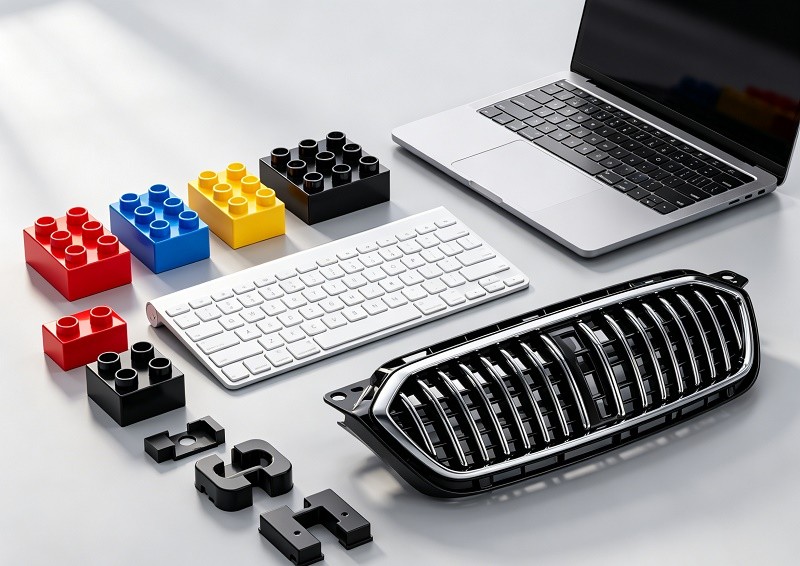
Consumer Electronics: This is a massive market for ABS. The material's rigidity, impact resistance, and excellent surface finish make it ideal for the housings of laptops, monitors, printers, remote controls, and kitchen appliances like coffee makers and food processors. Keyboard keycaps are another classic example, where the durability and feel of ABS are highly valued.
Automotive Industry: The automotive sector relies heavily on ABS for its combination of strength, heat resistance, and aesthetic quality. It's commonly used for interior components such as dashboard panels, center consoles, trim pieces, and pillar linings. On the exterior, its durability and ability to be plated make it suitable for radiator grilles, mirror housings, and emblems.
Consumer Goods and Toys: Perhaps the most famous application of ABS is in LEGO bricks, a testament to the material's incredible dimensional stability, impact strength, and vibrant colorability. Beyond that, it's used in a wide array of products including power tool housings, luggage shells, safety helmets, and small household items.
Medical and Healthcare: Specific medical-grade ABS formulations are used for applications that require good chemical resistance and the ability to be sterilized. You can find it in non-implantable devices like durable housings for medical equipment, drug delivery systems, and diagnostic machine components. These grades are selected for their biocompatibility and resistance to cleaning agents.
Plumbing and Pipe Systems: While PVC is more common for pressure pipes, ABS is widely used for drain, waste, and vent (DWV) pipe systems. Its toughness and ability to function in a range of temperatures make it a durable choice for non-pressurized plumbing applications.
The widespread use of ABS across these diverse fields underscores its status as a premier material for custom molding projects. Its ability to meet the functional demands of an automotive part, the aesthetic requirements of a consumer electronic device, and the safety standards of a child's toy is a clear indicator of its remarkable versatility.
Essential Considerations for Your Custom ABS Plastic Molding Project
Embarking on a custom ABS plastic molding project is a journey that requires more than just a great idea. It demands a strategic approach that balances design, material science, and manufacturing realities. To transform a digital model into a high-quality physical part, every detail matters. Overlooking key considerations during the early stages can lead to costly mold revisions, production delays, and subpar product performance. In this section, we will explore the critical elements that we believe are foundational to the success of any custom ABS molding endeavor: precision in design and strategic material selection.
Precision Design Elements for Custom ABS Plastic Molding
The success of an injection-molded part is often determined long before the plastic ever enters the mold. The design of the part itself—a practice known as Design for Manufacturability (DFM)—is paramount. Proper DFM ensures that the part can be produced efficiently, consistently, and with high quality. For ABS, certain design elements are crucial for avoiding common molding defects and maximizing the material's inherent strengths.
Uniform Wall Thickness: This is arguably the most important rule in injection molding design. Parts should be designed with walls that are as uniform in thickness as possible. Non-uniform walls cause the plastic to cool and shrink at different rates, leading to defects like warping (where the part bends or twists), sink marks (small depressions on the surface), and voids (internal bubbles). For ABS, a general wall thickness of 1.5mm to 3.5mm (0.060" to 0.138") is recommended for optimal results.
Draft Angles: Molds are typically made of two halves. To ensure the finished part can be smoothly ejected from the mold cavity after cooling, its vertical walls must be slightly angled. This angle is called a draft. Without a draft, the part's surface would drag against the mold, causing ejection issues, scratches, or even breakage. For ABS parts, a minimum draft angle of 1 to 2 degrees is standard, with more being better. Textured surfaces require even greater draft angles to prevent scraping the finish.
Ribs and Gussets for Strength: Instead of creating thick, chunky sections to add strength (which violates the uniform wall thickness rule), it's far better to incorporate thin support structures called ribs. Ribs can add significant rigidity and structural integrity to a part without introducing the risk of sink marks. Best practice dictates that the thickness of a rib should be about 50-60% of the main wall thickness to prevent sink. Gussets are similar support features, often triangular, used to reinforce areas like bosses or walls.
Radii and Fillets on Corners: Sharp internal and external corners are stress concentrators. They create weak points in the part that are more prone to cracking under load. They also impede the flow of molten plastic within the mold. All corners should be designed with radii (fillets for internal corners, rounds for external). A good rule of thumb is to make the inside radius at least 0.5 times the wall thickness. This simple change drastically improves part strength and manufacturability.
Bosses for Assembly: Bosses are cylindrical projections designed to accommodate screws, threaded inserts, or other fasteners for assembly. When designing bosses for ABS parts, it's crucial to follow specific guidelines to prevent defects. They should be cored out to maintain consistent wall thickness and reinforced with ribs or gussets if they are tall, to prevent them from being knocked over or bent.
Here is a summary table for quick reference on key design guidelines for ABS molding:
| Design Feature | Guideline | Rationale |
|---|---|---|
| Wall Thickness | Maintain uniformity; target 1.5mm - 3.5mm. | Prevents warping, sink marks, and internal voids. Ensures even cooling. |
| Draft Angles | Minimum 1-2 degrees on all vertical faces. | Facilitates easy and clean ejection from the mold. |
| Ribs | Thickness should be 50-60% of the supporting wall. | Adds strength and stiffness without creating thick sections that cause sink. |
| Corners | Add generous radii/fillets; Inside radius ≥ 0.5x wall thickness. | Reduces stress concentration, improves plastic flow, and increases part durability. |
| Bosses | Core out to maintain wall thickness; add gussets for support. | Prevents sink and voids; enhances structural integrity for assembly points. |
Paying close attention to these precision design elements is a non-negotiable step in creating a robust and high-quality custom ABS part.
Strategic Material Selection for Custom ABS Plastic Molding
While we have established that ABS is a versatile material, it is important to understand that "ABS" is not a one-size-fits-all solution. It is a family of materials, and manufacturers have developed dozens of specialized grades, each formulated to excel under specific conditions. Choosing the right grade is a strategic decision that directly impacts the final product's performance, cost, and lifespan.
The selection process involves a thorough analysis of the part's intended application and environment. Key questions to ask include:
- Will the part be exposed to sunlight (UV radiation)?
- Does it need to meet specific fire safety standards?
- Will it be subjected to high impacts?
- Does it require a metallic finish?
- What is the operating temperature range?
Based on the answers, you can narrow down the choices to the most suitable ABS grade. Here are some of the common categories:
General Purpose Grades: These are the most common and cost-effective grades. They offer the balanced profile of toughness, rigidity, and glossy finish that ABS is known for and are suitable for a wide range of indoor applications like electronic housings and consumer goods.
High-Impact Grades: By increasing the proportion of butadiene rubber, manufacturers create grades with enhanced toughness and impact resistance. These are ideal for products that are likely to be dropped or subjected to rough handling, such as power tool casings, protective headgear, and durable luggage.
Flame Retardant (FR) Grades: Many consumer electronics and appliances must meet regulatory safety standards like UL94, which governs plastic flammability. FR grades contain additives that allow the material to self-extinguish when exposed to a flame. They are essential for power adapters, internal electronic components, and device chargers.
UV Stabilized Grades: Standard ABS can become brittle and change color with prolonged exposure to ultraviolet (UV) light from the sun. For outdoor applications, such as automotive exterior parts, lawn equipment housings, or signage, UV-stabilized grades are necessary. These grades contain additives that absorb UV radiation and protect the polymer chain from degradation.
Plating Grades: If a part requires a metallic finish (like chrome), a special plating-grade ABS must be used. The surface of this grade is specifically formulated to be chemically etched in a pre-plating process, which creates microscopic pores that allow for a strong, permanent adhesion of the metal layers. This is commonly seen on automotive grilles, bathroom fixtures, and decorative trim.
High-Gloss Grades: While standard ABS has a good shine, some applications demand an even higher, piano-black type finish. High-gloss grades are formulated with a modified styrene component to produce an exceptional surface aesthetic right out of the mold.
Choosing the right grade is a critical step that ensures the final product not only looks right but also performs safely and reliably throughout its intended service life. Partnering with an experienced molder who understands the nuances of these different materials is key to making the correct strategic selection.
Conclusion
Successfully bringing a custom ABS plastic molding project to life is a sophisticated process that requires a harmonious blend of material science, knowledgeable design principles, and deep manufacturing expertise. It's about making deliberate choices at every stage, from the initial concept to the final production run. The journey involves understanding the fundamental strengths of ABS—its toughness, rigidity, and processability—and then leveraging those strengths through meticulous part design and strategic grade selection.
By focusing on these key considerations, such as ensuring uniform wall thickness, incorporating proper draft angles, and carefully choosing a material grade that matches the application's demands, we ensure that every custom ABS part we produce meets the highest standards of quality and functionality. We pride ourselves on delivering excellent OEM and ODM services for all your injection molding needs at SOMI Custom Parts. This commitment to precision and expertise turns great ideas into exceptional products, built to perform and last.