What are the Best 3D Printing Optional Materials for the Food and Beverage Industry?
- Share
- Issue Time
- Feb 6,2026
Summary
Discover the best food-safe 3D printing materials for the food and beverage industry—covering compliance, material options (FDM, SLA, SLS), key applications, and safety best practices.
The food and beverage industry is navigating a perfect storm of mounting pressures. From persistent labor shortages and rising operational costs to unpredictable supply chain disruptions, the need for innovative solutions to bolster efficiency and safety has never been more urgent. For an industry built on speed and consistency, traditional manufacturing methods are often too slow and rigid to meet today's fast-paced demands, particularly for producing custom parts and specialized tools. This is where additive manufacturing, or 3D printing, emerges as a transformative force, offering a flexible, responsive, and cost-effective alternative.
This article delves into the exciting world of 3D printing within the food and beverage sector. We will specifically focus on the best 3D Printing Optional Materials and explore how they are revolutionizing everything from on-demand replacement parts to a new standard of operator safety. Join us as we uncover how this technology is moving from a prototyping tool to an essential component of modern, regulated production environments.
Key Takeaways
- Addressing Key Challenges: 3D printing directly counters industry pressures like supply chain delays, labor shortages, and high costs by enabling in-house, on-demand production of parts, jigs, and fixtures. This reduces reliance on external suppliers and minimizes costly downtime.
- The Critical Role of Compliance: A material is not inherently "food-safe" just because its base polymer is. The entire 3D printing process—from the material and printer hardware to post-processing—must meet strict regulatory standards from bodies like the FDA and the EU to prevent chemical migration and bacterial growth.
- Material Types and Trade-offs: Different 3D printing technologies (SLA, FDM, SLS) offer unique advantages. SLA provides smooth surfaces ideal for hygiene, FDM offers material versatility, and SLS creates durable parts. However, each has food-safety challenges, such as uncured resin toxicity (SLA), layer-line porosity (FDM), and inherent surface porosity (SLS), which must be mitigated through proper post-processing.
- Transformative Applications: Key uses in the food industry include creating custom, lightweight robotic grippers, producing replacement parts for aging machinery to avoid line shutdowns, and designing ergonomic tools that enhance operator safety and reduce injuries.
- A Guide to Implementation: Successfully adopting food-safe 3D printing requires a holistic approach. This includes understanding certification requirements (e.g., FDA CFR 21, EC 1935/2004), evaluating material properties like chemical and temperature resistance, and implementing best practices such as using dedicated printers and validated cleaning protocols.
Why 3D Printing Optional Materials are Essential for Food and Beverage Manufacturing
Addressing Industry Challenges with 3D Printing Optional Materials
The food and beverage sector is continuously squeezed by a unique set of challenges that threaten profitability and operational stability. Persistent labor shortages make it difficult to staff production lines, rising maintenance costs eat into already slim margins, and volatile supply chains create uncertainty around the availability of critical components. A Deloitte study even projected that the manufacturing skills gap could lead to 2.1 million unfilled roles by 2030, potentially costing the U.S. economy $1 trillion. Furthermore, an hour of lost production on a high-speed beverage filling line can cost anywhere from $4,000 to $30,000, illustrating the devastating impact of downtime.
Additive manufacturing provides a powerful, direct response to these pressures. By integrating in-house 3D printing, companies can pivot from a reactive to a proactive operational model.
- Mitigating Supply Chain Disruptions: Instead of waiting days or weeks for a replacement part from a distant supplier, manufacturers can print it on-demand in a matter of hours. This drastically reduces dependence on fragile, fragmented supply chains and enhances production resilience.
- Reducing Costs: 3D printing eliminates the need for expensive tooling and minimum order quantities associated with traditional manufacturing. It allows for the creation of custom jigs, fixtures, and tools at a fraction of the cost, optimizing both production lines and maintenance budgets.
- Combating Labor Shortages: Automation is key to overcoming workforce gaps, and 3D printing accelerates this transition. It enables the rapid development and deployment of custom robotic end-of-arm tooling (EOAT), grippers, and other automated components tailored to specific products and tasks.
The Compliance Imperative: Food-Safe 3D Printing Optional Materials
While the benefits of 3D printing are clear, its application in the food industry hinges on one crucial factor: safety. Any material or object intended to come into contact with food is subject to strict regulatory oversight to protect consumer health. Simply using a material that is generally considered safe, like PET or PLA, is not enough. A holistic approach to compliance is mandatory.
A part is considered "food-safe" only when it meets a specific set of criteria defined by regulatory bodies like the U.S. Food and Drug Administration (FDA) and the European Food Safety Authority (EFSA). Key requirements include:
- No Migration of Harmful Substances: The material must not leach chemicals into the food that could be harmful to human health.
- No Impact on Food Quality: The part must not transfer any color, odor, or taste to the food product.
- Durability and Cleanability: The finished object must be non-absorbent, corrosion-resistant, and durable enough to withstand repeated washing. Crucially, it must have a smooth, easily cleanable surface free of cracks or crevices where bacteria can grow.
This means that food safety is not just about the filament or resin itself. The entire manufacturing process, including the printer's hardware (e.g., using a stainless steel nozzle instead of brass to avoid lead contamination) and the post-processing steps, must adhere to Good Manufacturing Practices (GMP) to ensure the final part is compliant.
Types of 3D Printing Optional Materials and Their Food Safety Considerations
Choosing the right 3D printing technology and material is a critical decision that balances mechanical needs with strict food safety requirements. The three most common technologies used in industrial applications—SLA, FDM, and SLS—each offer distinct advantages and present unique challenges for creating food-contact parts.
SLA 3D Printing Optional Materials: Precision and Smoothness
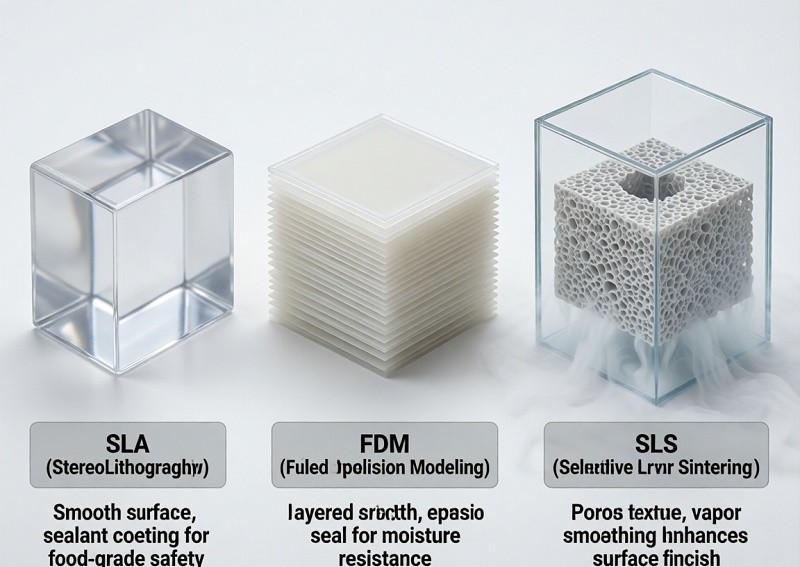
Stereolithography (SLA) is renowned for producing parts with exceptional detail and the smoothest surface finish of any plastic 3D printing technology. This is a significant advantage for food-related applications, as a smooth surface is easier to clean and less prone to bacterial growth.
However, the nature of SLA materials presents a major food safety hurdle: standard liquid resins are generally toxic and not suitable for food contact, even after being fully cured. Chemicals can potentially leach from the part, and biocompatible resins developed for medical applications are not automatically food-safe, as they are certified for different uses.
To safely use SLA in a food-contact context, two primary routes exist:
- Indirect Contact: SLA is an excellent technology for creating master patterns for molds. A highly detailed part can be printed via SLA and then used to create a thermoformed mold from a certified food-safe plastic. This leverages the precision of SLA without the printed part ever touching the food.
- Specialized Resins and Coatings: There are biocompatible resins designed for applications requiring features like non-cytotoxicity. For a printed part to be used directly, it must be thoroughly washed and cured according to manufacturer specifications and then coated with a certified food-grade sealant, such as an epoxy or polyurethane resin. This coating creates an inert barrier, but it's important to note that not all coatings are dishwasher-safe and may degrade over time, requiring regular inspection and replacement of the part.
FDM 3D Printing Optional Materials: Versatility and Filament Choices
Fused Deposition Modeling (FDM) is the most widely recognized 3D printing technology, known for its versatility and broad range of thermoplastic filaments. Several common FDM materials, such as PETG, PLA, and PP, are considered viable for food-contact applications. PETG, a close relative of the PET used in soda bottles, is often a preferred choice for its strength and relative neutrality.
The primary challenge with FDM printing is its layered construction. The process inherently creates microscopic crevices between layers, which are ideal breeding grounds for bacteria like E. coli and salmonella. These gaps are almost impossible to sanitize properly, even with thorough washing.
To mitigate this risk, several steps are essential:
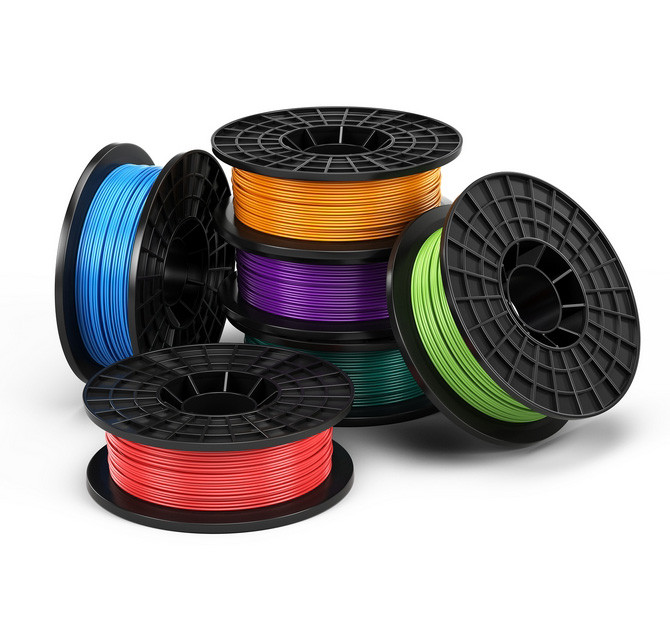
- Use Food-Grade Filament: Start with a filament that is certified as food-safe by the manufacturer. This ensures that the base polymer and any colorants or additives comply with regulations.
- Dedicated Hardware: Use a stainless steel nozzle instead of a standard brass one, as brass can contain lead that may contaminate the print. It's also best practice to use a printer dedicated solely to food-safe materials to avoid cross-contamination.
- Surface Sealing: The most effective method to make an FDM part safe for repeated use is to seal its surface. This can be achieved through chemical smoothing (e.g., with acetone for ABS) or, more reliably, by applying a food-safe epoxy or coating. This process seals the porous surface, making it smooth and easily cleanable.
| Feature | PLA (Polylactic Acid) | PETG (Polyethylene Terephthalate Glycol) | PP (Polypropylene) |
|---|---|---|---|
| Pros | Biodegradable, easy to print, good detail. | Strong, durable, good chemical resistance, low shrinkage. | Excellent chemical resistance, high flexibility, lightweight. |
| Cons | Low heat resistance (not dishwasher-safe), can be brittle. | Can be stringy, may require a heated bed. | Difficult to print (warping), poor layer adhesion. |
| Food-Safe Notes | Raw material is food-grade, but printed parts are porous. Best for single-use items like cookie cutters unless coated. | Often considered one of the best all-around food-safe filaments due to its durability and chemical properties. | Very resistant to chemicals but challenging to print reliably for functional parts. |
SLS 3D Printing Optional Materials: Durability and Porosity
Selective Laser Sintering (SLS) uses a high-powered laser to fuse powdered polymers, creating parts that are exceptionally strong and durable without the need for support structures. This makes SLS ideal for producing robust functional components like grippers, fixtures, and replacement machine parts. The most common material used is Nylon (PA11 or PA12), which is an excellent engineering thermoplastic.
While certain SLS powders, like PA12, can be food-grade, the sintering process leaves the final part with a microscopically porous surface. Even if not visible to the naked eye, this "sponge-like" texture can trap moisture, fats, and bacteria, making effective cleaning extremely difficult.
To make an SLS part suitable for food contact, post-processing is not optional—it is mandatory.
- Surface Sealing is Crucial: The inherent porosity must be sealed. This is typically done by applying a food-safe coating or using a chemical vapor-smoothing process that melts the outer surface, closing the pores and creating a smooth, hygienic finish.
- Beware of Dyes: While SLS parts can be dyed various colors, this process often renders them non-food-safe, as the dyes can leach out. For food-contact applications, undyed, sealed parts are the required standard.
- Sterilizability: A key advantage of some SLS materials like Nylon 12 is their ability to be sterilized via methods like autoclaving (steam cleaning), which is a significant asset in a food production environment.
Markforged, for instance, offers a specific material called Nylon White FS, which has undergone the necessary testing for food-safe certification, illustrating the industry's move toward providing verified solutions. Ultimately, with SLS, food safety is achieved through a combination of certified material and essential post-processing to create a non-porous, durable, and cleanable part.
Key Applications of 3D Printing Optional Materials in Food & Beverage Production
Beyond theory, the practical applications of food-safe 3D printing are already delivering significant value on factory floors. From custom tools that streamline workflows to on-demand parts that prevent costly shutdowns, additive manufacturing is proving to be an indispensable technology.
Streamlining Operations with Custom 3D Printing Optional Materials
One of the most immediate benefits of 3D printing is the ability to create custom jigs, fixtures, and tools that are perfectly tailored to a specific task, product, or piece of equipment. These manufacturing aids simplify processes, improve reliability, and lower production costs. Whereas traditional manufacturing of these tools is often slow and expensive, 3D printing allows for rapid and affordable in-house production.
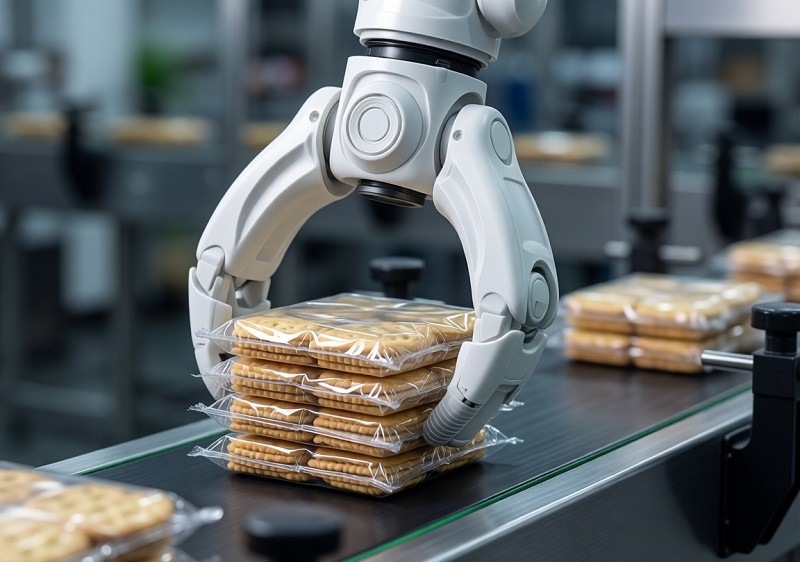
A prime example is in the realm of robotics and automation. End-of-arm tooling (EOAT), the "hands" of a robot, often needs to be customized to handle specific products, such as delicate baked goods or oddly shaped bottles. Conventional methods like CNC machining to create these tools are expensive and have long lead times. With 3D printing, engineers can design and produce lightweight, highly conformal grippers that are optimized for a specific task.
For example, a major U.S. food producer needed a robotic gripper to pick up stacks of wrapped crackers. The challenge was that the tool had to weigh less than 500 grams to allow the robot to operate at maximum speed. Using additive manufacturing, a lightweight yet strong nylon tool was designed and produced in just one week—a process that would have taken months with traditional methods—providing four times the gripping force of the legacy design.
Enhancing Equipment Longevity and Reducing Downtime with 3D Printing Optional Materials
Production line downtime is one of the biggest threats to profitability in the food and beverage industry. When a piece of machinery breaks, especially older or legacy equipment, sourcing a replacement part can take days or even weeks, bringing operations to a standstill. The most significant advantage of 3D printing for spare parts is the dramatic reduction in equipment downtime.
Additive manufacturing transforms maintenance from a waiting game into an on-demand solution. Instead of relying on external OEMs and their supply chains, companies can maintain a "digital inventory" of part designs. When a component fails, a replacement can be printed on-site within hours, not days. This capability is invaluable for:
- Obsolete Parts: Keeping aging but still functional machinery running by recreating parts that are no longer manufactured.
- Rapid Response: Minimizing downtime losses by printing a stopgap or even a permanent replacement part immediately after a failure. One German automotive supplier cut downtime by 50% by 3D printing a specialized connector, saving millions in lost production.
- Cost Reduction: Heineken's brewery in Spain found it could 3D print custom tools and replacement parts with an average of 80% lower costs and 80% faster delivery times compared to traditional methods. For example, a plastic can pusher was redesigned and printed at a fraction of the cost of its metal predecessor.
By enabling the on-demand production of spare parts, 3D printing not only extends the life of valuable equipment but also provides a crucial buffer against supply chain volatility and minimizes the crippling financial impact of unplanned downtime.
Boosting Operator Safety and Sustainability with 3D Printing Optional Materials
The benefits of adopting 3D Printing Optional Materials extend beyond the production line to improve the well-being of employees and advance corporate sustainability goals.
Operator Safety and Ergonomics: Repetitive tasks and poorly designed tools can lead to operator fatigue and strain injuries. 3D printing allows for the creation of customized, ergonomic tools designed to fit the user and the task perfectly. Manufacturers can quickly iterate and produce lightweight handles, jigs, and fixtures that are more comfortable and less risky to use. For example, 3D printing can be used to create custom guards for machinery pinch points or lightweight holding devices that reduce the risk of repetitive strain injuries. These improvements lead to a safer work environment, which has been proven to positively impact worker productivity.
Sustainability and Environmental Impact: Additive manufacturing is an inherently more sustainable process compared to traditional subtractive methods.
- Reduced Material Waste: 3D printing builds objects layer by layer, using only the material needed for the part itself. This additive approach drastically reduces the waste generated from carving a part out of a larger block of material.
- Lower Energy Consumption: By streamlining the value chain with fewer production steps and machines, additive manufacturing can consume significantly less energy. Some estimates suggest it can use up to 50% less energy than traditional methods.
- Decentralized Production: Printing parts on-site eliminates the carbon footprint associated with shipping components across the globe. This move towards local manufacturing also supports resource efficiency and can help stimulate local economies.
- Use of Sustainable Materials: The technology is driving innovation in the use of recycled and biodegradable materials, such as filaments made from renewable resources, further reducing environmental impact.
By integrating 3D printing, the food and beverage industry can not only optimize its operations but also build a safer, more sustainable, and resilient manufacturing ecosystem.
Choosing the Best 3D Printing Optional Materials: A Practical Guide
Successfully integrating 3D printing into a food and beverage production environment requires more than just buying a printer. It demands a thorough understanding of the regulatory landscape, a careful evaluation of material properties, and a commitment to best practices throughout the entire workflow.
Understanding Certification and Compliance for 3D Printing Optional Materials
Navigating the web of regulations is the first and most critical step. The primary goal of these regulations is to prevent the migration of harmful substances from materials into food. Key global standards include:
- FDA (U.S. Food and Drug Administration): In the United States, materials intended for food contact are regulated as "indirect food additives." The relevant regulations are found in Title 21 of the Code of Federal Regulations (CFR). Specifically, parts such as 174, 175 (adhesives and coatings), and 177 (polymers) outline which substances are permitted for food contact use.
- European Union Regulations: In the EU, Regulation (EC) No 1935/2004 provides the general framework, stating that materials must not transfer their constituents to food in quantities that could endanger human health. This is complemented by Regulation (EU) No 10/2011, which applies specifically to plastic materials. It establishes a "Union List" of authorized monomers, additives, and production aids that can be used. It also sets an Overall Migration Limit (OML) of 10 milligrams per square decimeter of the material's surface area.
- NSF International: While a non-governmental organization, NSF provides widely respected certification for food service equipment and materials. An NSF certification adds another layer of assurance that a product is safe for use in commercial food environments.
When selecting a material, it is crucial to review the Technical Data Sheet (TDS) and the Declaration of Conformity (DoC). The DoC is a document issued by the manufacturer to confirm that the product complies with relevant regulations. However, it's important to remember that a material being "compliant" does not mean it is explicitly "approved" by a regulatory agency. The certification often applies to the raw material (e.g., the filament spool or powder) and does not automatically extend to the final printed part.
| Regulation / Standard | Region | Key Focus | What It Governs |
|---|---|---|---|
| FDA 21 CFR Parts 174-179 | United States | Lists approved indirect food additives. | Regulates substances (polymers, adhesives, etc.) that can be used in materials that come into contact with food. |
| (EC) No 1935/2004 | European Union | General safety framework for all Food Contact Materials (FCMs). | Ensures materials do not endanger human health or alter food composition or taste. |
| (EU) No 10/2011 | European Union | Specific rules for plastic FCMs. | Provides a "positive list" of authorized substances and sets specific and overall migration limits. |
| NSF Certification | International | Standards for food equipment and materials. | Certifies that products meet specific safety and hygiene standards for commercial kitchens and production. |
Evaluating Material Properties and Post-Processing for 3D Printing Optional Materials
Beyond compliance, the practical performance of the material is paramount. The chosen material must be able to withstand the specific conditions of its intended use in a food production environment. Key properties to evaluate include:
- Temperature Resistance: Can the material handle the heat of a commercial dishwasher or sterilization processes like autoclaving without warping, cracking, or degrading? Materials like PLA have a low heat deflection temperature and are not suitable for hot applications.
- Chemical Resistance: The part will be exposed to various cleaning agents and sanitizers, as well as potentially acidic or fatty food products. The material must be chemically inert and not break down when exposed to these substances. Compatibility testing is crucial to ensure the material maintains its integrity.
- Mechanical Properties: The part must be strong, durable, and resistant to scratching and wear. Scratches can create new crevices for bacteria to hide, compromising hygiene.
- Non-Absorbency: The final part must be non-porous and non-absorbent to prevent it from soaking up moisture or food particles.
The Critical Role of Post-Processing: As discussed, the 3D printing process itself can create surface imperfections that harbor bacteria. Therefore, post-processing is a non-negotiable step for creating a truly food-safe part for repeated use.
- Surface Sealing: The most effective method is to apply a certified food-safe coating, such as an epoxy or polyurethane resin, to seal the surface completely. This creates a smooth, non-porous, and easily cleanable barrier between the printed part and the food.
- Smoothing Techniques: For some materials like ABS, chemical vapor smoothing can be used to melt the outer layer of the part, reducing layer lines. However, even after smoothing, applying a food-safe sealant is still highly recommended to ensure a completely inert surface.
Best Practices for Food-Grade 3D Printing Optional Materials
Achieving consistent, safe, and compliant results with food-grade 3D printing requires establishing a dedicated and controlled process.
- Use a Dedicated Printer: To prevent cross-contamination, it is essential to use a 3D printer exclusively for food-safe materials. A printer that has previously been used with non-certified materials may have residual particles that can contaminate a food-grade part.
- Install a Stainless Steel Nozzle: For FDM printers, standard brass nozzles can wear down and leach lead into the prints. Always use a high-quality stainless steel nozzle for any food-contact applications, as stainless steel is an FDA-approved material.
- Optimize Print Settings: Use settings that promote strong layer adhesion and minimize gaps, such as a lower layer height. This creates a more solid and less porous initial part before any sealing or coating is applied.
- Follow a Validated Cleaning Protocol: A printed part for repeated use must be cleanable. This involves more than a simple rinse. Studies have shown that washing with warm water and soap, followed by a sanitizing soak (e.g., a brief soak in a mild bleach solution), can effectively reduce pathogen levels on materials like PLA and PETG. Any cleaning protocol must be validated to ensure it effectively sanitizes the part without degrading the material or its coating.
- Design for Cleanability: When designing parts, avoid sharp internal corners, deep crevices, or complex textures where food particles and bacteria can become trapped. Opt for smooth curves and simple geometries wherever possible to make cleaning easier and more effective.
By combining certified materials, validated post-processing, and a robust set of best practices, manufacturers can confidently leverage 3D printing to create safe and effective tools for the food and beverage industry.
Conclusion
The adoption of certified, food-safe 3D Printing Optional Materials offers a clear strategic advantage for today's food and beverage manufacturers. This technology provides a direct and effective answer to some of the industry's most pressing challenges, enabling greater agility in the face of supply chain disruptions, delivering faster problem-solving on the factory floor, and ensuring adherence to the uncompromising standards of food contact safety.
As we have explored, integrating 3D printing moves additive manufacturing far beyond its origins as a prototyping tool and places it at the very heart of regulated production environments. The ability to print on-demand replacement parts, custom robotic tooling, and ergonomic safety aids is not just about improving efficiency or cutting costs. It is about building a more resilient, responsive, and innovative industry capable of adapting to market demands with unprecedented speed.
By thoughtfully embracing the right materials, technologies, and best practices, the food and beverage industry can unlock a future defined by enhanced adaptability, significantly reduced operational costs, and an unwavering commitment to product safety. The journey requires diligence—careful material selection, validated processes, and a deep understanding of compliance—but the rewards are transformative. We encourage you to explore how this technology can revolutionize your own operations. What applications do you see for food-safe 3D printing in your facility? Share your thoughts and this article with your team to spark the conversation.