Understanding Metal Stamping: A Guide for Die Manufacturers
- Share
- Issue Time
- Feb 10,2026
Summary
A comprehensive guide for die manufacturers on metal stamping processes, technologies, and the critical role of precision in modern manufacturing.
As a metal stamping die manufacturer, we understand the critical role precision and efficiency play in modern manufacturing. Metal stamping is a fundamental process that transforms flat sheet metal into intricate and precise components through various cutting and forming operations. This process is indispensable across a wide array of sectors, including automotive, aerospace, electronics, and medical device manufacturing, due to its versatility and cost-effectiveness in producing high volumes of consistent, high-quality metal parts. For us, as a metal stamping die manufacturer, mastering these processes is about delivering excellence and driving progress.
This guide is designed to provide you with a comprehensive understanding of metal stamping, from its historical roots to its advanced applications. We will explore the essential role of the metal stamping die manufacturer in ensuring quality and innovation in today's demanding industries. Our goal is to illuminate the complexities and showcase the opportunities within this dynamic field, demonstrating our commitment to not just manufacturing parts, but to being partners in our clients' success.
The Evolution of Metal Stamping and Our Role as a Metal Stamping Die Manufacturer
The journey of metal stamping is a story of continuous innovation, from ancient manual techniques to today’s highly automated, precision-driven systems. As a metal stamping die manufacturer, understanding this evolution is key to appreciating the technological advancements that define our industry and the critical importance of precision in everything we do.
A Brief History of Metal Stamping
The history of manipulating metal is ancient, with early humans working with copper as far back as 8700 B.C.. However, the direct lineage of metal stamping as an industrial process can be traced back to simpler methods used for centuries. For instance, in the 7th century B.C., the Lydians in present-day Turkey used basic stamping to create coins. A significant step forward occurred in 1550 when a German silversmith named Marx Schwab invented a screw press to automate the coin stamping process, a machine that required the force of up to a dozen men to operate.
The Industrial Revolution served as a major catalyst. The invention of the steam hammer allowed for the forging of large iron and steel items, enabling large-scale production at a relatively low cost for the first time. Still, stamping for industrial parts remained uncommon until the 1890s, when German bicycle manufacturers began using stamped components. This practice was soon imported to the United States, where American companies began commissioning their own custom-built stamping machines.
The 20th century saw an explosion in the use of metal stamping. The burgeoning automotive industry was a key driver; despite initial resistance, Henry Ford eventually adopted metal stamping for parts like fenders when other methods couldn't keep up with demand. The post-World War II economic boom further solidified metal stamping's role as an essential manufacturing process across numerous expanding industries. From its early beginnings of hand-hammered metals to the first machine presses of the 1800s, the process has continuously evolved, becoming an integral part of global manufacturing.
Modern Advancements in Metal Stamping Technology
Today's metal stamping industry is a far cry from the manual screw presses of the past. The sector has decisively entered the era of Industry 4.0, embracing smart manufacturing principles to enhance efficiency, precision, and flexibility. These advancements are crucial for meeting the ever-increasing demands for complex parts with tighter tolerances.
Key technological innovations that are shaping modern metal stamping include:
- Automation and Robotics: Automation is a cornerstone of the modern stamping facility. Robots are now employed for a wide range of tasks, from loading raw material into presses to transferring parts between stations and performing quality inspections. This not only increases production speed and volume but also significantly improves consistency and precision by minimizing human error.
- Advanced Press Technology: The presses themselves have seen revolutionary changes. The industry has moved beyond traditional mechanical and hydraulic presses to include servo-driven presses. These machines use high-torque motors to control ram movement, offering unparalleled precision, speed, and flexibility. Servo presses can reduce energy consumption by up to 50% while improving the quality of the final product.
- Smart Sensors and IoT Integration: Stamping machines and dies are now frequently embedded with smart sensors that monitor critical parameters like temperature, pressure, and vibration in real-time. By collecting and analyzing this data, manufacturers can predict and prevent maintenance issues, reduce downtime, and ensure consistent quality throughout a production run.
- Simulation and Virtual Prototyping: Computer-Aided Design (CAD) and Computer-Aided Manufacturing (CAM) systems have become standard, streamlining the tool and die design process. Furthermore, simulation technologies like Finite Element Analysis (FEA) allow manufacturers to virtually test the entire stamping process before any metal is cut. This reduces the need for costly and time-consuming physical tryouts, optimizes material usage, and ensures die longevity.
- Innovative Forming Techniques: New methods are constantly being developed to handle advanced materials and create complex geometries. Techniques like Hot Form Quench (HFQ) for ultra-high-strength aluminum and Press Hardening for complex steel parts have expanded the possibilities of what can be achieved through stamping.
These advancements empower a modern metal stamping die manufacturer to produce smaller, more intricate components with higher precision and better repeatability than ever before.
Why Precision is Paramount for Every Metal Stamping Die Manufacturer
In metal stamping, precision is not just a goal; it's a fundamental requirement that impacts every aspect of the manufacturing process and the final product's success. It refers to the ability to consistently produce components that meet exact specifications, tolerances, and quality standards. For a metal stamping die manufacturer, delivering on this promise of precision is our most critical responsibility.
The importance of precision can be seen in several key areas:
- Product Quality and Performance: Precision is directly linked to the quality and reliability of the final product. In safety-critical industries like aerospace and automotive, even a minor deviation from the specified tolerance can lead to part misalignment, premature wear, or catastrophic failure. Components for aircraft structures, medical diagnostic devices, or automotive engine parts must fit perfectly to ensure structural integrity and proper functionality.
- Cost-Effectiveness and Efficiency: High-precision processes lead to significant cost savings. By producing parts that are correct the first time, manufacturers minimize scrap, reduce the need for costly rework, and optimize material utilization. Precision also enables faster cycle times and higher throughput, which is essential for competing in high-volume industries.
- Tool and Die Longevity: The precision of the stamping operation has a direct impact on the lifespan of the tooling. A well-designed and precisely manufactured die, used in a controlled process, experiences less wear and tear. This extends the life of the dies and punches, reduces maintenance costs, and minimizes expensive production downtime caused by tool breakage.
- Enabling Innovation: Advances in precision engineering are what pave the way for innovation. As industries push for smaller, lighter, and more complex components, the ability to stamp metal to micro-tolerances becomes a key enabler. Precision stamping allows for the creation of intricate designs that were previously thought to be impossible, driving advancements across all sectors.
In essence, precision is the cornerstone of quality assurance in our industry. It is the unwavering commitment to accuracy that allows a metal stamping die manufacturer to transform a simple sheet of metal into a critical component that our customers can rely on.
Understanding the Core Processes: What Every Metal Stamping Die Manufacturer Should Know
To excel as a metal stamping die manufacturer, a deep and functional knowledge of the core stamping processes and the machinery that powers them is non-negotiable. Metal stamping is a broad category of manufacturing that encompasses a variety of specific operations used to cut, shape, and form sheet metal into desired components. Each technique has a unique purpose and application, and understanding them allows us to design and build dies that are not only effective but also optimized for efficiency, precision, and longevity. The process begins by feeding a flat metal sheet, either in blank or coil form, into a stamping press where a tool and die set shapes the material through applied force.
Key Stamping Operations and Techniques
The transformation of a flat metal sheet into a complex, three-dimensional part involves a sequence of distinct operations. As die manufacturers, we must master the physics and nuances behind each of these to create tooling that performs flawlessly. These operations can be broadly grouped into cutting processes and forming processes.
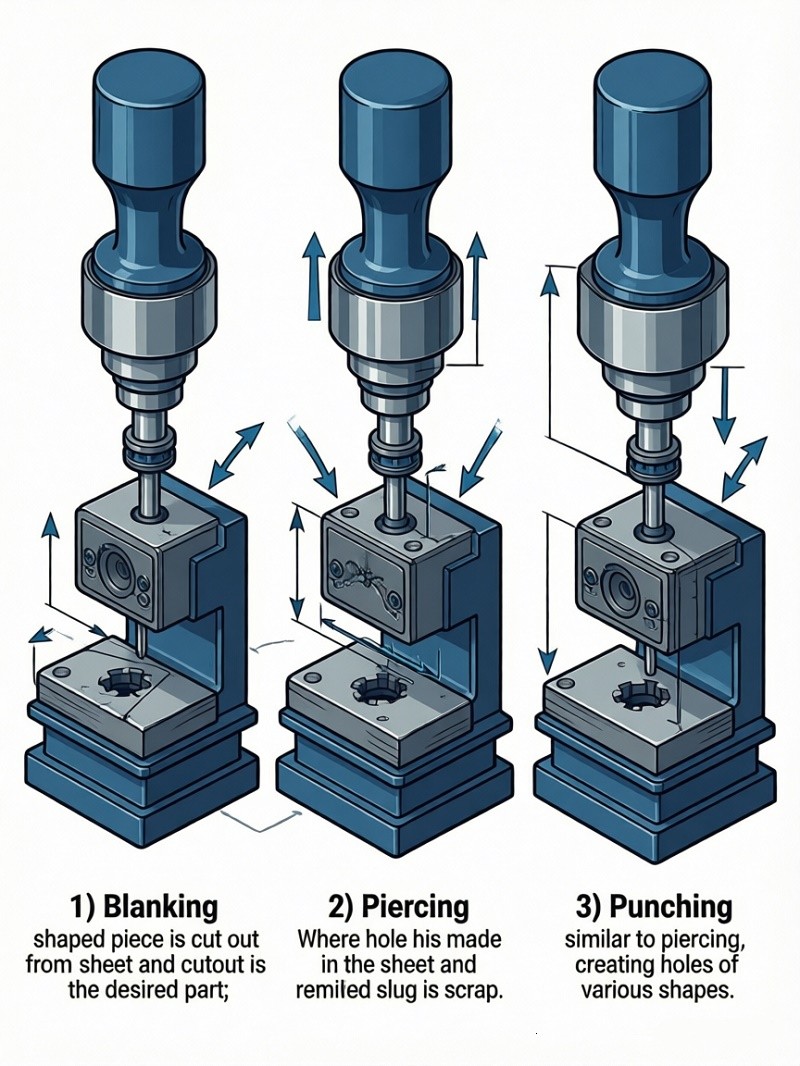
Blanking, Piercing, and Punching
These three processes are all shearing operations, meaning they are designed to cut the material. However, they are distinguished by their primary purpose and what is considered the final part versus the scrap.
Blanking: This is often one of the first steps in the stamping process. It involves cutting a specific shape out of a larger sheet of metal. The piece that is cut out, known as the "blank," is the desired workpiece that will undergo further stamping operations. The surrounding material from the original sheet is considered scrap.
Piercing: Piercing is a process that creates a hole in the workpiece. In this case, the material that is punched out to create the hole is considered the scrap, and the main workpiece continues on for further processing. The process involves forcing a punch tool through the sheet metal.
Punching: While often used interchangeably with piercing, punching can be seen as a similar operation where the goal is to create holes. It uses a machine and die to create specific shapes in the metal. In essence, both piercing and punching are used to create holes or openings, distinguishing them from blanking where the cutout piece is the desired part.
The key distinction lies in the intended outcome: in blanking, the part cut out is the product; in piercing and punching, the part with the new hole is the product.
Bending, Forming, and Drawing
These operations reshape the material without cutting it, relying on its ductility to achieve the desired geometry. They are fundamental to creating the three-dimensional features of a stamped part.
Bending: This is one of the most common forming operations, where a force is applied to plastically deform a flat sheet along a straight axis to create an angle or curve. It is used to produce L-shaped, V-shaped, or U-shaped profiles. The process is crucial for creating components like brackets, enclosures, and structural supports. As die manufacturers, we must carefully account for material properties and phenomena like "springback," where the metal naturally tries to return to its original flat shape after being bent.
Forming: This is a broader term that includes bending but also covers the creation of more complex, multi-bend structures. It refers to a variety of processes that modify the shape of the workpiece to achieve a specific geometry that goes beyond simple bends.
Drawing: This process transforms a flat blank into a hollow vessel, such as a can or a shell, without excessive wrinkling or fracturing of the material. A punch forces the sheet metal into a die cavity, causing it to take the shape of the die. Deep drawing refers to when the depth of the drawn part is greater than its diameter. This technique is used to produce items like oil filters, kitchen sinks, and automotive oil pans. It requires precise control of material flow to prevent thinning and tearing.
Coining and Embossing
Coining and embossing are finishing operations used to add fine details, improve strength, or create specific surface features. Though they may seem similar, they work in fundamentally different ways.
Coining: This is a high-pressure squeezing operation performed in a closed die. The immense pressure causes the metal to flow into the fine details of the die on both sides of the part. This process can create different designs on each side of the workpiece and is used for manufacturing coins, medals, and other parts requiring very sharp details and tight tolerances. Coining can also be used to improve the flatness of a part or eliminate burrs, often reducing the need for secondary machining operations.
Embossing: This process creates a raised or sunken design in the sheet metal using matched male and female dies. Unlike coining, embossing reshapes the metal without intentionally altering its thickness. The design on one side has a corresponding relief on the opposite side. Embossing is commonly used for decorative purposes, stiffening flat panels, and creating features like logos on parts.
Choosing between coining and embossing depends on the project's requirements; coining offers finer detail at a higher force, while embossing is excellent for creating textures and raised patterns without thinning the material.
Types of Stamping Presses and Their Applications
The press is the engine of the stamping process, providing the force necessary to cut and form the material. Different types of presses offer unique advantages, and as a metal stamping die manufacturer, we must design dies that are compatible with and can leverage the capabilities of each. The three primary classifications are mechanical, hydraulic, and servo presses.
| Press Type | Primary Mechanism | Key Advantages | Common Applications |
|---|---|---|---|
| Mechanical | Flywheel, clutch, and crankshaft | High speed, consistency, energy efficiency at high volume, lower initial cost. | High-volume production, blanking, piercing, shallow forming, coining. |
| Hydraulic | Pressurized hydraulic fluid and pistons | Full tonnage throughout the stroke, adjustable stroke length and speed, high precision and control, versatility. | Deep drawing, forming complex shapes, working with high-strength materials, forging. |
| Servo | High-torque servo motors | Fully programmable slide motion, high precision, combines speed of mechanical with control of hydraulic presses, energy-efficient. | Precision forming, deep drawing, working with exotic materials, in-die operations like tapping. |
Mechanical Presses for High-Speed Production
Mechanical presses are the traditional workhorses of the stamping industry, renowned for their speed and efficiency in high-volume production runs. These machines use a motor to spin a large flywheel, which stores kinetic energy. When the press is cycled, a clutch engages and a crankshaft converts the flywheel's rotational energy into the vertical motion of the press ram.
Because they operate with a fixed stroke length and deliver maximum force only at the bottom of the stroke, they are ideally suited for processes like blanking, piercing, and relatively simple forming. Their ability to achieve very high strokes per minute makes them the preferred choice for producing large quantities of parts quickly and consistently.
Hydraulic Presses for Control and Versatility
Hydraulic presses operate on the principle of Pascal's Law, using a hydraulic cylinder and pressurized fluid (typically oil) to generate force. A pump moves the fluid to drive a piston, which moves the ram. This mechanism provides a distinct advantage: the press can generate its full rated tonnage at any point in the stroke, not just at the bottom.
This characteristic makes hydraulic presses exceptionally versatile and provides a high degree of control over the forming process. The stroke length, speed, and pressure can be precisely regulated, which is crucial for applications like deep drawing, where a slow, controlled material flow is necessary to prevent defects. Their power and controllability make them the ideal choice for forming complex shapes, working with thick materials, and forging operations.
Servo Presses for Precision and Flexibility
Servo presses represent the cutting edge of stamping technology, combining the high speed of mechanical presses with the programmability and control of hydraulic systems. Instead of a flywheel or hydraulic pump, these presses use one or more high-torque servo motors to directly drive the ram's movement.
This direct drive system allows for complete control over the slide's position, velocity, and acceleration throughout the stroke. The ram's motion profile can be fully programmed, enabling complex operations such as dwelling at the bottom of the stroke for in-die assembly or welding, or creating pulsating motions to better form challenging materials. This level of precision and flexibility leads to higher quality parts, longer die life, and reduced energy consumption, making servo presses the ideal solution for the most demanding and complex stamping applications.