The Digital Manufacturing Blog: Insights for 3D Printing Parts Manufacturers
- Share
- Issue Time
- Jan 26,2026
Summary
Explore key 3D printing technologies—FDM, SLA, SLS, PolyJet & metal printing—for prototyping and production.
As we navigate the exciting world of additive manufacturing, understanding the diverse range of technologies available is crucial for any 3D Printing Parts Manufacturer. This blog aims to demystify some of the most prominent 3D printing methods, helping you make informed decisions for your production needs. From rapid prototyping to end-use parts, 3D printing offers unparalleled flexibility, speed, and cost-efficiency. Join us as we explore the nuances of Fused Deposition Modeling (FDM), Stereolithography (SLA), Selective Laser Sintering (SLS), and other advanced techniques that empower 3D Printing Parts Manufacturers to innovate and create.
Choosing the Right 3D Printing Technology for Your Manufacturing Needs as a 3D Printing Parts Manufacturer
Selecting the appropriate 3D printing technology is a pivotal decision that directly impacts the quality, cost, and functionality of the final parts. A 3D Printing Parts Manufacturer must weigh the unique strengths and weaknesses of each method against the specific requirements of a project. This involves a careful analysis of factors like desired material properties, surface finish, dimensional accuracy, production volume, and budget. Whether the goal is creating a quick and inexpensive conceptual model or producing a batch of robust, end-use components, a deep understanding of the available technologies is the foundation for success in the competitive landscape of digital manufacturing.
FDM: Economical Prototyping for the Astute 3D Printing Parts Manufacturer
Fused Deposition Modeling (FDM), also known as Fused Filament Fabrication (FFF), stands as one of the most widely adopted 3D printing technologies, primarily due to its accessibility and cost-effectiveness. For manufacturers focused on rapid prototyping and early-stage design validation, FDM offers an unbeatable combination of speed and low material cost, making it an indispensable tool for iterating quickly and efficiently.
How FDM Works
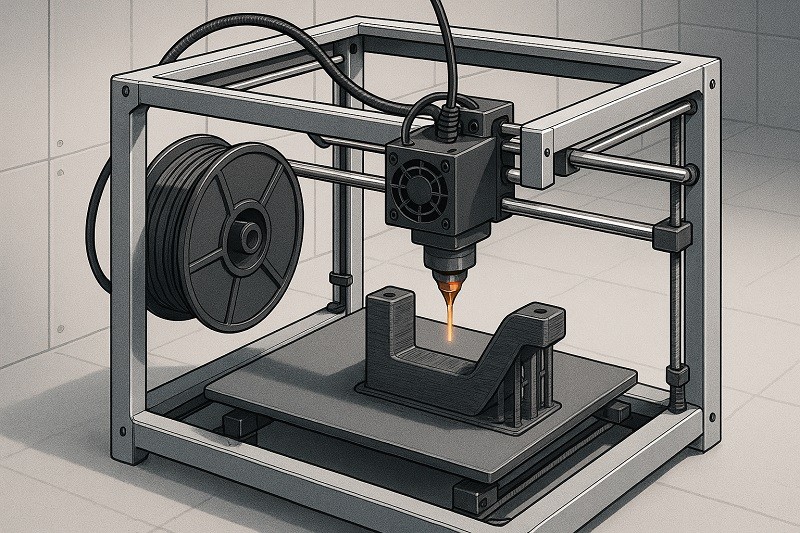
The Fused Deposition Modeling (FDM) process is a foundational technique in additive manufacturing, building objects layer by layer from the bottom up by heating and extruding thermoplastic filament. The process begins with a spool of this filament being fed into an extrusion head, which contains a heated nozzle. This head melts the thermoplastic to a semi-liquid state and precisely deposits it along a computer-controlled path to form a single layer. As the material is deposited, it cools and solidifies, fusing to the layer below it. This continues layer-by-layer until the entire object is formed. For designs with overhangs or complex geometries, the printer can extrude a secondary support material, which is later removed through mechanical breaking or dissolution in a liquid solution.
Advantages and Limitations for a 3D Printing Parts Manufacturer
FDM technology presents a distinct set of advantages and limitations that a 3D Printing Parts Manufacturer must consider. Its primary benefits are speed and affordability, making it ideal for producing low-cost prototypes. However, it's important to be aware of its trade-offs, particularly regarding surface finish and dimensional precision.
| Advantages | Limitations |
|---|---|
| Wide Range of Materials | Lower Resolution & Detail |
| Low Cost | Visible Layer Lines |
| Fast Turnaround | Anisotropic Strength |
| Durable Parts | Requires Support Structures |
SLA: High-Resolution Details for the Precision-Focused 3D Printing Parts Manufacturer
Stereolithography (SLA) holds the distinction of being the first commercialized 3D printing technology. It is renowned for its ability to produce parts with exceptionally high resolution, intricate details, and a smooth surface finish that is often comparable to injection-molded parts. This makes it a preferred choice for manufacturers who prioritize aesthetic quality and precision, such as in the fields of jewelry, dental applications, and detailed product mockups.
How SLA Works
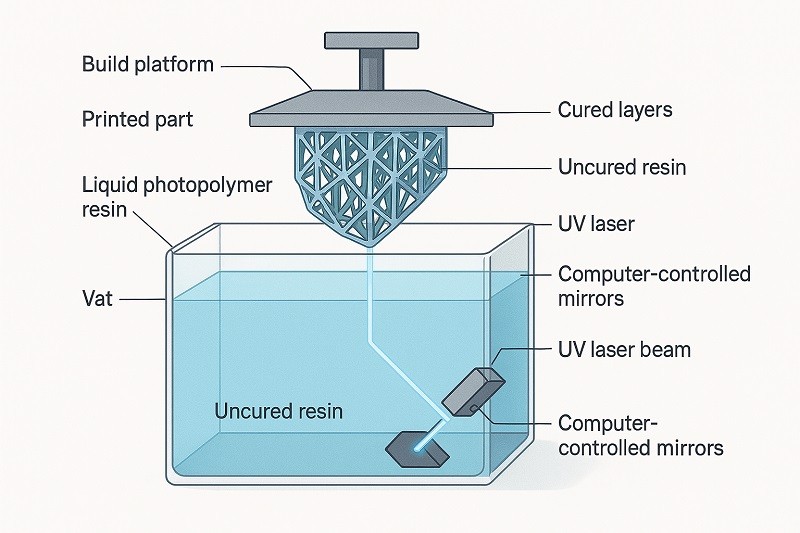
The Stereolithography (SLA) process utilizes a vat of liquid photopolymer resin and a UV laser to build parts one layer at a time. The process starts with a build platform lowering into the resin vat, leaving a thin layer of liquid resin above it. A UV laser, directed by computer-controlled mirrors, selectively draws the cross-section of the model onto this resin layer. The UV light cures and solidifies the resin it touches, bonding it to the layer below. After a layer is completed, the platform moves—typically upwards—and the process repeats until the entire object is formed. This method is instrumental in creating high-quality, precise 3D Printing SLA parts. Once printing is complete, the part is cleaned of excess resin and- a process known as post-curing.
Advantages and Limitations for a 3D Printing Parts Manufacturer
For any 3D Printing Parts Manufacturer considering SLA, it's essential to weigh its superior aesthetic output against its material properties and process requirements. While unrivaled for creating presentation-ready models, the standard resins can sometimes be less durable than thermoplastics used in other processes.
| Advantages | Limitations |
|---|---|
| Exceptional Detail & Smooth Finish | Can Be Brittle |
| High Dimensional Accuracy | Post-Processing Required |
| Ideal for Complex Geometries | Higher Cost Per Part |
| Broad Material Selection | UV Light Sensitivity |
SLS: Industrial-Grade Strength and Design Freedom for the Advanced 3D Printing Parts Manufacturer
Selective Laser Sintering (SLS) is a powerful additive manufacturing technology that uses a high-powered laser to fuse small particles of polymer powder into a solid structure. This method is highly valued in industrial settings for its ability to produce strong, durable parts with complex geometries. A key advantage of SLS is that the surrounding unsintered powder acts as a natural support structure, eliminating the need for dedicated supports and thus granting exceptional design freedom.
How SLS Works
The Selective Laser Sintering (SLS) process begins by heating a bin of powdered thermoplastic material to a temperature just below its melting point. A recoating blade or roller then spreads a thin layer of this powder across a build platform. A powerful CO2 laser, guided by a CAD file, then scans the cross-section of the object, selectively sintering (fusing) the powder particles together. After the layer is complete, the build platform lowers, and the process repeats. This cycle continues until the part is finished, encased in the bed of unsintered powder. This surrounding powder supports the part during printing, which means complex designs with internal features or undercuts can be created without the need for removable support structures.
Advantages and Limitations for a 3D Printing Parts Manufacturer
SLS technology is a go-to for functional prototypes and end-use parts, but manufacturers must consider its specific characteristics, including surface finish and a more involved post-processing workflow compared to some other methods.
| Advantages | Limitations |
|---|---|
| No Need for Support Structures | Rougher Surface Finish Than SLA |
| Excellent Mechanical Properties | Higher Equipment & Material Costs |
| Complex Geometries Possible | Longer Cooling Times Required |
| Good for Small to Medium Batches | Limited Material Color Options |
Beyond the Basics: Advanced 3D Printing Technologies for Specialized 3D Printing Parts Manufacturers
While FDM, SLA, and SLS cover a broad spectrum of manufacturing needs, the landscape of additive manufacturing is continually expanding with highly specialized technologies. These advanced systems unlock new possibilities in product development, allowing for the creation of parts with unparalleled realism, multi-functional properties, and the strength of metal. For a 3D Printing Parts Manufacturer aiming to push the boundaries of innovation, understanding these cutting-edge methods is essential.
Full-Color and Multi-Material Printing with PolyJet for the Innovative 3D Printing Parts Manufacturer
PolyJet technology, sometimes referred to as material jetting, operates similarly to a 2D inkjet printer, but instead of ink, it deposits droplets of liquid photopolymer onto a build tray, which are immediately cured by UV light. This process allows for the creation of parts with incredible detail and smooth surfaces. Its most significant capability is the ability to combine different materials and colors within a single print job, producing highly realistic prototypes that can mimic the look, feel, and function of final products.
Understanding Full-Color vs. Multi-Color Printing
In the context of 3D printing, it's important to distinguish between "multi-color" and "full-color" capabilities. Multi-color printing typically refers to creating parts with distinct, separate zones of different solid colors, much like assembling different colored blocks. Full-color printing, a hallmark of technologies like PolyJet, goes a step further by blending base colors (like cyan, magenta, and yellow) to create a vast spectrum of hues, gradients, and even textures on a single part. This allows manufacturers to produce photorealistic models that are invaluable for design verification, marketing samples, and medical models, accurately representing the final product's appearance without the need for painting or secondary finishing.
PolyJet's Unique Capabilities
PolyJet stands out due to its unique ability to combine materials with different properties in one print. By jetting multiple base resins simultaneously, it can create composite materials known as "digital materials." This allows a 3D Printing Parts Manufacturer to produce objects with varying degrees of flexibility, opacity, and hardness (Shore A values) all in a single part. For example, a prototype of a power tool could be printed with a rigid, opaque casing and a soft, rubber-like grip in one seamless operation. This capability is revolutionary for creating overmolded prototypes and complex assemblies that require both rigid and flexible components, drastically shortening the product development cycle.
Metal 3D Printing: Crafting Robust Components for the High-Performance 3D Printing Parts Manufacturer
Metal 3D printing has revolutionized industries like aerospace, automotive, medical, and tooling by enabling the production of strong, lightweight, and complex metal parts that are impossible to create with traditional manufacturing methods. These technologies allow for rapid iteration on high-performance components, on-demand production of spare parts, and the creation of optimized designs through generative design and topology optimization.
Key Metal 3D Printing Technologies
Several key technologies dominate the metal additive manufacturing space, each with its own process and ideal applications.
- Direct Metal Laser Sintering (DMLS) and Selective Laser Melting (SLM): These powder bed fusion processes are very similar to SLS but are used for metals. A high-powered laser melts and fuses metallic powder layer by layer to create dense, strong parts. SLM fully melts the powder, while DMLS sinters it. They are widely used for creating intricate and high-performance components from materials like aluminum, titanium, and stainless steel.
- Metal Binder Jetting: In this process, a liquid binding agent is selectively deposited to join metal powder particles. The "green" part is then sintered in a furnace to densify and achieve its final metallic properties. Binder jetting is typically faster and less expensive than laser-based systems, making it a viable option for medium-volume production runs.
- Directed Energy Deposition (DED): DED systems melt material as it's being deposited. This is often done by feeding metallic powder or wire through a nozzle into a melt pool created by a laser or electron beam. DED is unique in its ability to not only create new parts but also to repair or add material to existing components, making it invaluable for maintenance and repair operations.
Challenges and Innovations in Support-Free Metal Printing
A significant challenge in metal 3D printing, especially with powder bed fusion techniques like DMLS and SLM, is managing thermal stress. The rapid heating and cooling can cause parts to warp or crack, necessitating the use of extensive support structures. These supports anchor the part to the build plate, conduct heat away, and prevent distortion. However, removing them is a time-consuming, labor-intensive, and costly post-processing step that can also damage the part's surface.
To address this, the industry is seeing significant innovation. Advanced simulation software can now predict thermal stress and automatically optimize part orientation and support placement to minimize issues. Furthermore, new "support-free" printing strategies are emerging. These involve sophisticated printing parameters and novel techniques that allow for the creation of certain geometries, like low-angle overhangs, without traditional supports, dramatically reducing post-processing time and material waste.
Optimizing Production: Essential Considerations for Every 3D Printing Parts Manufacturer
Beyond selecting the right technology, optimizing the entire production workflow is critical for a 3D Printing Parts Manufacturer to remain competitive. This involves a holistic approach that balances material science, strategic process application, and economic considerations. From the initial material choice that dictates the part's final properties to the strategic use of 3D printing for either rapid prototyping or low-volume production, every decision plays a role in achieving efficiency, quality, and profitability.
Material Selection: The Foundation of Quality for the Discerning 3D Printing Parts Manufacturer
The choice of material is arguably as important as the choice of printing technology itself. It is the foundation upon which the part's performance, durability, and cost are built. A manufacturer must navigate a vast landscape of polymers, composites, and metals to find the perfect match for each application's specific demands, from mechanical strength and thermal resistance to biocompatibility and aesthetic appearance.
Thermoplastics vs. Thermosets
Understanding the fundamental difference between the two main classes of polymers—thermoplastics and thermosets—is crucial for material selection.
- Thermoplastics: These are polymers that become malleable when heated and solidify upon cooling, a process that can be repeated multiple times without significant degradation. This property makes them highly recyclable and suitable for processes like Fused Deposition Modeling (FDM), where a filament is melted and extruded, and Selective Laser Sintering (SLS), where a powder is fused. Common examples include PLA, ABS, PETG, and Nylon.
- Thermosets: In contrast, thermosets are materials that start as a liquid and are irreversibly cured—either by heat, light, or a chemical reaction—to form a solid. Once cured, they cannot be re-melted. This process results in materials that often have high strength, and excellent thermal and chemical resistance. Technologies like Stereolithography (SLA) and PolyJet use liquid thermoset resins that are cured by UV light.
The choice between them depends entirely on the application's requirements for properties like flexibility, durability, and temperature resistance.
Balancing Performance and Cost
For a 3D Printing Parts Manufacturer, finding the right equilibrium between material performance and cost is a constant objective. It's rarely necessary to choose the highest-performance material for every job. The key is to match the material's properties—and its price point—to the specific stage of product development and the part's end-use.
| Stage / Application | Common Material Choice | Rationale |
|---|---|---|
| Early Concept Models | PLA, Draft Resins | Low cost, fast printing, sufficient for visual and form validation. |
| Functional Prototypes | ABS, PETG, Nylon, Tough Resins | Offer better mechanical properties to test fit and function under stress. |
| End-Use Parts | PEEK, ULTEM, Carbon Fiber Composites, Metals | High-performance materials with specific properties (e.g., high strength-to-weight ratio, heat resistance, biocompatibility) required for the final product. |
By strategically selecting materials, manufacturers can control costs during the iterative design phase and invest in premium materials only when necessary for final production parts, optimizing the overall project budget.
Rapid Prototyping and Production: Strategic Approaches for the Agile 3D Printing Parts Manufacturer
Additive manufacturing serves two primary strategic functions in modern product development: accelerating the prototyping phase and enabling cost-effective low-volume production. An agile 3D Printing Parts Manufacturer leverages these capabilities to offer clients unparalleled speed to market and manufacturing flexibility.
Speeding Up Product Development
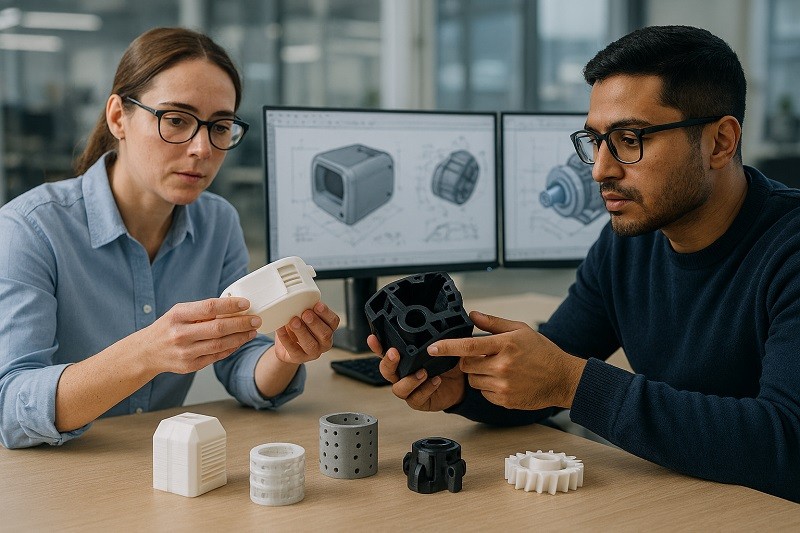
The term "rapid prototyping" is synonymous with 3D printing for a reason. Traditional prototyping methods, such as creating molds for injection molding or programming CNC machines, can take weeks or even months and incur significant upfront costs. Additive manufacturing completely changes this dynamic. A designer can create a CAD model and have a physical part in hand within hours or days. This speed allows for rapid design iteration, enabling engineers and designers to test, fail, and fix problems at a much faster pace. Being able to hold a physical object reveals design flaws related to ergonomics and usability that are often missed on a computer screen. This accelerated feedback loop drastically reduces the overall time from concept to market-ready product.
Cost-Effectiveness in Various Production Volumes
One of the most significant economic advantages of 3D printing is the absence of tooling costs. Traditional manufacturing methods like injection molding require the creation of expensive molds, which means production is only cost-effective at very high volumes where the cost of the mold can be amortized across hundreds of thousands of parts.
3D printing bypasses this tooling requirement entirely, making it highly cost-effective for:
- One-off custom parts: Ideal for bespoke solutions, jigs, fixtures, and replacement parts.
- Low-volume production: For batches from a few units up to several thousand, where the cost of creating a mold would be prohibitive.
- Bridge manufacturing: Used to produce a product for market while the high-volume tooling is still being manufactured, thus avoiding delays.
While the cost-per-part in 3D printing remains relatively constant regardless of volume, for injection molding it drops dramatically as volume increases. There is a "break-even point" where, for a given part, injection molding becomes more economical. A key role for a 3D Printing Parts Manufacturer is to help clients identify this point and choose the right manufacturing process for their required volume.
The Future Landscape for 3D Printing Parts Manufacturers: Adaptability and Innovation
The world of 3D printing is in a state of perpetual motion. For manufacturers, success is no longer just about mastering current technologies but about anticipating the future. Adaptability and a commitment to innovation are the cornerstones for navigating the evolving landscape. By staying ahead of industry trends and deeply integrating digital manufacturing principles into every stage of the product lifecycle, businesses can secure a competitive edge and unlock new opportunities for growth.
Navigating Industry Trends and Technological Advancements
The future of additive manufacturing is being shaped by several key trends that are set to redefine the industry.
- AI and Generative Design: Artificial Intelligence is playing an increasingly crucial role, particularly through generative design software. These tools can autonomously generate thousands of optimized design options that meet specified constraints (e.g., weight, material, manufacturing method), creating components that are lighter, stronger, and more efficient than what a human designer might conceive.
- Automation and Post-Processing: A major focus of innovation is on automating the entire 3D printing workflow. This includes automated material handling, part removal, and especially post-processing steps like support removal and surface finishing, which have traditionally been manual bottlenecks.
- Sustainability and New Materials: There is a growing demand for sustainable manufacturing solutions. This is driving research into recyclable and biodegradable 3D printing materials, as well as processes that minimize waste. Concurrently, material science continues to advance, introducing new polymers, composites, and metal alloys with superior performance characteristics.
- Increased Speed and Scale: Manufacturers are constantly pushing for faster printing speeds and larger build volumes. Innovations in hardware and software are enabling quicker production runs and the ability to print larger single parts or greater quantities of smaller parts in a single build, making 3D printing more competitive for higher volume applications.
The Role of Digital Manufacturing in the Product Lifecycle
3D printing is a core component of the broader concept of digital manufacturing and Industry 4.0. Its true power is realized when it's integrated into a seamless digital thread that runs through the entire product lifecycle. This digital thread connects every stage, from the initial CAD design to simulation, production, and even in-field performance monitoring. For a 3D Printing Parts Manufacturer, embracing this concept means:
- Enhanced Agility: The ability to quickly move from a digital design file to a physical part enables on-demand manufacturing. This reduces the need for large physical inventories and allows for rapid response to changing customer demands or supply chain disruptions.
- Digital Inventory: Instead of warehousing vast quantities of spare parts, companies can maintain a "digital inventory"—a collection of CAD files ready to be printed whenever a part is needed. This is particularly transformative for managing legacy parts and reducing storage costs.
- Mass Customization: Because each part can be individually customized with no additional tooling costs, digital manufacturing empowers businesses to offer personalized products at scale, from custom medical implants to bespoke consumer goods. By leveraging this digital thread, manufacturers can create more efficient, resilient, and customer-centric supply chains, fundamentally changing how products are designed, made, and maintained.
As 3D Printing Parts Manufacturers, our role is continuously evolving. By staying abreast of technological advancements and understanding the intricate details of each printing method, we can continue to push the boundaries of innovation. The journey through FDM, SLA, SLS, and advanced techniques shows that the right technology, coupled with smart material choices and optimized processes, is key to success in this dynamic industry. We are excited to see what the future holds for 3D Printing Parts Manufacturers worldwide. We encourage you to share your thoughts and experiences with these technologies in the comments below.