The Complete Guide to Metal Surface Treatments: Matching Finishes for Surface Finishing Manufacturers
- Share
- Issue Time
- Jan 27,2026
Summary
Comprehensive guide to metal surface treatments—enhance corrosion resistance, durability & aesthetics with the right finish for your manufacturing needs.
As surface finishing manufacturers, we know that the right metal surface treatment is crucial for enhancing both the performance and appearance of metal parts. It's not just about making something look good; it's about making it last and perform optimally. From the aerospace industry to consumer electronics, the functionality and aesthetic appeal of a metal component often depend on its surface finish.
Metal surface finishing encompasses a vast array of processes that modify the surface characteristics of a metal. These modifications can be mechanical, chemical, electrochemical, or thermal, providing benefits like improved corrosion resistance, increased durability, better adhesion for coatings, and enhanced aesthetics. We're here to guide you through the essential methods and considerations for selecting the perfect finish for your manufacturing needs.
Why Surface Finishing Matters for Every Surface Finishing manufacturer
The decision to apply a specific surface finish is one of the most critical steps in modern manufacturing. Far from being a mere afterthought, the chosen treatment defines a product's interaction with its environment and its user. It dictates durability, functionality, aesthetic appeal, and overall quality. For a surface finishing manufacturer, mastering the science and art of surface treatments is not just a value-added service; it is a core competency that directly impacts a component's service life, performance integrity, and even its final cost. Every choice, from a rough blast to a mirror polish, carries significant consequences for the finished product.
Understanding Surface Texture and Roughness
At a microscopic level, no metal surface is perfectly flat. It is a landscape of minute peaks and valleys. This inherent topography is known as surface texture, and understanding its components is fundamental to controlling a product's final properties. A seemingly minor variation in texture can drastically alter how a part performs under stress, how it resists environmental decay, and how it is perceived by the end-user.
Defining Surface Finish Characteristics
The term "surface finish" is often used interchangeably with "surface roughness," but roughness is just one component of the overall surface texture. A complete description includes three main characteristics:
- Roughness: This refers to the fine, high-frequency irregularities on a surface, typically resulting from the manufacturing process itself, like the marks left by a cutting tool. These microscopic peaks and valleys are crucial in determining friction, wear, and the ability of a surface to retain lubricants.
- Waviness: These are the larger, more widely spaced variations on a surface. Waviness can be caused by machine tool vibration, heat treatment distortion, or other instabilities in the manufacturing process. It can affect the sealing capability of a surface or create unwanted noise in moving parts.
- Lay: This describes the principal direction of the surface pattern. It is determined by the production method used; for instance, turning creates a circular lay, while grinding produces a linear pattern. The lay can influence fluid flow, reflectivity, and the development of fatigue cracks.
Together, these three characteristics define the complete surface texture and are what surface finishing processes aim to modify. The goal is to manipulate this topography to achieve a set of desired performance outcomes.
The Impact on Product Functionality and Aesthetics
Controlling surface texture allows manufacturers to precisely engineer a part's functional and aesthetic properties. The influence of surface finish is far-reaching and can be the deciding factor in a product's success or failure.
Functionality: A component's surface directly influences its mechanical performance. Variations in texture can affect:
- Friction and Wear: Smoother surfaces generally exhibit lower friction, reducing wear and tear on moving parts like bearings and gears, which in turn improves efficiency and prolongs service life. Conversely, some applications, such as brake pads or clutch plates, require a rougher texture to achieve high friction.
- Fatigue Resistance: Surface irregularities, especially sharp valleys, can act as stress concentration points where fatigue cracks initiate. A smoother, more uniform finish can significantly enhance a component's ability to withstand cyclic loading.
- Sealing: For components in hydraulic or pneumatic systems, a smooth surface is critical for creating a proper seal. Rough or uneven surfaces can lead to leaks and system failure.
- Lubrication: The microscopic valleys in a slightly rough surface can act as reservoirs for lubricants, which is essential for the function of components like engine cylinder walls.
Aesthetics: Beyond pure function, the surface finish is a primary contributor to a product's visual and tactile appeal. A high-gloss, polished finish often conveys a sense of quality and precision, which is critical for consumer goods, decorative hardware, and automotive trim. In contrast, a matte or brushed finish might be chosen to hide fingerprints, reduce glare, or achieve a specific design language. The final look and feel of a product are inseparable from its surface treatment, directly impacting consumer perception and brand value. Ultimately, the right surface finish ensures a product not only works flawlessly but also meets the aesthetic expectations of the market.### Key Benefits of Strategic Surface Treatment
Strategic surface treatment is not an expense but an investment in a product's longevity, reliability, and overall quality. By intentionally modifying the surface of a metal part, manufacturers can unlock a wide range of beneficial properties that the bulk material alone cannot provide. These enhancements are critical for meeting the demanding performance requirements of modern applications, from aerospace and automotive to medical devices and consumer electronics.
Enhancing Corrosion and Wear Resistance
Two of the most common failure modes for metal components are corrosion and wear. Surface treatments are the first line of defense against these destructive forces.
- Corrosion Resistance: Most metals are susceptible to corrosion when exposed to moisture, chemicals, or atmospheric elements. Surface treatments create a protective barrier that isolates the base metal from its environment. Techniques like galvanizing (coating with zinc), anodizing (creating a thick oxide layer), and applying advanced polymer coatings can dramatically extend the service life of a product by preventing rust and other forms of chemical degradation. Thicker coatings, often achieved through heavy build-up plating, provide an even more substantial barrier against corrosive agents.
- Wear Resistance: In applications involving moving parts, friction and abrasion inevitably lead to wear. Surface treatments can significantly increase a component's surface hardness and reduce its coefficient of friction. Hard coatings like chromium nitride, or processes like case hardening, make the surface more resistant to scratching and material loss. This not only improves durability but also enhances efficiency by minimizing energy loss due to friction. Adding wear-resistant coatings can add significant value and extend the life of equipment.
Improving Adhesion and Electrical Conductivity
Surface treatments are essential for preparing a component for subsequent manufacturing steps or for imparting specific electrical properties.
- Adhesion: The ability of a surface to accept a coating, paint, or adhesive is heavily dependent on its texture and surface energy. Processes like abrasive blasting or chemical etching create a microscopic profile that increases the surface area and provides mechanical "teeth" for a coating to grip. This is critical for ensuring that paint doesn't chip and adhesive bonds don't fail. For an adhesive to form a strong bond, the surface must have high surface energy, which allows the adhesive to spread out and make intimate contact, a phenomenon known as "wetting."
- Electrical Conductivity: While the bulk material determines a component's intrinsic conductivity, the surface finish can have a significant impact on its performance in an electrical assembly. A smooth, clean surface ensures a larger effective contact area, which reduces contact resistance and allows for more uniform current flow. Conversely, a rough or oxidized surface can impede conductivity. Specific plating materials, such as silver or gold, are often used to enhance surface conductivity for critical electronic applications. For some printed electronics, however, a rougher surface can surprisingly contribute to a reduction in electrical resistance.
Meeting Industry Standards and Safety Requirements
For many industries, surface finishing is not optional but a mandatory step for compliance and safety.
- Industry Standards: Organizations like ASTM International, the International Organization for Standardization (ISO), and SAE International publish detailed standards for surface finishes. These standards ensure that products meet specific, universally recognized benchmarks for quality, consistency, and performance. For example, the aerospace industry relies on specifications like MIL-A-8625 for anodizing to guarantee corrosion resistance and surface hardness. Adhering to these standards is crucial for product reliability, regulatory compliance, and global market access.
- Safety Requirements: The metal finishing industry itself involves the use of hazardous substances and processes, necessitating strict safety protocols. This includes proper handling of chemicals, adequate ventilation, and the use of personal protective equipment (PPE) like safety glasses, gloves, and respirators. From a product perspective, certain surface treatments are vital for safety. For instance, components used in oxygen-rich environments must undergo specific cleaning procedures to prevent combustion, as defined by standards like ASTM G93. By following established safety and industry standards, manufacturers not only protect their workers but also ensure the final product is safe and reliable for the end-user.
Mechanical Surface Treatment Methods for Surface Finishing Manufacturers
Mechanical surface treatments involve the use of physical force to alter the surface of a metal part. These methods are fundamental in manufacturing for cleaning, shaping, smoothing, or roughening a surface to prepare it for subsequent coatings or to achieve the desired final properties. From aggressive material removal to subtle texturing, mechanical treatments are a versatile and essential part of the surface finishing toolkit.
Abrasive Blasting Techniques
Abrasive blasting is a process that involves forcibly propelling a stream of abrasive material against a surface under high pressure. The primary goals are to clean, texturize, or prepare the surface for painting or coating. The choice of abrasive media—which can range from sand and glass beads to steel shot and aluminum oxide—is critical as it determines the final texture and aggressiveness of the process.
Sandblasting and Bead Blasting for Texture and Preparation
Sandblasting and bead blasting are two of the most common abrasive blasting techniques, but they serve different purposes.
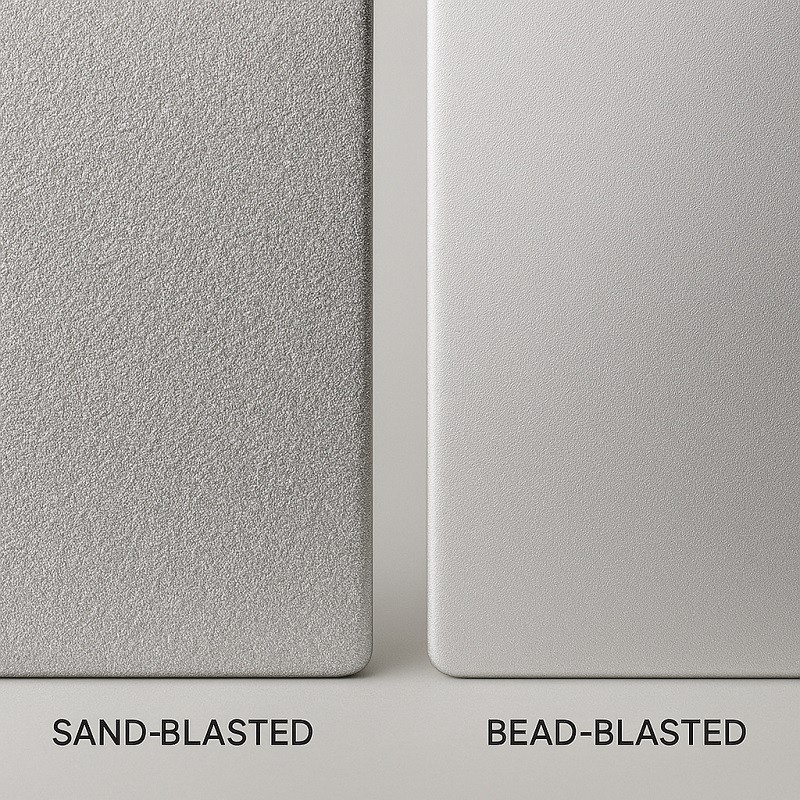
Sandblasting: This is a more aggressive method that uses sand or other hard, angular abrasives propelled at high velocity. It is highly effective for heavy-duty applications such as removing thick rust, scale, and old paint from large steel structures. The result is a deeply etched, rough surface that provides an excellent profile for the adhesion of new coatings. However, due to its aggressive nature, it is not suitable for delicate or thin-walled components where material loss is a concern.
Bead Blasting: In contrast, bead blasting is a much gentler process that uses fine, spherical glass beads. Instead of cutting into the metal, the beads peen the surface, creating a uniform, satin, or matte finish. It is ideal for cleaning surface deposits, removing minor imperfections, and texturing parts without significantly changing their dimensions. This makes it the preferred choice for finishing softer metals like aluminum, or for applications in the automotive and aerospace industries where a consistent, non-directional finish is desired without damaging the underlying substrate.
Precision Grinding and Polishing
Grinding and polishing are finishing processes designed to achieve exceptional smoothness, high dimensional accuracy, and superior aesthetic appeal. While both involve abrasives, they represent different stages in the finishing sequence.
Achieving Smoothness and Aesthetic Appeal
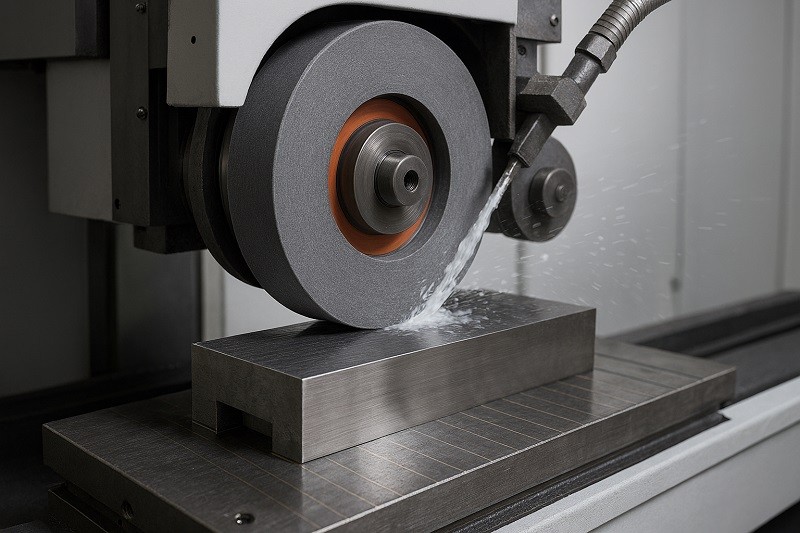
Grinding is an abrasive machining process that uses a spinning wheel or belt to remove material and shape a workpiece. It is a crucial step for achieving tight tolerances and creating a flat, smooth foundation for further finishing. Polishing follows grinding and is a more refined process that uses finer abrasives to remove the microscopic scratches left by grinding. The goal of polishing is not significant material removal but to produce a smooth, lustrous, and often mirror-like surface. This enhances not only the aesthetic quality of a part but can also improve its corrosion resistance and reduce friction.
Electropolishing for Complex Geometries
For parts with intricate shapes, internal channels, or complex features, mechanical polishing can be difficult or impossible. This is where electropolishing offers a unique advantage.
Electropolishing is an electrochemical process, essentially the reverse of plating. The part is submerged in an electrolyte bath and becomes the anode (+). When a direct electrical current is applied, metal is dissolved from the surface. This dissolution happens preferentially at the microscopic high points or "peaks" of the surface, resulting in a smoothing and leveling action known as anodic leveling.
This method offers several key benefits:
- Uniform Finish: It can reach and polish areas that are inaccessible to mechanical methods, ensuring a consistent finish across the entire part, including complex internal geometries.
- Improved Cleanliness: The process removes a thin outer layer of metal, stripping away any embedded contaminants and creating an ultraclean surface.
- Enhanced Properties: By removing micro-cracks and other surface defects, electropolishing can improve a part's fatigue life and corrosion resistance, in some cases up to 30 times more than standard passivation.
- Aesthetic Quality: It produces a bright, highly reflective, and decorative appearance, which is desirable in many medical, pharmaceutical, and consumer product applications.
Shot Peening and Forming
Shot peening is a cold-working process used to improve the material properties of a component rather than for aesthetic purposes. It involves bombarding the surface with small, spherical media (shot) at high velocity. Each impact acts like a tiny peening hammer, creating a small indentation or dimple.
Improving Fatigue Life and Stress Resistance
The primary benefit of shot peening is a significant increase in fatigue life and resistance to stress-corrosion cracking. The process works by introducing a layer of beneficial compressive residual stress into the surface of the part. Since fatigue cracks almost always initiate at the surface due to tensile stresses, this layer of compressive stress acts to counteract the applied tensile loads. This makes it much more difficult for cracks to form and propagate, thereby extending the component's service life.
Shot peening is a critical process for high-stress components found in the aerospace and automotive industries, such as:
- Gears and connecting rods
- Springs
- Turbine blades and engine disks
- Structural aircraft components
By carefully controlling parameters like shot size, velocity, and coverage, manufacturers can tailor the compressive stress profile to meet the specific demands of the application, dramatically improving the durability and reliability of critical parts.
Chemical and Electrochemical Processes for the Modern Surface Finishing Manufacturer
While mechanical methods physically alter a surface, chemical and electrochemical processes use controlled reactions to deposit new layers, remove material, or modify the surface chemistry. These advanced techniques offer a high degree of precision and are essential for achieving specific functional properties like enhanced corrosion resistance, conductivity, and durability in modern manufacturing.
Electroplating and Electroless Plating
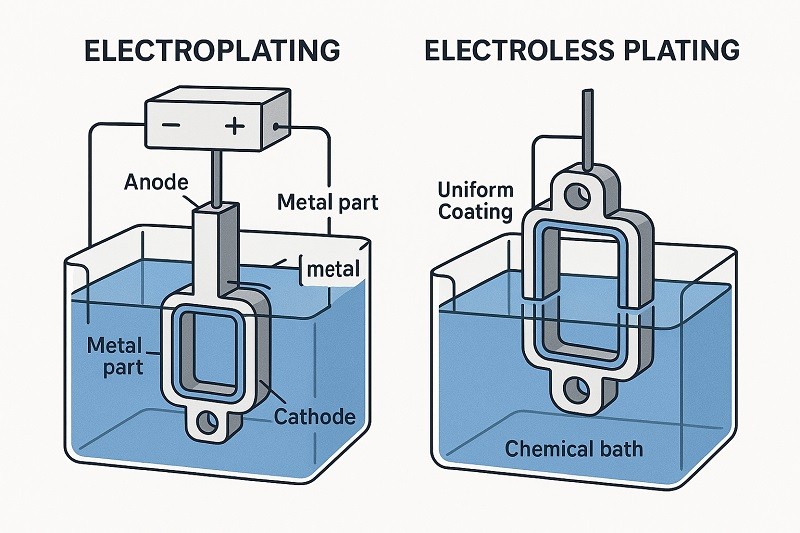
Plating involves depositing a thin layer of one metal onto the surface of another. The primary goals are to improve aesthetics, increase corrosion resistance, enhance conductivity, or add hardness. The two main categories of plating are electroplating and electroless plating.
Depositing Protective and Decorative Layers
Electroplating: This well-established process uses an electric current to coat a conductive object with a layer of metal. The part to be plated (the substrate) acts as the cathode in an electrolytic bath, while the metal to be deposited forms the anode. When a direct current is applied, metal ions from the bath are reduced onto the substrate, forming a thin, coherent metallic coating. A wide variety of metals can be used, including nickel, chromium, zinc, gold, and silver, each offering unique benefits from corrosion protection to enhanced electrical conductivity and a lustrous decorative finish. Electroplating is a cost-effective method for high-volume production and offers a wide range of aesthetic and functional finishes.
Electroless Plating: Also known as auto-catalytic plating, this method deposits a metal coating without the use of an external electric current. The process relies on a chemical reaction involving a reducing agent in the plating solution, which supplies the electrons to reduce metal ions onto the substrate. One of the most significant advantages of electroless plating is its ability to create a perfectly uniform coating, even on parts with complex geometries, internal bores, and sharp corners, as the deposition is not dependent on current distribution. It can also be used to plate non-conductive materials. Electroless nickel plating is particularly popular for its exceptional corrosion and wear resistance.
The choice between electroplating and electroless plating depends on the part's geometry, the required coating uniformity, and production volume.
Anodizing and Passivation
Anodizing and passivation are two distinct but related processes designed to enhance the natural corrosion resistance of certain metals by modifying their surface oxide layer.
Creating Durable Oxide Films
Anodizing is an electrochemical process that converts the surface of a metal into a durable, corrosion-resistant, and anodic oxide finish. It is most commonly applied to aluminum but is also used for titanium, magnesium, and zinc. Unlike plating, which adds a new layer on top of the substrate, anodizing grows a layer of oxide that is integral to the part itself.
The process involves immersing the metal part in an acid electrolyte bath and passing an electric current through it, with the part acting as the anode. This thickens the naturally occurring oxide layer, creating a highly ordered, porous structure that is much harder and more durable than the base metal. This porous structure can also be dyed to produce a wide range of vibrant, long-lasting colors before being sealed. The result is a finish that significantly improves wear and corrosion resistance and offers excellent aesthetic options without the risk of peeling or chipping.
Enhancing Corrosion Resistance in Stainless Steel
Passivation is a chemical treatment specifically designed to maximize the natural corrosion resistance of stainless steel. Stainless steel's inherent resistance comes from a thin, invisible layer of chromium oxide that forms on its surface. However, during manufacturing processes like machining and fabrication, microscopic iron particles can become embedded in the surface, disrupting this passive layer and creating sites for rust to begin.
The passivation process uses an acid solution, typically nitric or citric acid, to remove these free iron contaminants from the surface. This cleaning action allows the chromium to react freely with oxygen in the air, forming a more uniform, stable, and protective chromium-oxide layer. This robust passive film shields the underlying steel from corrosive agents, significantly extending the component's lifespan, especially in aggressive environments. It is a critical final step for parts used in the medical, pharmaceutical, and aerospace industries.
Chemical Etching and Acid Pickling
Chemical etching and acid pickling both use corrosive chemicals to remove material from a metal surface, but they are employed for different purposes.
Material Removal for Precision and Cleaning
Acid Pickling: This is a surface cleaning process used to remove impurities, such as stains, rust, or inorganic scale, from a metal's surface. It is commonly used on steel alloys to remove the "mill scale"—a layer of iron oxides—that forms during hot working processes like forging and welding. The parts are dipped into a bath of acid, known as "pickle liquor," which dissolves the surface oxides, leaving a clean, bare metal surface ready for subsequent finishing processes like galvanizing or plating.
Chemical Etching: Also known as chemical milling, this process is used for the controlled removal of material to produce complex, highly precise parts. A chemically resistant mask is applied to the metal surface, leaving specific areas exposed. When the part is submerged in an etchant solution, the chemical attacks and dissolves the unprotected metal. This allows for the creation of intricate patterns, thin sheets, and complex shapes with tight tolerances that would be difficult or impossible to achieve with traditional mechanical machining. The process is widely used in the production of printed circuit boards, microelectronics, and aerospace components.
Advanced Coating and Thermal Treatments for Surface Finishing Manufacturers
Beyond traditional mechanical and chemical methods, a range of advanced coating and thermal treatments offer specialized solutions for demanding applications. These processes are designed to either apply highly durable coatings or fundamentally alter the properties of the metal itself, providing superior performance, longevity, and environmental benefits.
Powder Coating and E-Coating
Powder coating and e-coating are two advanced finishing methods that provide excellent durability and corrosion resistance. Both are widely used in industries like automotive, appliance, and architecture.
Durable and Eco-Friendly Finishing Options
Powder Coating: This is a dry finishing process where a fine powder, typically made of resins and pigments, is electrostatically applied to a metal part. The charged powder particles adhere to the grounded substrate. The part is then cured in an oven, which causes the powder to melt, flow, and form a tough, durable, and uniform finish. Powder coating provides superior resistance to chipping, scratching, and fading compared to traditional liquid paints. Because it contains no solvents, it releases virtually no volatile organic compounds (VOCs), making it an environmentally friendly option. Its versatility in colors and textures makes it a popular choice for both protective and decorative applications.
E-coating (Electrocoating): This is a wet immersion process similar to electroplating. The part is dipped into a water-based solution containing paint or epoxy. An electric current is passed through the bath, causing the coating particles to migrate and deposit evenly onto the part's surface. E-coating is renowned for its ability to provide complete and uniform coverage, even on complex shapes and in hard-to-reach areas. It offers exceptional corrosion resistance and is often used as a primer for automotive bodies and components before a final powder or liquid topcoat is applied. Like powder coating, e-coating is an eco-friendly process with low VOC emissions.
Thermal Spraying and Cladding
For components operating in the most demanding environments, thermal spraying and cladding provide high-performance coatings designed to withstand extreme wear, corrosion, and heat.
High-Performance Coatings for Extreme Conditions
Thermal Spraying: This process involves melting (or heating) a coating material—in powder or wire form—and spraying it onto a surface at high velocity. The heat source can be a combustion flame, an electric arc, or a high-temperature plasma. As the molten droplets impact the substrate, they flatten and solidify, building up a dense, mechanically bonded coating. A wide variety of materials can be sprayed, including metals, ceramics, and polymers, allowing for the creation of coatings with specific properties like extreme wear resistance, thermal insulation, or electrical conductivity.
Cladding: Laser cladding is an advanced overlay process that uses a laser beam to melt a filler material (powder or wire) and fuse it to the substrate. This creates a true metallurgical bond between the coating and the part, resulting in an exceptionally strong and dense layer with minimal dilution. Cladding is used to apply highly wear- and corrosion-resistant alloys to critical components, repair worn areas, and extend the service life of parts in industries like oil and gas, aerospace, and power generation. While both thermal spray and cladding can apply similar materials, the metallurgical bond of cladding typically offers superior performance for the most extreme applications.
Heat Treatment
Unlike coating methods, heat treatment does not add a new layer to a part. Instead, it is a group of processes that use controlled heating and cooling to intentionally alter the internal microstructure of a metal. This modification changes the material's physical and sometimes chemical properties to enhance its performance.
Modifying Material Properties for Enhanced Performance
Heat treatment is a fundamental process in metallurgy used to manipulate properties like hardness, strength, toughness, and ductility. The key steps involve heating the metal to a specific temperature, holding it for a certain duration (soaking), and then cooling it at a controlled rate. This can refine the metal's grain structure, which reduces the likelihood of cracks and improves fatigue resistance. By precisely controlling the thermal cycle, manufacturers can tailor a metal's properties to meet specific application demands.
Common heat treatment processes include:
- Annealing: This process involves heating a metal and then cooling it slowly to make it softer and more ductile, which improves its machinability.
- Hardening: This involves heating the metal and then rapidly cooling it (quenching) to increase its hardness and strength.
- Tempering: Performed after hardening, this process involves reheating the metal to a lower temperature to reduce brittleness and improve toughness.
- Normalizing: This process uses a specific heating and air-cooling cycle to refine the grain structure and improve mechanical properties like strength and hardness.
Through these techniques, a single metal alloy can be adapted for a wide variety of functions, from a soft, formable state to a hard, wear-resistant one.
Measuring and Selecting the Right Surface Finish as a Surface Finishing Manufacturer
Selecting the appropriate surface finish requires a deep understanding of measurement techniques, industry standards, and the interplay between a part's function, material, and manufacturing process. A successful choice balances performance requirements with practical considerations like cost and production time. For a surface finishing manufacturer, providing expert guidance through this selection process is a key part of delivering value.
Understanding Surface Roughness Parameters (Ra, Rz)
Surface roughness is a critical, quantifiable aspect of a part's texture. Communicating roughness requirements accurately is essential to ensure a component functions as designed. While many parameters exist, Ra and Rz are the most widely used in the industry.
How to Measure and Interpret Roughness Values
Surface roughness is measured using instruments like a profilometer, which traces a fine-tipped stylus across the surface to record the microscopic peaks and valleys. The resulting data is used to calculate various parameters.
Ra (Roughness Average): This is the arithmetic average of the absolute deviations of the roughness profile from the mean line over a specified length. It provides a general, overall value for the surface's smoothness. A low Ra value indicates a smoother surface, while a high Ra value signifies a rougher one. Because Ra is an average, it can sometimes be misleading, as different surface profiles (e.g., one with uniform small peaks versus one with occasional large scratches) can produce the same Ra value.
Rz (Mean Roughness Depth): This parameter measures the average distance between the highest peak and lowest valley over five separate sampling lengths. Rz is more sensitive to extreme variations like scratches or burrs than Ra. It provides a better indication of the maximum height of the profile and is often specified for applications where isolated imperfections could cause problems, such as a leak in a sealing surface.
Interpreting these values correctly is crucial. Ra is excellent for general quality control and monitoring process consistency, but Rz is often more valuable for applications where single, large defects can lead to failure.
Industry Standards and Their Significance
To ensure clear communication and universal quality control, several organizations have developed standards for specifying surface finishes. Adherence to these standards is critical for consistency across different manufacturers and industries.
ISO (International Organization for Standardization): ISO standards are recognized globally. ISO 1302 (now superseded by ISO 21920-1:2021) provides the framework for indicating surface texture on technical product documentation, using symbols to define requirements for roughness, waviness, and lay. These standards facilitate clear communication between designers, manufacturers, and inspectors worldwide.
ASME (American Society of Mechanical Engineers): In the United States, ASME Y14.36M is the primary standard for defining and symbolizing surface texture on technical drawings. The related ASME B46.1 standard details the methods for measuring surface roughness and defines the parameters used, including Ra and Rz.
Other Standards: Specific industries may have their own standards, such as VDI for German engineering or SPI for the plastics industry. These provide detailed grades for finishes ranging from high gloss to matte and textured surfaces.
Understanding and correctly applying these standards ensure that a part not only has the right measured roughness value but also possesses the intended functional and aesthetic characteristics.
Factors to Consider for Optimal Selection
Choosing the right surface finish is a multi-faceted decision. It requires balancing the ideal functional requirements with the practical constraints of manufacturing.
Material Type and Application Requirements
The first and most critical factors are the material of the component and its intended function.
- Material: The inherent properties of the metal, such as its hardness and ductility, will influence which finishing processes are suitable. For example, a hard steel may be best suited for grinding, while a soft aluminum part might be damaged by aggressive blasting. The material's natural corrosion resistance will also dictate the level of protection needed.
- Application: The end-use of the part determines the necessary surface properties. A part in sliding contact requires a low-friction, wear-resistant finish. A component exposed to a corrosive environment needs a protective coating. A medical implant requires a biocompatible and ultra-clean surface. Defining these functional needs is the starting point for narrowing down the options.
Cost, Lead Times, and Environmental Impact
Practical considerations often play a decisive role in the final selection.
- Cost: The cost of manufacturing a surface generally increases as the finish improves. Highly polished, ultra-smooth surfaces require more processing steps and are therefore more expensive than a standard machined or as-cast finish. The cost must be justified by improved performance, longevity, or aesthetic value.
- Lead Times: Different finishing processes require different amounts of time. Simple processes like tumbling can be done quickly in bulk, while multi-layer plating or specialized coating processes can add significantly to the production schedule.
- Environmental Impact: Environmental regulations on chemical usage, waste disposal, and emissions are increasingly stringent. Many traditional finishing processes generate hazardous waste. Choosing eco-friendly options like powder coating, water-based cleaners, or closed-loop plating systems can reduce compliance costs, improve worker safety, and enhance a company's brand image.
Integrating Surface Treatments with Manufacturing Processes
Finally, the chosen surface treatment must be compatible with the overall manufacturing workflow.
- Process Sequencing: Surface treatments should be planned from the design stage. They are not an afterthought but a vital part of the manufacturing process. For example, a part may need to be heat-treated for hardness before the final grinding to achieve dimensional accuracy.
- Handling and Contamination: The surface must be properly prepared before treatment, and once finished, it must be protected from contamination or damage during subsequent handling and assembly. Even temporary exposure to the environment can deactivate a chemically prepared surface, compromising the adhesion of coatings or bonds.
- Supply Chain: The availability of specialized finishing services can also influence the choice. Integrating with reliable partners who can deliver consistent quality and meet deadlines is crucial for a smooth production flow.
By carefully evaluating these functional, economic, and logistical factors, a surface finishing manufacturer can guide their clients to the optimal finish that meets all project requirements.
As surface finishing manufacturers, our expertise in metal surface treatments is vital for delivering high-quality, durable, and aesthetically pleasing products. By carefully considering the material, application, and desired properties, we can select the most appropriate finishing methods to meet specific project needs. This guide has walked through the critical aspects of surface modification, from understanding the fundamentals of surface texture to exploring a vast array of mechanical, chemical, and thermal treatments.
The world of metal surface treatments is diverse and constantly evolving. Staying informed about the latest techniques and their benefits allows us to provide innovative solutions that extend product lifespans, enhance performance, and satisfy customer expectations. We look forward to partnering with you on your next project to achieve exceptional results in surface finishing. Share this complete guide with your team and let's start a conversation about how we can elevate the quality and durability of your components.