Strategies for Finding the Right Liquid Silicone Rubber Molding Manufacturer
- Share
- Issue Time
- Jan 15,2026
Summary
Evaluate experience, ISO certifications, cleanroom capabilities, LIM expertise, and production scalability for medical, automotive, and electronics parts. Partner with SOMI Custom Parts for precision and reliability.
As we navigate the complexities of modern manufacturing, selecting the right Liquid Silicone Rubber (LSR) molding manufacturer is paramount to the success and longevity of your products. LSR, a versatile synthetic elastomer, has become a material of choice across diverse industries like medical, automotive, and electronics due to its exceptional properties, including high heat and chemical resistance, flexibility, and biocompatibility. I often see companies struggle with this critical decision, and that's why I'm here to offer insights.
The process of liquid injection molding (LIM) is a highly efficient manufacturing technique that yields durable and versatile components. Given that LIM is integral to producing precise and complex LSR parts, partnering with an experienced and reliable Liquid Silicone Rubber Molding manufacturer is crucial for maintaining product quality, ensuring adherence to regulatory standards, and ultimately impacting your project's profitability. At SOMI Custom Parts, a leading Liquid Silicone Rubber molding manufacturer, we understand these challenges intimately and are committed to guiding you through this selection process.
Understanding Liquid Silicone Rubber Molding and its Advantages
To make an informed decision, it's essential to first grasp the fundamentals of the material and the manufacturing process. Understanding what makes Liquid Silicone Rubber a superior choice and how the liquid injection molding process works will provide a solid foundation for evaluating potential manufacturing partners. This knowledge empowers you to ask the right questions and identify a manufacturer whose capabilities align perfectly with your product requirements.
What is Liquid Silicone Rubber?
Liquid Silicone Rubber (LSR) is a high-purity, two-part platinum-cured silicone with a low viscosity. This allows it to be easily pumped through a liquid injection molding (LIM) system. During the LIM process, the two components (Part A and Part B) are mixed in a 1:1 ratio, often with a colorant, before being injected into a heated mold cavity. Inside the hot mold, the material cures rapidly, solidifying into the final part shape. This high-efficiency process transforms the liquid material into a solid, durable, and flexible component.
The molecular structure of LSR, consisting of a backbone of silicon and oxygen atoms, is responsible for its remarkable stability and inertness. Unlike conventional thermoplastic elastomers, LSR maintains its physical properties across an extreme range of temperatures, from freezing lows to intense highs, without degrading. This thermal stability is a key reason for its widespread adoption in demanding applications.
Properties and Applications of LSR
The unique chemical and physical properties of Liquid Silicone Rubber make it an invaluable material for a vast array of applications across numerous industries. Its versatility stems from a combination of characteristics that are difficult to find in any other single polymer.
Key Properties of Liquid Silicone Rubber (LSR):
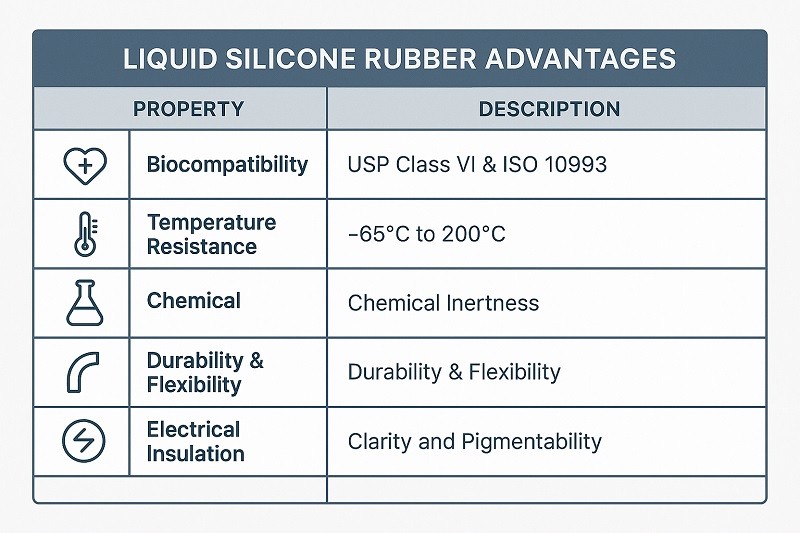
| Property | Description |
|---|---|
| Biocompatibility | LSR is non-toxic and hypoallergenic, having passed stringent biocompatibility tests like USP Class VI and ISO 10993. This makes it the standard for medical devices, healthcare products, and food-contact items. |
| Temperature Resistance | It can withstand a wide temperature range, typically from -65°C to 200°C (-85°F to 392°F), without losing its elasticity or structural integrity. Special grades can handle even more extreme temperatures. |
| Chemical Inertness | LSR exhibits excellent resistance to water, oxidation, and a variety of chemicals, including acids and bases. This makes it suitable for seals, gaskets, and components used in harsh chemical environments. |
| Durability & Flexibility | The material offers high tear strength and tensile strength, combined with excellent elongation and flexibility. It can be stretched repeatedly and will return to its original shape, ensuring a long service life for dynamic components. |
| Electrical Insulation | LSR is an excellent electrical insulator, making it ideal for protecting sensitive electronic components, connectors, and wiring from moisture and environmental factors. Its dielectric properties are stable across a broad frequency and temperature range. |
| Clarity and Pigmentability | The base material is naturally translucent, allowing for excellent clarity and easy pigmentation. This enables the creation of parts in a wide spectrum of colors or transparent components for aesthetic or functional purposes, such as in lighting applications. |
Common Applications:
- Medical & Healthcare: Surgical instruments, respiratory masks, seals for medical devices, syringe stoppers, and implantable components.
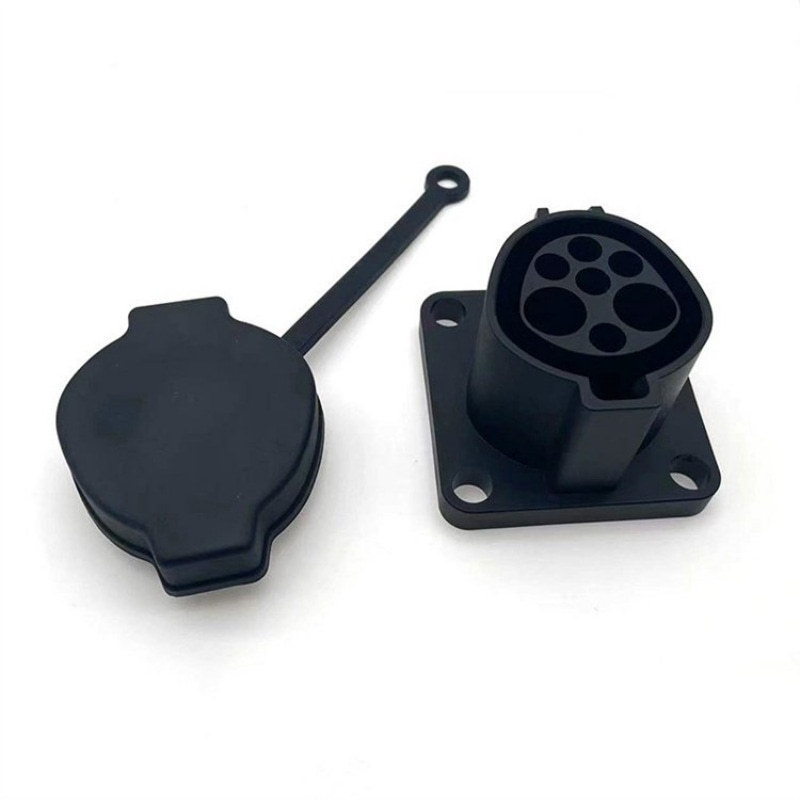
- Automotive: Seals, gaskets, wire harnesses, connectors, vibration dampeners, and keypad buttons.
- Electronics: Insulators, protective coverings for keypads and mobile devices, O-rings, and environmental seals for connectors.
- Consumer Goods: Bakeware, kitchen utensils, baby products like bottle nipples and pacifiers, and wearable devices.
The Liquid Injection Molding Process
Liquid Injection Molding (LIM) is a specialized manufacturing process designed to handle the unique characteristics of liquid silicone rubber. It is a highly automated and precise method that ensures consistent quality, tight tolerances, and high production volumes. The process begins with two separate liquid components, typically referred to as the "A" and "B" compounds, which are stored in containers.
The process unfolds in several key stages:
- Material Delivery: Pumps deliver the two LSR components in a precise 1:1 ratio to a static mixer. If color is required, a third stream for a color paste can be added at this stage.
- Mixing: The components are thoroughly blended in the static mixer to ensure a homogeneous mixture just before entering the injection unit. This mixing is done without introducing air, which prevents voids in the final product.
- Injection: The mixed material is then injected under high pressure into a pre-heated, sealed mold. Unlike plastic injection molding where the mold is cooled, LSR molding uses a hot mold to initiate the curing process.
- Curing: The heat from the mold (typically between 150°C to 200°C or 300°F to 400°F) triggers the platinum-catalyzed curing reaction. The LSR solidifies, or vulcanizes, into its final shape within a matter of seconds. The cure time depends on the part's thickness and the specific LSR grade.
- Demolding and Ejection: Once curing is complete, the mold opens, and the finished part is ejected, often with the assistance of an automated robotic arm to ensure a clean release and reduce cycle time.
Advantages of LIM for High-Precision Components
The liquid injection molding process is particularly well-suited for producing high-precision components with complex geometries and tight tolerances. This capability is critical for industries where performance and reliability are non-negotiable.
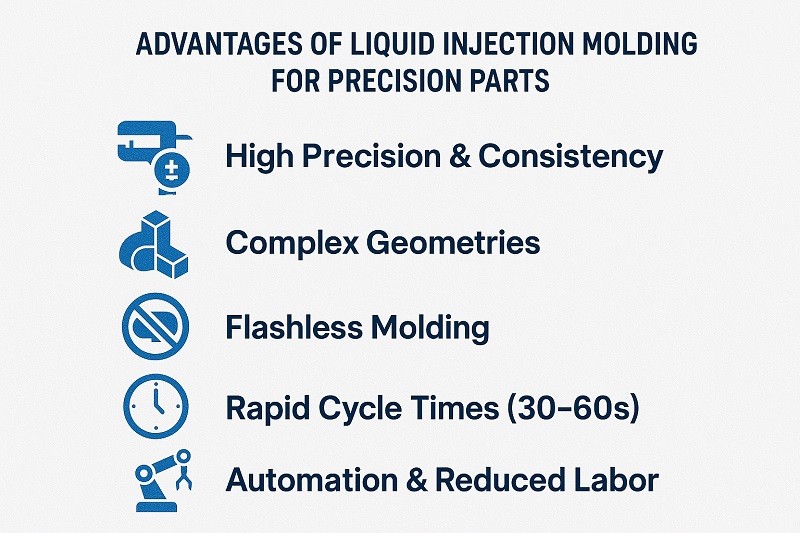
- High Precision and Consistency: LIM allows for extremely tight tolerances, often within a few thousandths of an inch. The automated nature of the process ensures that every part is virtually identical, eliminating the part-to-part variation common in other molding methods.
- Complex Geometries: The low viscosity of liquid silicone rubber allows it to flow easily and fill intricate and complex areas of a mold cavity. This enables the production of parts with thin walls, undercuts, and fine details that would be difficult or impossible to achieve with other materials.
- Flashless Molding: Advanced mold design and the precise nature of the LIM process can result in "flash-free" parts. This means little to no excess material, or "flash," seeps out of the mold parting lines, eliminating the need for secondary trimming operations and reducing material waste.
- Rapid Cycle Times: The quick curing nature of LSR, often completing in 30 to 60 seconds, leads to very short cycle times. This high level of automation and speed makes LIM an extremely efficient process for high-volume production, ultimately lowering the cost per part.
- Automation and Reduced Labor: The entire LIM process is highly automated, from material mixing to part ejection. This minimizes labor costs and reduces the risk of human error, contributing to both cost-efficiency and product quality.
Key Factors to Consider When Choosing a Liquid Silicone Rubber Molding Manufacturer
Selecting the right manufacturing partner is a strategic decision that extends far beyond a simple price comparison. The ideal manufacturer becomes an extension of your team, providing the expertise, quality, and reliability needed to bring your product to market successfully. When vetting potential partners for LSR molding, a thorough evaluation of several key factors is essential.
Experience and Expertise in Liquid Silicone Rubber Molding
A manufacturer's experience is arguably the most critical factor. LSR molding is a specialized field that requires deep technical knowledge of material science, mold design, and the intricacies of the LIM process.
- Years in Business and Industry Focus: Look for a company with a long and proven track record specifically in LSR molding. How many years have they been working with this material? Do they specialize in your industry (e.g., medical, automotive)? A manufacturer with experience in your specific market will already be familiar with the relevant standards, material requirements, and common challenges.
- Technical Knowledge: An expert team can provide invaluable Design for Manufacturability (DFM) feedback. They can help optimize your part design for the LIM process, suggesting improvements that can enhance performance, reduce costs, and streamline production. Inquire about their engineering team's capabilities and ask for examples of how they've helped other clients solve complex design challenges.
- Case Studies and Portfolio: Ask to see a portfolio of their work. Reviewing case studies or examples of past projects can provide tangible proof of their capabilities. Do they have experience producing parts with similar complexity, size, or material requirements to yours? This is a direct indicator of their ability to handle your project successfully.
Quality Assurance and Certifications of a Liquid Silicone Rubber Molding Manufacturer
Quality cannot be an afterthought; it must be embedded in the manufacturer's culture and processes. A robust quality management system (QMS) is non-negotiable, especially for critical components in the medical and automotive sectors.
- ISO Certifications: At a minimum, a reputable manufacturer should hold an ISO 9001 certification, which demonstrates a commitment to a standardized quality management system. For medical and automotive projects, certifications like ISO 13485 (Medical Devices) and IATF 16949 (Automotive) are essential. These certifications indicate that the manufacturer adheres to the stringent quality and traceability requirements of these industries.
- Cleanroom Manufacturing: For medical and electronic applications, contamination control is critical. Inquire if the manufacturer has certified cleanroom manufacturing capabilities (e.g., ISO Class 7 or Class 8). This ensures that parts are molded, inspected, and packaged in a controlled environment to prevent contamination from dust and other airborne particulates.
- Process Control and Inspection: A top-tier manufacturer will use advanced process control and in-process monitoring to ensure consistency. This includes statistical process control (SPC) to track critical dimensions and material properties in real-time. They should also have a range of metrology and inspection equipment, such as vision systems, CMMs (Coordinate Measuring Machines), and material testing devices, to verify that parts meet all specifications.
Production Capabilities and Equipment of a Liquid Silicone Rubber Molding Manufacturer
The manufacturer's equipment and facility directly impact their ability to meet your project's demands for quality, volume, and scale. An investment in modern, high-quality machinery is a strong signal of a company's commitment to excellence.
- Range and Quality of Machinery: Inquire about their injection molding presses. What are the brands, tonnage, and shot sizes? Top-tier manufacturers like Engel, Arburg, or KraussMaffei are known for their precision and reliability. A diverse range of press sizes allows them to handle projects of varying scales, from small micro-molded parts to larger components.
- Automation and Robotics: The use of automation is a hallmark of a modern and efficient LSR molder. Robotic arms for part removal, automated packaging systems, and integrated quality checks reduce cycle times, minimize labor costs, and improve consistency. High automation levels are particularly crucial for high-volume production runs.
- Scalability and Capacity: Can the manufacturer support your project from prototyping to full-scale production? Do they have the capacity to ramp up production if your demand increases? A partner with scalable infrastructure provides the flexibility you need as your product grows in the market. They should have a clear process for moving from low-volume prototype tooling to high-cavitation, high-volume production molds.
Mold Design Expertise and Tooling
The mold is the heart of the injection molding process, and its quality directly determines the quality of the final part. A manufacturer with in-house mold design and fabrication capabilities offers significant advantages in terms of speed, quality control, and cost-effectiveness.
- In-House Tooling Capabilities: Does the manufacturer design and build molds in-house, or do they outsource this critical function? An in-house tool shop provides much greater control over the mold making process. It allows for faster revisions, easier maintenance, and ensures that the engineering team that designed the mold is readily available to troubleshoot any issues that arise during production.
- Mold Design for LSR: Designing a mold for LSR is different from designing one for thermoplastics. The design must account for the material's low viscosity, thermal expansion, and a hot-runner system to keep the material flowing. An experienced LSR mold designer will know how to optimize gate locations, parting lines, and venting to produce a high-quality, flash-free part.
- Materials and Longevity: Ask about the types of steel they use for their molds (e.g., P20, H13, S7) and the expected lifespan of the tooling. A high-quality mold built from hardened tool steel may cost more upfront but will last for millions of cycles, ultimately resulting in a lower total cost of ownership for high-volume projects.
Evaluating a Liquid Silicone Rubber Molding Manufacturer's OEM Capabilities
When you partner with a manufacturer, you are engaging them as an Original Equipment Manufacturer (OEM) service provider. This relationship goes beyond just producing a part; it involves a comprehensive service model that supports your project from concept to delivery. Evaluating these broader capabilities is crucial for ensuring a smooth and successful partnership.
Comprehensive Service Offerings
A truly valuable OEM partner offers a suite of services that streamline your supply chain and add value at every stage of the product lifecycle.
- Prototyping to Production: The ideal partner can support you from the very beginning. Look for manufacturers offering rapid prototyping services, such as 3D-printed molds or single-cavity prototype tools. This allows you to test and iterate your design quickly and cost-effectively before committing to expensive, high-volume production tooling.
- Secondary Operations and Assembly: Does your part require additional processing after molding? This could include post-curing, slitting, printing, or assembly with other components. A manufacturer that offers these secondary operations in-house can save you time, reduce logistical complexity, and ensure quality control throughout the entire production process.
- Value-Added Services: Beyond basic molding, some manufacturers provide advanced services like Design for Manufacturability (DFM) analysis, Finite Element Analysis (FEA) to simulate part performance, and material selection assistance. These expert services can significantly improve your product's design, durability, and cost-effectiveness.
Material Sourcing and Quality
The quality of the final product is directly dependent on the quality of the raw materials used. A reliable OEM partner will have a transparent and robust process for sourcing and verifying materials.
- Reputable Suppliers: Ask the manufacturer about their material suppliers. They should be sourcing LSR from well-known, reputable producers like Dow, Wacker, Shin-Etsu, or Momentive. These leading suppliers provide consistent, high-quality materials with detailed documentation and traceability.
- Material Certification and Traceability: For every batch of material, the manufacturer should be able to provide a Certificate of Analysis (COA) that verifies its properties and compliance with required standards. They must have a robust traceability system in place that allows them to track the specific material lot used for every production run, which is a critical requirement for medical and automotive products.
- Custom Formulations: For unique applications, you might require a custom LSR formulation with specific properties (e.g., enhanced lubricity, specific durometer, or color). Inquire if the manufacturer has the capability and supplier relationships to develop or source custom-compounded materials to meet your exact specifications.
Communication and Customer Service
Technical capabilities are vital, but a successful partnership also hinges on clear communication and responsive customer service. You need a partner who is accessible, transparent, and collaborative.
- Dedicated Project Management: Will you have a single point of contact for your project? A dedicated project manager or engineer who understands your goals and can provide regular updates is essential for keeping the project on track. This person acts as your advocate within the manufacturing facility, ensuring your requirements are met at every stage.
- Transparency and Reporting: The manufacturer should be transparent about their processes, timelines, and any challenges that arise. Look for partners who provide regular progress reports, production schedules, and quality data. Open and honest communication builds trust and prevents surprises down the line.
- Responsiveness and Support: How quickly do they respond to your inquiries? A responsive partner is crucial, especially when issues arise that require quick resolution. Their level of customer support, from the initial quoting process to post-delivery assistance, is a strong indicator of how they will behave as a long-term partner.
Why SOMI Custom Parts is Your Ideal Liquid Silicone Rubber Molding Manufacturer
In a market with numerous options, selecting the right partner can be daunting. SOMI Custom Parts distinguishes itself not just as a supplier, but as a dedicated partner invested in your success. Our specialized focus, unwavering commitment to quality, and customer-centric approach make us the ideal choice for your LSR molding needs. We combine deep industry expertise with advanced technology to deliver solutions that exceed expectations.
Industry Leadership and Specialization
At SOMI Custom Parts, we are not generalists; we are specialists. Our primary focus is on high-precision custom parts, with a deep specialization in Liquid Silicone Rubber molding. This focus allows us to cultivate an unparalleled level of expertise that directly benefits our clients.
- Deep Domain Expertise: We live and breathe LSR. Our engineering team possesses an in-depth understanding of LSR material science, mold design intricacies, and the LIM process. This allows us to provide expert DFM guidance, helping you optimize your designs for superior performance and cost-efficiency.
- Proven Track Record: With years of experience serving critical industries such as medical, automotive, and electronics, we have a portfolio filled with successful projects that showcase our ability to handle complex geometries, tight tolerances, and stringent regulatory requirements.
- Cross-Industry Innovation: Our work across diverse sectors allows us to apply lessons and innovations from one industry to another. An advancement in medical-grade materials might inspire a solution for a consumer electronics application, providing our clients with a unique competitive edge.
Commitment to Quality and Innovation
Quality is the cornerstone of our operations. We believe that continuous improvement and investment in technology are essential for delivering the best possible outcomes for our clients.
- Robust Quality Systems: Our facilities operate under stringent quality management systems, holding key certifications like ISO 9001, with processes aligned to meet ISO 13485 and IATF 16949 standards. We utilize advanced metrology and inspection equipment, including CMMs and vision systems, to ensure every part meets your exact specifications.
- State-of-the-Art Technology: We invest in the latest LSR injection molding technology, including high-precision presses from leading manufacturers and advanced automation. Our facilities feature certified cleanrooms for medical and electronics projects, ensuring a contamination-free production environment.
- In-House Tooling and Prototyping: Our vertically integrated approach includes an in-house tool room staffed by expert mold makers. This allows us to control the quality of the mold, reduce lead times, and quickly move from rapid prototyping to high-volume production, ensuring a seamless transition and faster time-to-market.
Seamless Project Management and Support
We understand that our clients need more than just a part manufacturer; they need a reliable partner who makes the process easy and transparent. Our customer-centric approach is designed to provide just that.
- Dedicated Project Ownership: From the moment you engage with us, you are assigned a dedicated project manager who serves as your single point of contact. This expert will guide you through every step, from quoting and design review to production and delivery, ensuring clear communication and a smooth workflow.
- Collaborative Partnership: We view our clients as partners. We work collaboratively to solve challenges, offering transparent communication and regular updates. Our goal is to function as an extension of your own team, providing the support and expertise you need to achieve your objectives.
- Comprehensive Solutions: We offer a full spectrum of services under one roof, including DFM analysis, material selection, secondary operations, and assembly. This integrated model simplifies your supply chain, reduces logistical burdens, and ensures consistent quality from start to finish.
Choosing the right Liquid Silicone Rubber Molding manufacturer is a strategic decision that directly impacts the success of your project. By carefully evaluating factors such as experience, quality systems, production capabilities, and customer support, you can secure a partnership that guarantees high-quality, reliable, and cost-effective LSR components.
At SOMI Custom Parts, we pride ourselves on being a premier Liquid Silicone Rubber Molding manufacturer, dedicated to providing exceptional solutions tailored to your specific needs. Our comprehensive expertise, advanced technology, and unwavering commitment to quality make us the ideal partner for your next LSR project. We are ready to help you bring your innovative designs to life.