Smart Tool Monitoring: How IoT Sensors Are Preventing CNC Tool Failure
- Share
- publisher
- SOMI Custom Parts
- Issue Time
- Aug 16,2026
Summary
IoT sensors, edge computing and AI are transforming how CNC shops detect tool wear and predict failure. This guide explains the five monitoring signals, detection lead times, AI models, ISO standards and real-world ROI behind smart tool monitoring - and how SOMI Custom Parts supports reliable precision machining.

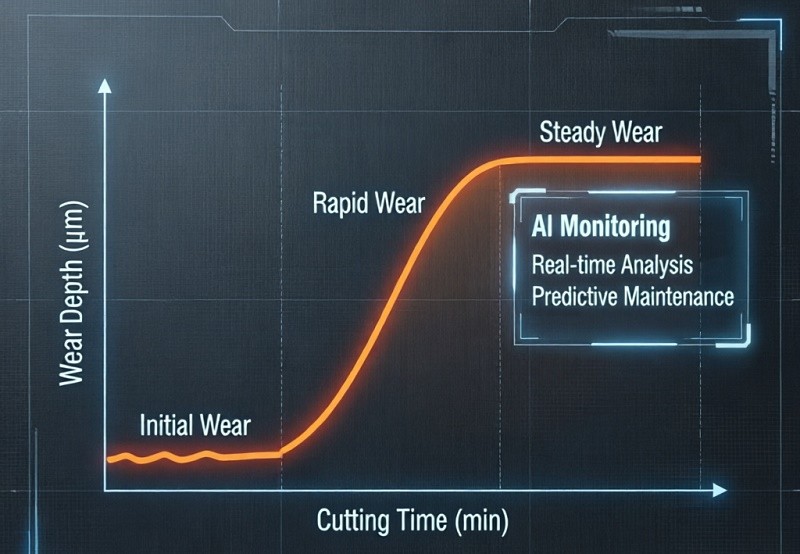
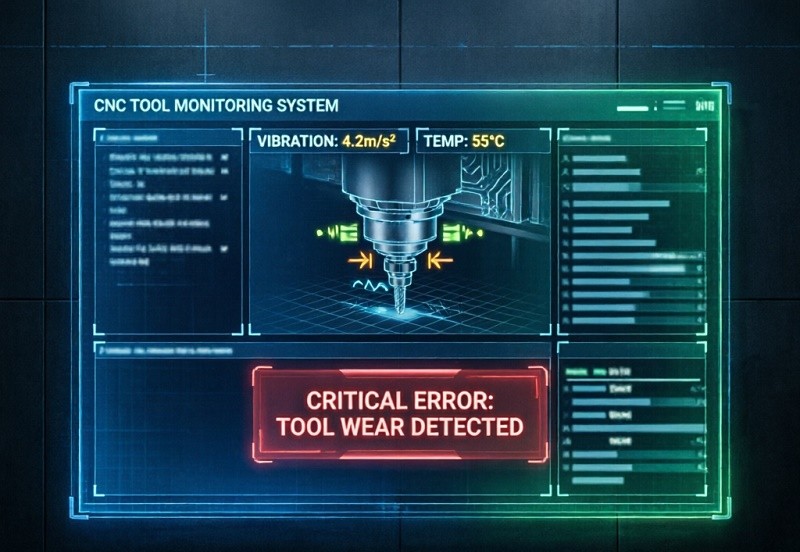
A cutting tool never fails all at once. It edges from sharp to dull over hundreds of cuts — and by the time an operator hears the whine or sees a burr on the part, the tolerance is already gone and the spindle bearings have often taken damage too. IoT sensors, edge computing and AI now read the cut itself, catching the shift from healthy tool to failing tool long before a person would notice. Tool wear is the quiet thief of the machine shop. Because wear is invisible during the cut, most manufacturers still rely on fixed tool-change intervals, operator experience or post-process inspection. All three are reactive by design: the fixed interval either scraps good tools early or misses tools that fail sooner than expected, and manual inspection catches damage only minutes before failure — or after a part has already been scrapped. The financial exposure is far larger than the price of a cutting tool. Industry studies show that a broken drill or tap lodged in a workpiece can convert a $50 tooling event into a $5,000+ spindle repair, while unplanned downtime in manufacturing can cost up to $260,000 per hour and equipment failure accounts for about 42% of all unplanned downtime. Tool-related losses are estimated to consume more than 25% of total production costs in many plants, yet over 60% of small and mid-size manufacturers still depend on manual judgment. Smart tool monitoring changes this equation. By fusing vibration, acoustic emission, motor current, spindle power and temperature signals with machine learning, modern systems detect the earliest signs of wear, estimate remaining tool life, and raise an alert up to 72 hours before a failure threshold is reached — giving planners time to swap tools during a natural production break instead of in the middle of a rush job. Smart tool monitoring (also called tool condition monitoring, or TCM) is a closed-loop system that continuously watches the condition of cutting tools and machine spindles during production. It combines three layers: Accelerometers, acoustic emission sensors, current transducers and thermocouples mounted on the spindle, tool holder and axes capture real-time cutting behaviour on every cut, not on a sampling schedule. Edge gateways pre-process and de-noise signals locally in milliseconds, then stream data through IIoT platforms (OPC-UA, MTConnect, MQTT) to MES and analytics systems. Trained models classify tool state — normal, slight wear, moderate wear, severe wear — and predict remaining useful life (RUL), delivering a colour-coded health score operators can act on instantly. The market reflects the urgency of this shift. The global tool condition monitoring market is projected to grow from $4.2 billion in 2025 to $8.1 billion by 2034 (7.8% CAGR), and the AI-driven segment is expanding even faster at 14.2% CAGR, from $1.8 billion to $6.4 billion. Asia-Pacific leads with roughly 38% of global revenue, driven by high-volume automotive and electronics machining, followed by Europe (29%) and North America (20%). Condition-based replacement lets shops use tools to ~99% of their real life instead of discarding them at a conservative 80% margin. Reported gains range from 30-60% longer tool life, plus 15-30% from parameter optimisation. Predictive alerts cut unplanned tool- and spindle-related stoppages by 20-40% and can reduce overall downtime by up to 50%, shifting repairs from Friday rush to a planned Tuesday. In live pilot deployments, scrap rates dropped from above 3% to under 1.2%, and defect-related production losses fell by up to 27% once worn tools were flagged before they cut out-of-tolerance parts. In aerospace and medical work a single scrapped part can cost thousands of dollars. Catching micro-chipping and flank wear early protects both the workpiece and the spindle bearings underneath it. Reliable monitoring is the prerequisite for unattended night and weekend shifts — the system pauses the cycle or swaps to a sister tool automatically when a predicted breakage is flagged. Analytics-based predictive maintenance reduces maintenance costs by 10-40% compared with reactive repair, and condition-based replacement extends spindle bearing life by about 35%. No single sensor tells the whole story of a cut. A spike in one signal that looks ambiguous alone becomes a clear, high-confidence flag when it lines up with a matching shift in two or three others. Production-proven monitoring platforms fuse five complementary signals: Accelerometers on the spindle housing and axis drives track amplitude and frequency spectra. Characteristic defect frequencies — BPFO, BPFI and BSF — identify which bearing component is degrading, following the vibration severity approach of ISO 20816. Piezo sensors listen for high-frequency stress waves (roughly 67-471 kHz) from micro-cracks, friction and chipping — events far below the threshold of vibration sensors. AE RMS levels climb from about 35 dB to 55 dB as wear advances, enabling alerts at flank wear values as low as 0.25 mm VB. Spindle and servo motor current tracks load without any external sensor. A 2024 study found that a spindle load current ratio above 1.4x its initial value indicates severe tool wear, and current-based sensing caught breakage-related energy spikes in 18 of 20 experiments (90%). Rising power draw for the same feed and depth of cut is one of the earliest, most reliable signs that an edge has dulled and is fighting the material instead of cutting it cleanly. Housing and bearing temperature climbs steadily as friction increases. This slow-moving signal confirms what power and vibration already suggest and rules out one-off spikes, catching bearing trouble hours before it becomes audible. Different detection strategies give fundamentally different lead times before a tool or bearing failure. The table below summarises what each method actually catches and how much warning it realistically provides: This is why the industry is moving from reactive alarms to predictive, fused-signal monitoring: it is the only approach that turns a tool-change decision into a scheduled event rather than an emergency. Cutting tool wear follows a well-documented three-stage curve — the same logic that underlies tool-life testing standards such as ISO 3685. A fresh edge passes through rapid break-in wear as it seats into the cut, settles into a long, gradual steady-state region, and then tips into an accelerated zone where flank wear, chipping and thermal softening compound quickly toward catastrophic failure. The danger is that steady-state wear looks calm right up until it doesn't — the transition into accelerated wear can happen within a handful of parts. An AI model that has learned what steady-state looks like for a specific tool, material and feed rate flags the exact moment the curve bends upward, well inside the steady-state region. That early warning window is what converts an unplanned crash into a planned tool change. Modern tool monitoring replaces fixed thresholds with learning systems. Neural networks and hybrid models analyse cutting signatures continuously and detect anomalies long before a human or a PLC alarm would: Convolutional networks extract deep features from vibration, AE and force streams; SVM layers classify tool state as normal, slight, moderate or severe wear with accuracy consistently above 95% in field deployments. Long short-term memory networks capture the gradual wear trend while attention mechanisms spot sudden loss spikes, issuing failure warnings 2-3 full machining cycles in advance. In-machine cameras measure flank wear down to ~8 μm and fuse with force and AE data; fused systems report 91% insert-wear prediction accuracy with 55% fewer false positives, essential for overnight unattended runs. Machine-tool builders now embed these capabilities directly into controls: Siemens SINUMERIK Edge, Mazak SMOOTH Ai, Fanuc FIELD AI, Okuma OSP-AI and Haas pilot Smart Monitor packages all ship with predictive tool analytics, comparing live telemetry against learned baselines. Collecting signals is only useful if it turns into something an operator can act on in seconds. Effective systems run as a continuous loop on every cut: Power, vibration, acoustic, current and thermal data captured on every cut. Five signals combined into one model, not judged in isolation. Fused reading checked against the machine's own learned normal. A colour-coded status turns the math into an instant glanceable result. A tool-change work order is raised while there is still time to schedule it. Because the loop repeats on every cut, the picture of tool and spindle health stays current instead of going stale between scheduled checks — the basis of true predictive maintenance. Predictive tool monitoring is built on recognised measurement practice, not black-box thresholds. The key reference standards include: Importantly, retrofitting is well proven: external vibration transmitters, thermal sensors and current clamps can be added without touching the controller, and RS-232 legacy machines connect through serial adapters or PLC intermediaries. Even 30-year-old CNCs can join a fleet-wide monitoring platform. Field deployments across automotive, aerospace, mould-making and job shops consistently report the same outcomes. In one two-plant pilot covering full CNC turning and milling lines, smart tool monitoring delivered 32% less unplanned downtime, 27% lower defect-related production losses and 21% less wasted tooling — while completely eliminating manual walk-around inspections. A second deployment reported 18% lower overall tooling cost and scrap falling from above 3% to under 1.2% within months. Spindle rebuilds for VMCs typically cost $2,000-$7,000 and HMC spindles $7,500-$12,000, plus 5-14 working days of lost production; spindle bearings alone can cost $5,000-$50,000. Catching degradation early avoids nearly all of this. A broken drill or tap caught in time is a $50 event. Left undetected it can damage the spindle — a $5,000+ repair. Monitoring closes that gap by flagging breakage within seconds. For a 10-machine shop at $150/hour, recovering just 4 hours of unplanned downtime per month covers a full-year software subscription. Most shops report payback within 2-8 weeks. At SOMI Custom Parts, we combine the same discipline that makes tool monitoring effective — controlled processes, validated tooling and data-backed quality — across every order we machine. Our precision CNC drilling, CNC milling and CNC turning services are backed by a documented quality system, first-article inspection and stable cutting parameters that protect both tool life and part consistency. Tell us about your project and we will recommend the right machining strategy, materials and tolerances for your budget — send your inquiry or contact our team today. The most common set combines vibration accelerometers, acoustic emission sensors, motor current transducers, spindle power/torque monitors and temperature sensors. Controller-based data (spindle load, axis current, alarms) can often be used without any external hardware, making current monitoring the logical first step for many shops. AI multi-signal fusion typically provides up to 72 hours of advance warning before a failure threshold is reached, and LSTM-based models issue alerts 2-3 machining cycles ahead of breakage. By contrast, manual inspection gives only minutes, and fixed-interval changes give none. No. Monitoring is a retrofit-friendly technology: current and power data come from existing drives and controllers, and vibration, AE and thermal sensors bolt onto spindles and tool holders. Legacy machines connect through serial adapters or PLC intermediaries, so entire fleets — new and 30 years old — can be covered. Yes. Published low-cost systems built on off-the-shelf hardware achieve ~88% wear-classification accuracy for about $170, and a 10-machine shop at $150/hour recovers a full monitoring subscription by avoiding just 4 hours of unplanned downtime per month. Most deployments pay back in 2-8 weeks. No system is perfect, but fused AI monitoring catches the large majority of failure modes — gradual wear, chipping, bearing degradation and chatter onset — before they scrap parts, with 55% fewer false positives than single-signal approaches. It turns tool management from guesswork into a scheduled, data-driven process. Smart tool monitoring has moved from research labs to the shop floor, and the numbers make the case: up to 72 hours of advance warning, 30-60% longer tool life, 20-40% fewer unplanned breakdowns and near-zero scrap. Whether you run a single machining centre or a lights-out production cell, fusing IoT sensor data with AI models turns your cutting tools from a source of hidden risk into a managed, optimised asset. Ready to put precision machining and disciplined process control to work on your next project? SOMI Custom Parts delivers high-quality CNC-machined components with transparent quality assurance — explore our manufacturing blog for more technical guidance, or request a quote and let our engineers help you from design to delivery.Smart Tool Monitoring: How IoT Sensors Are Preventing CNC Tool Failure

Introduction: The Hidden Cost of Tool Failure
What Is Smart Tool Monitoring?
IoT Sensors
Edge & Cloud Computing
AI & Machine Learning
Key Benefits of Smart Tool Monitoring
Extended Tool Life
Less Unplanned Downtime
Near-Zero Scrap
Protection for High-Value Workpieces
Lights-Out Manufacturing
Lower Maintenance Spend
The Five Signals: How IoT Sensors Detect Tool Wear
Vibration Analysis
Acoustic Emission
Current Signature
Spindle Power & Torque
Thermal Drift
Detection Methods Compared: From Fixed Intervals to AI Fusion
Detection Method What It Catches Typical Lead Time Key Limitation Fixed-interval tool change Nothing specific — a schedule, not a detector 0 (reactive by design) Scraps good tools early; misses tools that fail sooner Manual operator inspection Visible chipping, obvious wear, gross bearing noise Minutes before failure Intermittent, subjective, unsafe near a running spindle Vibration-only monitoring Bearing imbalance, misalignment, some chatter Hours Misses acoustic and thermal precursors Acoustic emission sensing Micro-cracking, early lubrication faults Minutes to hours High-frequency data needs specialised processing AI multi-signal fusion Tool wear, bearing wear, chatter onset, holder wear Up to 72 hours Needs a short baseline period per machine The Tool Wear Curve and Why Timing Matters
How AI Models Predict Tool Failure
CNN-SVM Hybrid Classifiers
LSTM-Attention RUL Models
Vision & Sensor Fusion
From Sensor to Action: The Continuous Monitoring Loop
Sense
Fuse
Compare
Score
Act
Standards, Interoperability and Retrofitting
Standard / Protocol Role in Tool Monitoring ISO 3685 Tool-life testing with single-point turning tools; defines wear criteria used to train wear-curve models ISO 20816 Measurement and evaluation of vibration on rotating machinery — severity scale for spindle bearings ISO 13373 / ISO 17359 Condition monitoring and diagnostics frameworks, including alert severity zones ISO 13374 / IEC 62264 Condition monitoring data processing and integration with manufacturing systems MTConnect 2.5 / OPC-UA Machine connectivity: spindle load, axis current, alarms and program state without extra hardware Fanuc FOCAS / HAAS MNET / Mazak Mazatrol OEM controller interfaces that expose real-time machining telemetry Real-World Results and Return on Investment
Avoided Spindle Repairs
The $50-to-$5,000 Escalation
A Realistic ROI Model

How SOMI Custom Parts Can Help
Frequently Asked Questions
What sensors are used for CNC tool monitoring?
How much warning does smart tool monitoring give before failure?
Do I need new CNC machines to adopt tool monitoring?
Is tool monitoring worth it for a small machine shop?
Can smart tool monitoring prevent every tool failure?
Conclusion