Sheet Metal Stamping Process Explained: A Manufacturer's Perspective
- Share
- Issue Time
- Jan 8,2026
Summary
This article provides an in-depth manufacturer's perspective on sheet metal stamping, a fundamental cold-forming process used to transform flat metal sheets into precise, three-dimensional parts essential across numerous industries, from automotive to electronics.
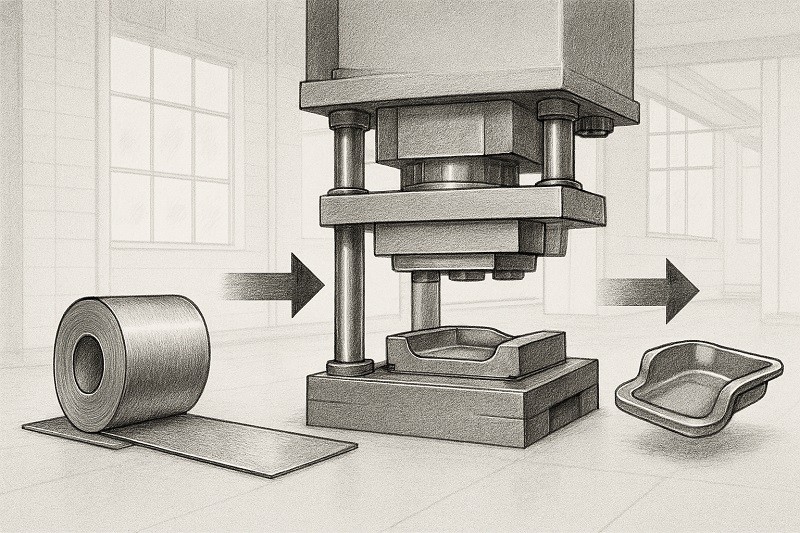
As an experienced sheet metal fabrication manufacturer, we often get asked about the intricacies of the sheet metal stamping process. It's a fundamental technique that transforms flat metal sheets into precise, three-dimensional parts, vital for countless industries from automotive and aerospace to electronics and consumer goods. Sheet metal stamping is a versatile and efficient manufacturing method that utilizes specialized tools called dies within a stamping press to cut, bend, or form metal into desired shapes. The process largely relies on cold-forming techniques, meaning it generally doesn't use heat to shape the material, though friction between the die and the metal can generate some warmth.
Join us as we, a leading sheet metal fabrication manufacturer, explain the key stages, critical components, and types of operations involved in sheet metal stamping. This article will provide you with a manufacturer's perspective on this essential process, delving into the technical expertise and careful planning required to bring high-quality metal components to life.
Understanding What We Do: A Sheet Metal Fabrication Manufacturer's Definition of Stamping
From our perspective as manufacturers, sheet metal stamping, sometimes called pressing, is a core competency. It's a highly controlled and repeatable process that allows us to convert flat metal stock into complex parts with exceptional precision and speed. The definition is rooted in its method: applying immense force via a press to a custom-made tool (a die) to permanently alter the shape of sheet metal.
What Exactly is Sheet Metal Stamping?
At its most basic, sheet metal stamping is a cold-forming manufacturing process. "Cold-forming" signifies that the metal is shaped at or near room temperature, without the addition of external heat. This method is distinct from hot working processes like forging or casting. The primary goal is to stress the metal beyond its elastic limit (the point where it would spring back) but below its tensile strength (the point where it would fracture), causing it to permanently take on a new shape.
The Core Concept: Flat Metal to Finished Part
The journey from a simple flat sheet of metal to a complex, functional component is the essence of stamping. It all begins with a sheet or coil of metal which is fed into a stamping press. Inside the press, a die—a tool custom-built for the specific part—is mounted. The press then exerts tremendous force, often measured in tons, causing the die to close and cut, bend, or form the metal. The result can be a finished part in a single press stroke or may require a series of operations to achieve its final, intricate geometry. This transformation from 2D to 3D is what makes stamping indispensable for producing everything from automotive body panels and aircraft brackets to the metal casings for your electronic devices.
Key Components in Our Stamping Operations
Successful stamping operations depend on the precise interplay of three fundamental components: the sheet metal itself, the die that shapes it, and the press that provides the force. As a manufacturer, mastering the selection and application of each is critical to quality and efficiency.
The Sheet Metal: Our Raw Material
The entire process begins with the raw material. The choice of sheet metal is dictated by the end-use application's requirements, including strength, durability, corrosion resistance, conductivity, and cost. Common materials we work with include:
- Carbon Steel: This is the most widely used material due to its excellent strength, formability, and affordability. It is often categorized as:
- Low-Carbon Steel (e.g., AISI 1008, 1010): Very easy to stamp and weld, making it ideal for enclosures, brackets, and automotive panels.
- High-Strength Low-Alloy (HSLA) Steel: Used for structural parts where more durability is needed without adding significant weight.
- Cold Rolled Steel (CRS): Processed at room temperature for a smoother finish and higher strength, suitable for parts requiring precision.
- Hot Rolled Steel (HRS): Processed at high temperatures, it is easier to form and is often used where surface finish is less critical.
- Stainless Steel: Chosen for its superior corrosion resistance and aesthetic appeal, making it essential for medical devices, food processing equipment, and marine applications. Grades like 304L offer great formability, while 316 includes molybdenum for enhanced corrosion resistance.
- Aluminum Alloys: Prized for its high strength-to-weight ratio, aluminum is crucial in aerospace and automotive industries to reduce weight. Grades like 6061 offer good corrosion resistance and weldability, while 5052 is excellent for forming.
- Copper and Brass: Selected when electrical conductivity or specific aesthetic qualities are needed. Copper is common for electrical terminals and heat sinks, while brass is used for decorative hardware and fasteners.
- Coated and Pre-Plated Metals: Materials like galvanized steel (zinc-coated) are used to provide corrosion protection without requiring secondary finishing processes, common in HVAC and construction parts.
The material's thickness, or gauge, is another critical factor, influencing both the stamping process and the tooling design.
The Die: Shaping the Future of Sheet Metal Fabrication
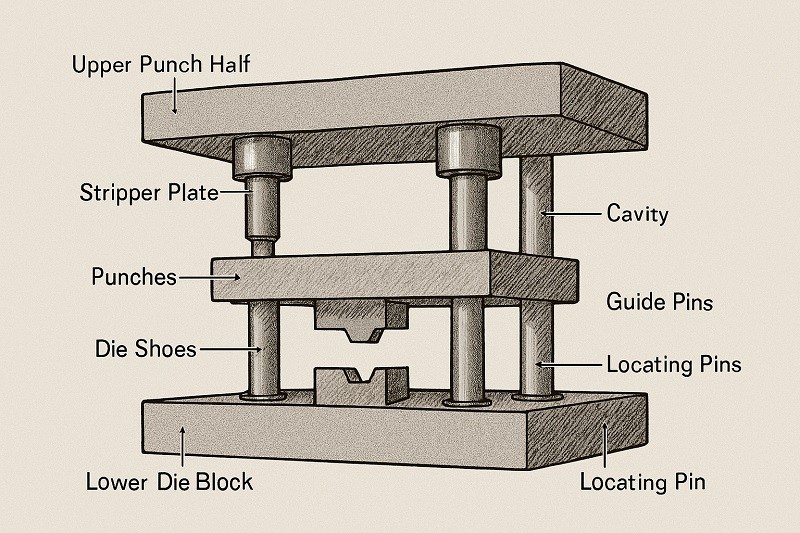
The die is the heart of the stamping process; it is a specialized, custom-made tool that cuts and forms the sheet metal. Dies are complex assemblies of precision-machined components that must withstand immense, repetitive forces. A typical die set consists of two halves:
- Upper Die (Punch Half): This half is mounted to the moving slide (or ram) of the stamping press. It contains the punches, which are the components that perform the cutting or forming.
- Lower Die (Die Block): This half is secured to the stationary bed (or bolster plate) of the press. It contains the die cavity, which the metal is formed into, as well as guides and other essential components.
Key components within a die include:
| Component | Function |
|---|---|
| Die Shoes | The upper and lower base plates that form the foundation of the die set. |
| Guide Pins & Bushings | Ensure precise alignment between the upper and lower halves of the die during every press stroke. |
| Punches | The tools that directly cut, pierce, or form the metal. They are shaped according to the desired feature. |
| Die Block/Cavity | The stationary part into which the metal is pressed to achieve its final shape. |
| Stripper Plate | A spring-loaded plate that prevents the material from sticking to the punch on the upstroke. |
| Locating Pins/Pilots | Accurately position the sheet metal strip to ensure each operation occurs in the correct location. |
The design and material of these components are paramount, as they directly determine part accuracy, repeatability, and the overall lifespan of the tool.
The Press Machine: The Powerhouse
The stamping press is the machine that houses the die and applies the necessary force to shape the metal. These machines are rated by their tonnage, or the maximum force they can exert. They convert rotational motion from a motor into linear motion to move the ram up and down. The main components of a press are the frame, the bed (bolster plate) where the lower die is mounted, and the ram (slide) which holds the upper die and reciprocates. An automated feeding system often supplies the press with sheet metal from a coil, allowing for continuous, high-speed production. The press's stroke cycle involves the ram descending to form the part and then returning to its starting position, ready for the next cycle.
The Step-by-Step Stamping Process by a Sheet Metal Fabrication Manufacturer
Creating a high-quality stamped part is a systematic process that begins long before any metal is cut. As a manufacturer, we follow a rigorous workflow to ensure every component meets exact specifications for quality, function, and cost-effectiveness. This process can be broken down into five key phases: design and planning, tooling setup, material preparation, the stamping operation itself, and finally, inspection and finishing.
Design and Planning: Laying the Foundation
This initial phase is arguably the most critical, as decisions made here impact the entire manufacturing lifecycle. It involves deep collaboration between our engineering team and the client to translate a concept into a manufacturable design.
Understanding Client Needs and Material Selection
The process starts with a thorough analysis of the part's requirements. We work with the client to understand its intended function, the environment it will operate in, required strength, and desired lifespan. Based on this, we select the optimal raw material. Factors like ductility (how much it can be stretched without breaking), yield strength, and hardness are crucial for manufacturability, while corrosion resistance and conductivity are key for performance. Choosing between a more formable but weaker metal versus a high-strength steel that is harder to work with is a critical decision that balances performance with production cost.
Tooling Design and Feasibility Analysis
Once the part design and material are defined, our tooling engineers use Computer-Aided Design (CAD) software to create a virtual model of the die. This is where our expertise as a manufacturer truly shines. We perform a Design for Manufacturability (DFM) analysis to identify potential issues like the risk of cracking, wrinkling, or excessive springback (the tendency of metal to return to its original shape after forming). The die design must be incredibly precise to ensure proper clearances between the punch and die, which is essential for creating clean cuts and accurate forms. This feasibility analysis helps us optimize the part design for stamping, ensuring a stable and efficient production process.
Tooling and Equipment Setup: Crafting Precision for Sheet Metal Fabrication
With a finalized design, we move on to creating the physical tool that will produce the parts. The quality and longevity of the die are non-negotiable for high-volume production.
Creating the Die and Punch
The components of the die are meticulously machined from high-strength tool steels, and in some cases, carbide for extreme wear resistance. Processes like CNC machining and Electrical Discharge Machining (EDM) are used to create the intricate shapes of the punches, die blocks, and other components with tolerances measured in microns. Each component is crafted to perfectly match the CAD designs, as even the slightest deviation can impact the quality of the final stamped part.
Heat Treatment and Assembly
After machining, many die components undergo heat treatment. This process hardens the steel, making it durable enough to withstand the repeated impact of a production run without wearing out or deforming. Following heat treatment, the components are ground to their final, precise dimensions. Our skilled toolmakers then assemble the dozens or even hundreds of individual parts into the upper and lower die sets. They carefully install guide pins, springs, stripper plates, and punches, ensuring everything is perfectly aligned and moves smoothly. Finally, the completed die is installed and calibrated in the stamping press.
Material Preparation and Feeding: Getting Ready to Stamp
Before the stamping can begin, the raw material must be prepared. Sheet metal is typically delivered to our facility in large, heavy coils. The coil is loaded onto an uncoiler, which feeds the metal into a straightener to remove any curvature and ensure it is perfectly flat. This is critical for preventing defects and ensuring consistent part quality. In some cases, a lubricant is applied to the metal's surface to reduce friction during stamping, which helps extend the life of the die and improve the surface finish of the parts. The flattened strip is then fed into the stamping press by an automated feeder, which precisely advances the material for each stroke of the press.
The Stamping Operation: Transforming Metal with Our Expertise
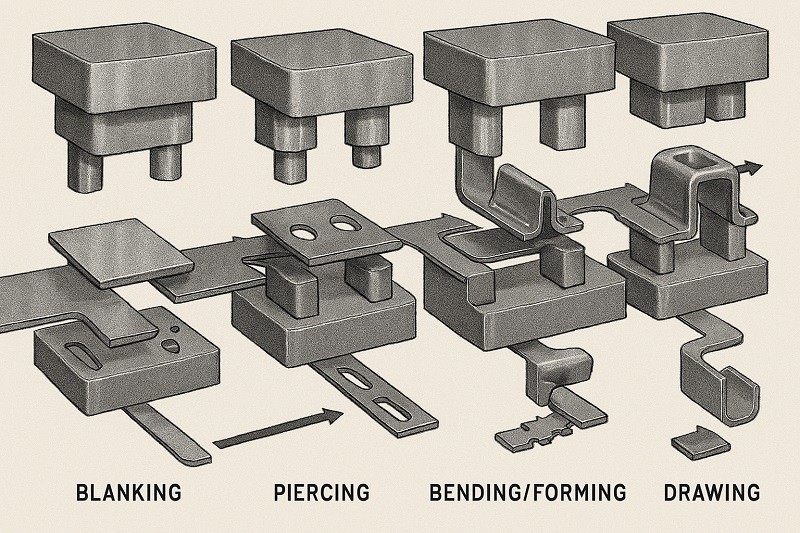
This is where the transformation from a flat strip to a finished part occurs. A single part may be formed through one or more different stamping operations, often performed sequentially in a progressive die. Each stroke of the press performs a specific action.
Blanking: The Initial Cut
Blanking is often the first step in the process. It is a cutting operation where a punch and die are used to shear a piece of metal—the "blank"—from the larger sheet or coil. This blank is the workpiece that will be carried through subsequent forming operations. The goal is to create a clean cut with minimal burrs (sharp edges), as excessive burrs can require costly secondary removal operations.
Punching and Piercing: Creating Holes and Openings
Punching and piercing are similar to blanking, but their purpose is to create holes, slots, or other internal features in the part. In piercing, the small piece of metal that is cut out is the scrap, while the main workpiece continues on. The accuracy of the hole size and location is critical, especially for parts that will be assembled with other components.
Bending and Forming: Shaping the Metal
Bending gives the part its three-dimensional shape by deforming the metal along a straight axis. Forming is a more general term that encompasses creating more complex features like flanges (rims), curls, and louvers. Our engineers must accurately predict and compensate for springback during the die design phase to ensure the final bend angle is correct.
Drawing: For Deeper Shapes
Drawing is used to transform a flat blank into a hollow, cup-like, or shell-like shape, such as a can or a sink. In this process, the blank is clamped down around the edges and a punch pushes the material into a die cavity, stretching it into the desired shape. This technique is carefully controlled to stretch the metal without causing it to wrinkle or tear. When the depth of the part is greater than its diameter, the process is known as deep draw stamping.
Embossing and Coining: Adding Detail
These operations add fine details to the part's surface.
- Embossing: Creates a raised or recessed design on the metal surface without significantly changing its thickness. Think of the raised letters on a license plate.
- Coining: Applies extreme pressure to force the metal to flow into the die's details. This process can create very sharp, precise features and may slightly alter the metal's thickness. It is used for adding logos, lettering, or creating very precise surface features.
Flanging and Lancing: Edge Control
- Flanging: Involves bending an edge of the workpiece, usually to an angle of 90 degrees. Flanges are often used for strengthening a part or for providing a mating surface for assembly.
- Lancing: A unique operation that involves cutting and forming the metal in a single stroke without separating the slug from the part. This is often used to create tabs or vents.
Ejection, Inspection, and Finishing: The Final Touches from a Sheet Metal Fabrication Manufacturer
Once the part is fully formed in the press, it is not yet complete. The final stages are just as important for delivering a high-quality product ready for use.
Post-Stamping Operations: Trimming and Deburring
After the primary stamping operations, parts may require trimming to remove any excess material from the outer edges. Deburring is another common secondary process used to remove the small, sharp burrs left behind by cutting and piercing operations. This ensures the part is safe to handle and will fit correctly during assembly.
Surface Finishing and Assembly
Depending on the application, stamped parts may undergo various surface finishing treatments. This can include:
- Plating: Applying a layer of another metal (like zinc, nickel, or chrome) for corrosion resistance or aesthetic appeal.
- Powder Coating or Painting: Providing a durable, colored finish.
- Anodizing: (For aluminum) an electrochemical process that creates a durable, corrosion-resistant, and decorative oxide layer.
- Assembly: In our role as a comprehensive manufacturer, we often assemble stamped components with other parts, fasteners, or electronics to create a sub-assembly or even a fully finished product.
Quality Control and Final Inspection
Quality is paramount throughout the entire process. At every stage, from material inspection to in-process checks and final inspection, we use advanced metrology equipment like coordinate measuring machines (CMMs), vision systems, and calipers. This ensures that every part meets the required dimensional tolerances and quality standards. By maintaining rigorous quality control, we guarantee that the components we deliver are consistent, reliable, and conform perfectly to the client's specifications.
Types of Stamping: Diverse Capabilities of a Sheet Metal Fabrication Manufacturer
Sheet metal stamping is not a one-size-fits-all process. As a versatile manufacturer, we employ different types of stamping operations and die designs to optimize for production volume, part complexity, and cost. Choosing the right method is key to a successful project.
Progressive Die Stamping: Efficiency for High Volume
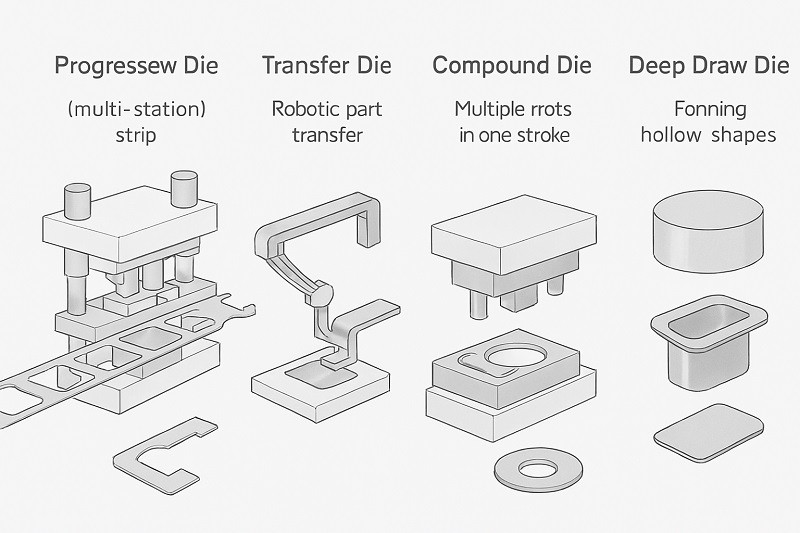
Progressive die stamping is a marvel of efficiency and is ideal for producing large quantities of complex parts. In this method, a coil of metal is fed through a single, large die that contains a series of stations. At each station, a different operation (like piercing, bending, or blanking) is performed sequentially. The metal strip remains intact as it "progresses" through the die, with the fully formed part being cut from the strip at the very last station. Since multiple operations occur with each stroke of the press, this method is extraordinarily fast and cost-effective for high-volume runs.
Transfer Die Stamping: Similar, but with Part Separation
Transfer die stamping is similar to progressive stamping in that multiple operations are performed in sequence. The key difference is that the part is separated from the metal strip (blanked) early in the process. A mechanical transfer system, like robotic arms, then moves the individual part from one station to the next. This method is particularly useful for large or C-parts that are difficult to manage while still attached to a carrier strip.
Compound Dies: Multiple Operations in One Stroke
A compound die performs multiple cutting operations (like blanking and piercing) in a single press stroke at a single station. For example, a compound die can cut the outer profile of a washer and its inner hole simultaneously. This method is known for producing very flat parts with high dimensional accuracy, as all cuts are made at once. However, it is generally slower than progressive stamping.
Combination Dies: Versatility in Forming and Cutting
A combination die takes the concept of a compound die a step further by performing both a cutting and a non-cutting (forming or drawing) operation in a single press stroke. For example, it could blank a part and then immediately form a flange on it. This consolidates operations, reducing the need for multiple presses or setups.
Deep Draw Stamping: For Complex Hollow Shapes
Deep draw stamping is a specialized forming process used to create deep, seamless, hollow components where the part's depth is greater than its diameter. It involves drawing a sheet metal blank into a die cavity with a punch. The process requires careful control of the material flow to prevent wrinkling or tearing. This technique is essential for manufacturing items like beverage cans, sinks, and cylindrical enclosures.
Fine Blanking: Achieving Smooth, Precise Edges
Fine blanking is an advanced cutting process that produces parts with exceptionally smooth, sheer edges, often eliminating the need for secondary deburring or finishing. It uses a triple-action press and a special die design with tight clearances to create a clean-sheared surface over the entire material thickness. This method is chosen for precision components like gears and safety-critical parts where edge quality and flatness are paramount.
Short Run Stamping: Ideal for Prototypes and Small Batches
When production volumes are low, the high cost of conventional hard tooling (like a progressive die) is not justifiable. Short run stamping utilizes simpler, more modular tooling and adaptable setups to produce smaller quantities of parts economically. This approach is perfect for creating prototypes, fulfilling small orders, and testing designs before committing to expensive high-volume tooling. While slower per part, it offers flexibility and significantly lower upfront tooling investment.
Understanding the Presses: The Engines of a Sheet Metal Fabrication Manufacturer
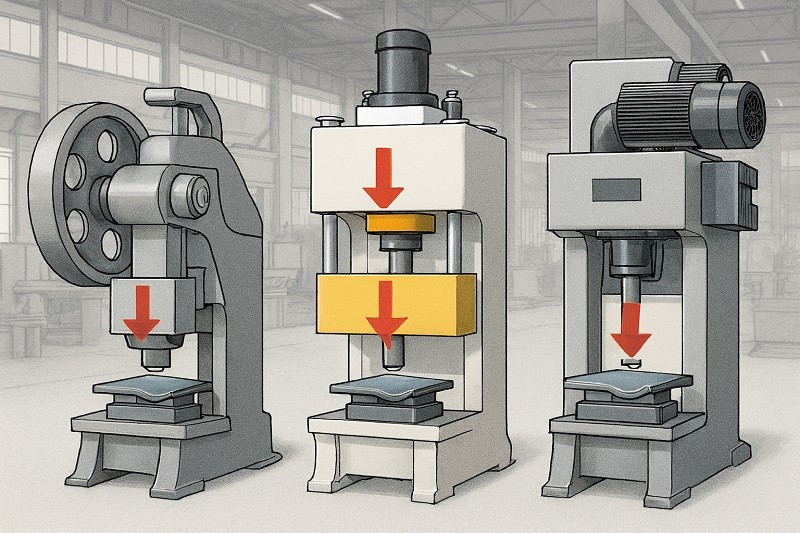
The stamping press is the machine that provides the force needed to shape sheet metal. As manufacturers, our choice of press depends heavily on the specific requirements of the job, including the part's complexity, the material being used, and the desired production speed. There are three main types of presses we utilize in our operations.
Mechanical Presses: Speed and Power
Mechanical presses are the workhorses of the stamping industry, especially for high-volume production. These presses use a motor to turn a large flywheel, which stores kinetic energy. When the press is activated, a clutch engages the flywheel, which drives a crankshaft or eccentric gear system to move the ram up and down.
- Advantages: Mechanical presses are known for their high speed and consistency. They can operate at very high stroke rates (40-80 strokes per minute or more), making them extremely efficient for progressive and transfer die applications.
- Best For: High-volume runs of relatively simple parts where speed is the primary driver of cost-effectiveness.
Hydraulic Presses: Versatility for Complex Shapes
Hydraulic presses use one or more hydraulic cylinders to move the ram. The force is generated by fluid pressure based on Pascal's principle. This design allows for complete control over the ram's speed and pressure throughout the entire stroke.
- Advantages: The primary benefit of a hydraulic press is its versatility. It can deliver full tonnage at any point in the stroke, not just at the bottom like a mechanical press. This makes it ideal for deep drawing, forming complex shapes, and working with less-formable high-strength materials that require a slower, more controlled application of force.
- Best For: Deep draw stamping, forming parts with complex geometries, and applications requiring precise control over pressure and speed.
Mechanical Servo Presses: Blending the Best of Both Worlds
Mechanical servo presses are a more recent innovation that combines the speed of a mechanical press with the control of a hydraulic press. Instead of a conventional motor and flywheel, these presses use high-capacity servo motors to directly drive the ram.
- Advantages: The servo motor allows the ram's motion profile—its speed and position throughout the stroke—to be fully programmable. This means we can speed up the non-working portion of the stroke and slow it down during the forming portion to optimize material flow. This programmability offers incredible precision, efficiency, and flexibility, making it possible to form complex parts at speeds closer to those of a traditional mechanical press.
- Best For: Stamping complex parts from advanced materials, improving die life, and applications where a high degree of precision and control is needed at high speeds.
Here is a comparison of the three main press types:
| Feature | Mechanical Press | Hydraulic Press | Mechanical Servo Press |
|---|---|---|---|
| Drive System | Flywheel and Clutch | Hydraulic Cylinders | Servo Motors |
| Speed | Very High | Moderate to Slow | High and Variable |
| Force Control | Full force only near bottom of stroke | Full force available throughout stroke | Full force available, highly programmable |
| Stroke Control | Fixed | Fully Adjustable | Fully Programmable motion profile |
| Primary Advantage | Speed and Efficiency | Versatility and Control | Precision and Flexibility at speed |
| Common Use Cases | High-volume progressive stamping | Deep drawing, complex forming | Stamping complex parts from advanced materials |
Advantages and Considerations from a Sheet Metal Fabrication Manufacturer
As with any manufacturing process, sheet metal stamping offers a distinct set of advantages that make it the preferred method for many applications. However, it also has certain limitations and considerations that we, as experienced manufacturers, must carefully manage to ensure a successful outcome for our clients.
Benefits of Sheet Metal Stamping: Why We Choose This Method
We rely on sheet metal stamping because, for the right applications, its benefits are unparalleled. The process is a cornerstone of modern manufacturing for several key reasons.
High Precision and Repeatability
One of the greatest strengths of stamping is its ability to produce thousands or even millions of identical parts with extremely tight tolerances. The hard tooling of the die ensures that every part produced is a near-perfect replica of the one before it. This consistency is critical for industries like automotive and electronics, where components must fit together seamlessly in automated assembly lines. Tolerances can often be held to within ±0.1 mm to ±0.5 mm, with even tighter precision possible for critical features.
Cost-Effectiveness and Efficiency
For medium to high-volume production, sheet metal stamping is exceptionally cost-effective. While the initial investment in tooling can be significant, the high speed of stamping presses means the cost per part becomes very low as production volume increases. Automated feeding systems and progressive dies can churn out finished parts in a matter of seconds, leading to remarkable production efficiency and a lower overall piece price compared to processes like CNC machining.
Versatility and Material Options
The stamping process is highly versatile, capable of producing a vast range of part sizes and complexities, from tiny electrical connectors to large automotive body panels. Furthermore, it is compatible with a wide array of materials, including various grades of steel, stainless steel, aluminum, copper, brass, and even exotic alloys. This allows us to select a material that perfectly matches the mechanical, thermal, and corrosion-resistance requirements of the final application.
Fast Production and Short Lead Times
Once the tooling is complete and approved, the production of stamped parts is incredibly fast. Mechanical presses can operate at hundreds of strokes per minute, enabling very short lead times for large production quantities. This speed allows us to respond quickly to client demands and support just-in-time manufacturing schedules, a crucial advantage in today's fast-paced markets.
Potential Drawbacks and How We Address Them as a Sheet Metal Fabrication Manufacturer
While the advantages are significant, it is equally important to understand the potential drawbacks. Our role as a manufacturer is to proactively address these challenges through smart design, planning, and process control.
Initial Tooling Costs
The primary drawback of stamping is the high upfront cost of designing and building the custom die. Dies are complex, precision tools that require significant investment in engineering, high-grade materials, and skilled labor.
- Our Approach: We mitigate this by working closely with clients on Design for Manufacturability (DFM) to simplify part geometry where possible. For lower volumes or prototypes, we recommend short-run stamping, which uses more affordable, modular tooling. We also emphasize that for high-volume runs, the initial tooling cost is quickly amortized, leading to a very low piece price.
Material Thickness Limitations
Sheet metal stamping is best suited for parts made from relatively thin materials, typically ranging from a few thousandths of an inch up to about a quarter-inch thick. Attempting to stamp materials that are too thick can require immense press tonnage and place excessive strain on the die, leading to premature tool failure.
- Our Approach: We carefully analyze the material specification during the design phase. If a thick section is required, we may suggest alternative processes like machining or forging for that specific feature, or explore designs that use ribs or flanges to add strength to a thinner material.
Material Waste
Cutting operations like blanking and piercing inherently generate scrap material. The material that is punched out or trimmed away contributes to the overall part cost. In some cases, especially with complex part shapes, the amount of scrap can be substantial.
- Our Approach: Our engineers use advanced nesting software during the die design phase. This software arranges the part layout on the sheet metal strip in the most efficient way possible to maximize material utilization and minimize scrap. For certain features, we may also use forming operations like lancing instead of piercing to create an opening without generating a slug of scrap.
Design Constraints for Complex Parts
While versatile, the stamping process does have some geometric limitations. Features like undercuts, where a feature is recessed beneath another, can be very difficult or impossible to create with a standard vertical press motion. Extremely deep and narrow features can also be challenging.
- Our Approach: We engage in early-stage design collaboration with our clients. Our engineering team can often suggest minor design modifications that achieve the same functional goal while making the part much more suitable for stamping. When truly complex geometries are unavoidable, we may utilize secondary operations or more advanced tooling, such as dies with side-acting cams, to form these features.
As a dedicated sheet metal fabrication manufacturer, we rely on the precision and efficiency of sheet metal stamping to deliver high-quality components across diverse industries. Understanding this process, from initial design concepts and material selection through to the final finishing and quality inspection, is absolutely key to achieving successful manufacturing outcomes. The ability to transform a flat piece of metal into a complex 3D part with high repeatability is a powerful capability that drives modern production.
The ongoing advancements in stamping technology—from sophisticated servo presses that offer unparalleled control to advanced die simulation software that predicts material behavior—allow us to meet ever-evolving demands. As a forward-thinking sheet metal fabrication manufacturer, we leverage these innovations to tackle more complex designs, achieve tighter tolerances, and improve cost-effectiveness for our clients. These developments continue to reinforce sheet metal stamping's role as a cornerstone of modern manufacturing.
We hope this manufacturer's perspective on the sheet metal stamping process has provided you with valuable insights into how these essential parts are brought to life. It is a testament to the technical expertise, meticulous planning, and robust engineering that underpins every single project we undertake.