Precision on Demand: How Custom Metal Stamping Leverages Rapid Prototyping for Unmatched Speed and Flexibility
- Share
- Issue Time
- Dec 28,2025
Summary
This blog post explains how custom metal stamping integrates rapid prototyping techniques—such as CNC machining and soft tooling—to overcome traditional delays in die creation. It enables faster design validation, iterative improvements, reduced costs, enhanced flexibility for complex geometries and small batches, and quicker speed-to-market, benefiting industries like automotive, aerospace, electronics, and medical devices
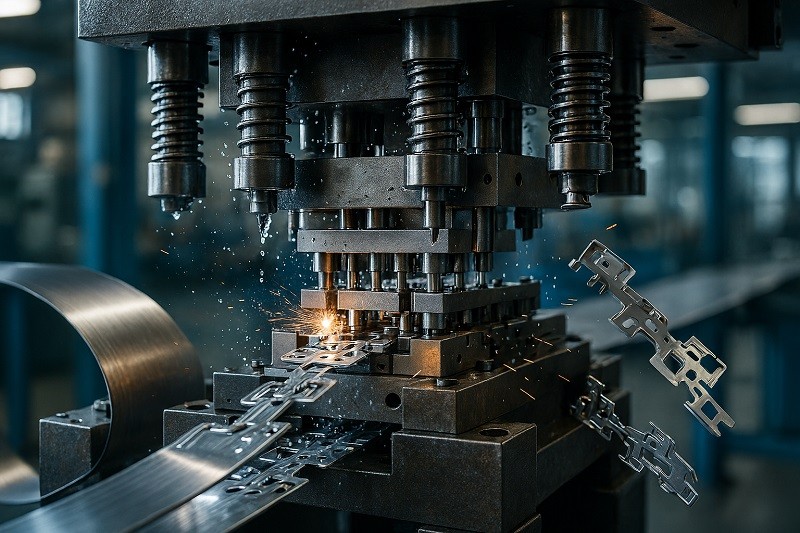
From Concept to Component: The New Era of Custom Metal Stamping
In a market that rewards speed and precision, manufacturers are constantly seeking ways to accelerate development without compromising quality. The pressure to innovate and deliver customized solutions is relentless, especially in industries like aerospace, automotive, and electronics. This is where the synergy between custom metal stamping and rapid prototyping principles creates a transformative advantage. By moving beyond traditional, time-consuming tooling processes, modern metal stamping services now offer unprecedented speed, cost-effectiveness, and design flexibility, turning complex ideas into tangible, high-quality components faster than ever before.
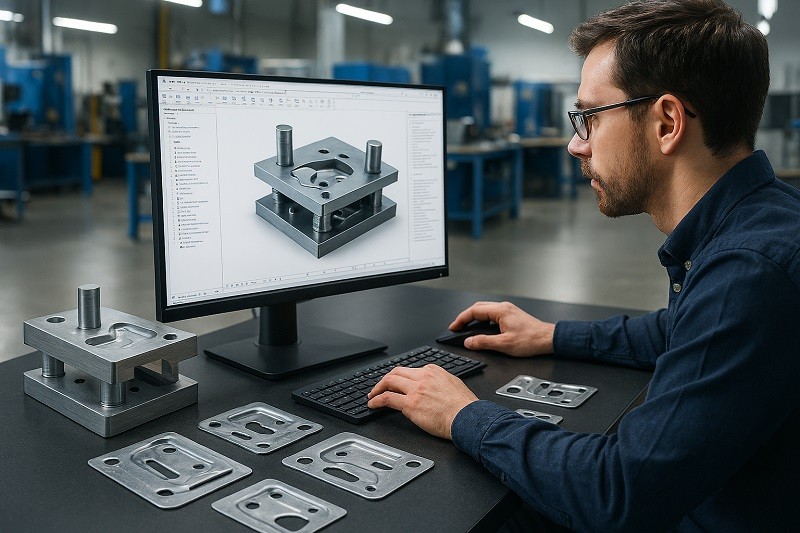
What is Custom Metal Stamping?
Custom metal stamping is a manufacturing process used to convert flat metal sheets into specific shapes. It's a cold-forming process that uses a die and a stamping press to shape the material. This process can include a variety of metal forming operations, such as punching, blanking, bending, coining, and flanging. The primary advantage of metal stamping is its ability to produce large quantities of identical parts with high precision and repeatability. When a project requires unique specifications, dimensions, or materials, it becomes custom metal stamping.
The Traditional Challenge: Slow and Costly Tooling
Historically, one of the biggest bottlenecks in custom metal stamping has been the creation of the tool and die set. This process was often a significant investment in both time and money. A complex die could take weeks or even months to design, machine, and test. If the initial part prototype revealed a design flaw, the entire tooling process would need expensive and time-consuming modifications. This lack of agility made it difficult to iterate on designs or produce small, customized batches economically.
Integrating Rapid Prototyping for Agility and Speed
The principles of rapid prototyping—initially popularized by technologies like 3D printing—are now revolutionizing metal stamping. Instead of committing to hard tooling immediately, manufacturers can now use rapid, cost-effective methods to validate a design. This can involve creating prototype tools or initial part samples using CNC machining or even 3D printing of prototype dies for certain applications (soft tooling). This approach allows engineers and clients to test the form, fit, and function of a part before investing in mass-production tooling, drastically reducing risk and development time.
Key Benefits of Modern Custom Metal Stamping
By embracing a rapid prototyping mindset, custom metal stamping services deliver significant advantages:
- Accelerated Speed-to-Market: Quickly create and test prototypes to validate designs in days, not weeks.
- Reduced Development Costs: Identify and correct design flaws early, avoiding expensive modifications to hard tooling.
- Enhanced Design Flexibility: Experiment with complex geometries and make iterative improvements without significant financial penalty.
- Improved Part Quality: Thoroughly test and refine components to ensure they meet exact performance and quality standards before full-scale production.
- Facilitated Customization: Produce small, custom batches economically, making personalization and niche applications viable.
Our Custom Metal Stamping Process: From Concept to Production
Our process is built on a foundation of collaboration and expertise, ensuring your project's success from start to finish.
- Consultation and Design Review: We start by understanding your requirements, analyzing your CAD model, and providing Design for Manufacturability (DFM) feedback to optimize for efficiency and cost.
- Rapid Prototyping & Validation: We utilize rapid prototyping techniques to produce initial samples for functional testing and design verification.
- Tooling Design and Fabrication: Once the design is validated, our experts design and build high-quality, durable tool and die sets for precision production.
- Full-Scale Production & Quality Assurance: We launch mass production, implementing rigorous quality control checks throughout the process to ensure every part meets your exact specifications.
- Finishing and Assembly: We offer a range of secondary services, including deburring, tapping, finishing, and assembly, to deliver a complete component solution.
Materials We Work With
Our expertise covers a wide range of metals, allowing us to select the perfect material for your application's requirements, whether for strength, conductivity, corrosion resistance, or weight. We commonly work with:
- Stainless Steel (various grades)
- Carbon Steel
- Aluminum
- Copper
- Brass
- Phosphor Bronze
- Specialty Alloys
Industries We Serve with Precision
Custom metal stamping is critical in numerous industries where precision and reliability are non-negotiable. Our experience spans across key sectors, including:
- Automotive: Brackets, clips, sensors, and structural components.
- Aerospace: High-strength fasteners, connectors, and interior components.
- Electronics: Connectors, terminals, shields, and heat sinks.
- Medical Devices: Surgical instruments, implantable components, and diagnostic equipment housing.
- Consumer Goods: Components for appliances, hardware, and recreational equipment.
Comparing Prototyping Approaches for Metal Stamping
To better understand the shift, here's a comparison between traditional and modern prototyping methods in metal stamping:
| Feature | Traditional Prototyping | Modern Rapid Prototyping |
|---|---|---|
| Tooling | Requires creation of expensive, hard production tooling | Utilizes soft tooling, CNC machining, or 3D printing |
| Lead Time | Weeks to Months | Days to Weeks |
| Cost for Iteration | Very High | Low |
| Design Flexibility | Low; changes are difficult and costly | High; easy to refine and test multiple variations |
| Ideal Use Case | Final design validation before mass production | Early-stage design validation and functional testing |
Why Choose Our Custom Metal Stamping Services?
Choosing the right manufacturing partner is critical. We stand out by offering a unique blend of experience, technology, and a commitment to quality. Our team of engineers provides expert guidance from the outset, ensuring your design is optimized for performance and cost. By integrating rapid prototyping into our workflow, we mitigate risks, accelerate your timeline, and provide the flexibility needed to innovate. Our adherence to strict quality control standards guarantees that the final product is not just made, but made right.
The Future is Fast and Flexible
The future of manufacturing belongs to those who can adapt quickly. The integration of rapid prototyping principles with trusted manufacturing processes like custom metal stamping is leading this charge. As technology continues to evolve, we can expect even faster turnarounds, more complex part capabilities, and greater levels of customization. By choosing a forward-thinking partner for your metal stamping needs, you position your business to stay ahead of the curve and bring superior products to market faster.
Ready to transform your component manufacturing? Contact us today to discuss your project.