Precision CNC Machining for Medical Devices: Regulatory Requirements and Best Practices
- Share
- publisher
- SOMI Custom Parts
- Issue Time
- Jul 24,2026
Summary
Explore the critical regulatory requirements, process validation standards, and best practices for precision CNC machining of medical devices. Learn about FDA QMSR compliance, ISO 13485 certification, material selection, and IQ/OQ/PQ validation for medical-grade components.
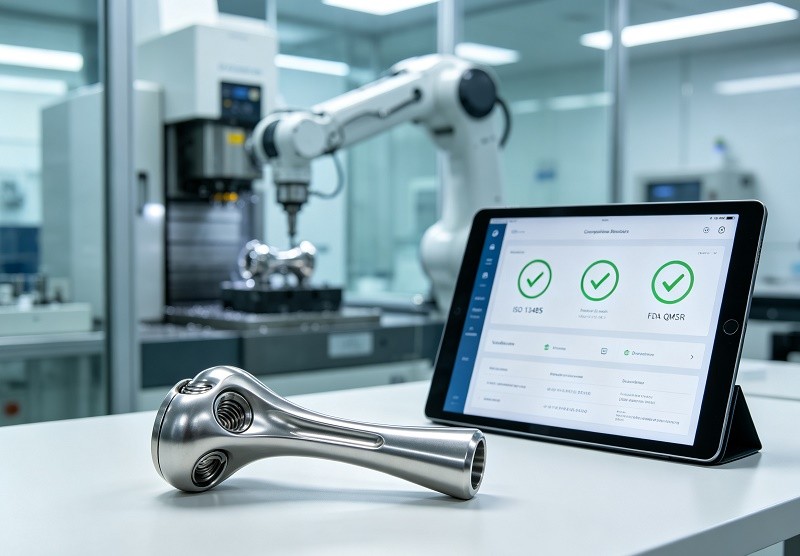
The global medical device market is projected to reach USD 800 billion by 2030, growing at a CAGR of approximately 5.4%. At the heart of this expanding industry lies precision CNC machining — the manufacturing backbone that produces everything from orthopedic implants and surgical instruments to diagnostic equipment components and drug delivery systems. Unlike general industrial parts, medical components operate inside or near the human body, where even a micron-level error can compromise patient safety. In 2026, the regulatory landscape has shifted significantly with the full enforcement of the FDA's Quality Management System Regulation (QMSR), which aligns 21 CFR Part 820 with ISO 13485:2016. This transformation demands that CNC machining suppliers demonstrate not only exceptional precision but also comprehensive regulatory compliance, full material traceability, and validated manufacturing processes. For medical device OEMs, selecting a CNC machining partner with expertise in both precision engineering and regulatory affairs is no longer optional — it is a requirement for market access. Precision CNC machining for medical devices is a subtractive manufacturing process that uses computer-controlled machine tools to produce components with extreme accuracy from biocompatible materials such as titanium alloys (Ti-6Al-4V ELI per ASTM F136), stainless steel 316L (ASTM F138), PEEK (ASTM F2026), and cobalt-chromium alloys (ASTM F75). What distinguishes medical CNC machining from standard precision machining is the triple requirement of micron-level tolerances, validated processes, and full regulatory compliance. Typical tolerances in medical CNC machining range from ±0.005 mm for implant mating surfaces to ±0.05 mm for general diagnostic housings. Critical-to-quality (CTQ) features on implants and surgical instruments must demonstrate a process capability index (Cpk) of 1.67 or higher — equivalent to fewer than 1 defective part per million. This level of precision is achieved through 5-axis CNC machining centers, Swiss-type lathes, and advanced measurement systems including CMM (Coordinate Measuring Machines) with calibrated measurement uncertainty below 1 micron. Medical CNC machining achieves tolerances as tight as ±0.0025 mm on critical features, ensuring perfect fit and function for implants and surgical tools. This precision directly impacts patient outcomes and device reliability. ISO 13485:2016-certified CNC suppliers maintain complete Device History Records (DHR), process validation documentation (IQ/OQ/PQ), and material traceability from raw material lot to finished part — essential for FDA 510(k) and CE Mark submissions. Certified suppliers work exclusively with medical-grade materials per ASTM and ISO standards, ensuring ISO 10993 biocompatibility, sterilization compatibility, and corrosion resistance for long-term implantable and patient-contact applications. With validated processes, SPC monitoring, and Cpk ≥ 1.67 on CTQ features, medical CNC machining delivers consistent quality across production volumes — from prototype batches of 10 to full production runs of 10,000+ units. On February 2, 2026, the FDA's Quality Management System Regulation (QMSR) took full effect, replacing the previous Quality System Regulation (21 CFR Part 820) by incorporating ISO 13485:2016 by reference. This is the single most significant regulatory change for CNC machining suppliers serving the US medical device market. Key implications include: For CNC shops already ISO 13485-certified, the transition to QMSR is minimal. However, suppliers qualified only under the old QSR must update their SOPs, validation protocols, and DHR templates to align with ISO 13485 terminology and structure. Material selection is one of the most critical decisions in medical device manufacturing. The chosen material must satisfy biocompatibility requirements (ISO 10993), withstand repeated sterilization cycles, and provide the mechanical properties required for the specific clinical application. Below is a comparison of the most commonly used medical-grade materials in CNC machining: Medical-grade materials carry significantly higher cost than their industrial counterparts — implant-grade titanium can cost 3–5 times more than standard titanium alloy. However, the cost is justified by the rigorous certification, lot traceability, and documented biocompatibility that these certified materials provide. Process validation is the cornerstone of regulatory compliance in medical CNC machining. Under both FDA QMSR and ISO 13485:2016 Clause 7.5.6, manufacturers must demonstrate that their production processes consistently produce parts meeting specifications. The three-stage qualification framework — Installation Qualification (IQ), Operational Qualification (OQ), and Performance Qualification (PQ) — is the industry standard. IQ: Verifies the CNC machine was installed correctly per manufacturer specifications — power supply, coolant system, software version, and safety interlocks. Run once at initial installation. OQ: Proves the machine operates within specified limits across its full range — positioning accuracy per ISO 230-2, spindle runout, repeatability (30 cycles minimum), and tool changer reliability (100 cycles). PQ: Demonstrates the machine can produce actual medical parts consistently — run 30+ consecutive parts, verify all critical dimensions, and achieve Cpk ≥ 1.33 on critical characteristics. A critical distinction in medical manufacturing is between product verification and process validation. Verification (ISO 13485 §8.2.6) applies when every critical dimension can be measured on every part — typical for most CNC-machined components. Validation (§7.5.6) is required when quality attributes cannot be fully verified by testing the finished product, such as subsurface material integrity or internal microstructure after machining. In medical CNC machining, documentation is not merely administrative — it is a regulatory requirement and the primary evidence of compliance. A single implantable device component can generate 15–20 pages of documentation, including material certificates, in-process inspection reports, CMM measurement data, surface finish readings, and sterilization records. Key documentation requirements include: Quality inspection in medical CNC machining goes beyond dimensional verification. CMM inspection, optical measurement, surface roughness testing (profilometer), X-ray or CT scanning for internal features, and hardness testing are all part of a comprehensive quality assurance program. Advanced facilities also implement in-process probing and SPC monitoring to detect dimensional drift before parts go out of tolerance. At SOMI Custom Parts, we combine over a decade of precision manufacturing experience with a deep understanding of medical device regulatory requirements. Our facility is equipped with advanced 5-axis CNC machining centers, Swiss-type lathes, and CMM inspection equipment capable of holding tolerances down to ±0.005 mm on critical medical components. We maintain a robust quality management system aligned with ISO 13485 principles, including process validation documentation, full material traceability, and Device History Record capability. Whether you need prototype surgical instruments, production-run orthopedic implants, or custom diagnostic equipment components, our engineering team works closely with your design and quality teams to ensure every part meets the required specifications and regulatory standards. We provide comprehensive documentation packages including material certifications, inspection reports, and process validation records to support your FDA 510(k) or CE Mark submissions. Explore our CNC machining capabilities and learn how we can support your medical device manufacturing needs. For detailed inquiries and project discussions, visit our contact page to speak with our engineering team. ISO 13485:2016 certification with scope explicitly covering CNC machining operations is the minimum baseline. Additionally, the supplier should maintain FDA registration (21 CFR Part 807) for US-market components, process validation documentation (IQ/OQ/PQ), and Device History Record capability. The certificate scope must explicitly include precision machining or CNC manufacturing — not just design or assembly. Medical CNC machining requires Cpk ≥ 1.67 on Critical-to-Quality (CTQ) features — those directly affecting device safety or functional performance. This is equivalent to approximately 1 defective part per million at process steady state. General non-critical features can be held to Cpk ≥ 1.33, but every drawing callout designated CTQ requires Cpk ≥ 1.67 demonstrated from production data. While both are rigorous quality standards, IATF 16949 (automotive) does not satisfy FDA QMSR requirements. ISO 13485 requires Device History Records, risk management per ISO 14971, biocompatibility documentation per ISO 10993, and FDA QMSR alignment — none of which IATF 16949 covers. A supplier with IATF 16949 but no ISO 13485 lacks the medical-specific quality infrastructure required for regulated medical device components. No. IATF 16949 does not satisfy FDA QMSR, ISO 14971 medical risk management, ISO 10993 biocompatibility, or Device History Record requirements. The required path for medical device components is: ISO 13485 certificate (with machining scope) + FDA QMSR alignment + biocompatible material documentation + IQ/OQ/PQ validation + DHR capability. IATF 16949 can complement this stack but cannot substitute for it. Medical CNC machining typically achieves tolerances of ±0.005–0.013 mm for implant mating surfaces, ±0.025–0.05 mm for bone screws and fixation hardware, and ±0.05–0.13 mm for surgical instruments. Surface finish requirements range from Ra 0.025–0.05 µm (mirror polish) for implant bearing surfaces to Ra 0.4–0.8 µm for surgical instrument functional surfaces. These tolerances are verified through CMM inspection, optical measurement, and profilometer testing. Precision CNC machining for medical devices represents one of the most demanding yet rewarding segments of precision manufacturing. With the FDA QMSR now in full effect and medical devices becoming increasingly complex and patient-specific, the importance of regulatory-compliant, validated CNC manufacturing processes has never been greater. From material selection and process validation to quality documentation and traceability, every aspect of medical CNC machining must be executed with the highest standards of precision and accountability. For medical device OEMs seeking a reliable CNC machining partner, the criteria are clear: ISO 13485 certification with machining scope, demonstrated process validation capability, comprehensive documentation systems, and a proven track record of producing critical medical components to the tightest tolerances. At SOMI Custom Parts, we are committed to meeting and exceeding these standards for every medical component we produce. Browse our product catalog to explore our capabilities, or submit an inquiry to discuss your medical device manufacturing project with our engineering team. For more insights, visit our blog for the latest articles on CNC machining technologies and best practices.Introduction: The Critical Role of Precision in Medical Device Manufacturing
What Is Precision CNC Machining for Medical Devices?

Key Benefits of Precision CNC Machining for Medical Applications
Micron-Level Accuracy
Full Regulatory Compliance
Biocompatible Material Expertise
Repeatable Quality at Scale
Regulatory Framework: FDA QMSR and ISO 13485 Requirements
Material Selection for Medical CNC Machining
Material
Standard
Typical Applications
Key Characteristics
Titanium Ti-6Al-4V ELI
ASTM F136
Orthopedic implants, spinal cages, dental abutments
High strength-to-weight ratio, excellent osseointegration, MRI-compatible
Stainless Steel 316L
ASTM F138
Surgical instruments, temporary implants, bone screws
Excellent corrosion resistance, cost-effective, good machinability
PEEK
ASTM F2026
Spinal implants, dental healing abutments, radiolucent components
Ray-transparent, lightweight, chemical-resistant, sterilizable
Cobalt-Chromium (CoCr)
ASTM F75/F1537
Hip femoral heads, knee components, dental frameworks
Superior wear resistance, high hardness (35-45 HRC), challenging to machine

Process Validation: IQ/OQ/PQ for Medical CNC Manufacturing
IQ/OQ/PQ at a Glance
Quality Control and Documentation Requirements
How SOMI Custom Parts Can Help
Frequently Asked Questions
What certification does a CNC machining supplier need for medical devices?
What Cpk value is required for medical CNC machining?
What is the difference between ISO 13485 and IATF 16949 for medical CNC?
Can IATF 16949 be used instead of ISO 13485 for medical CNC parts?
What tolerances can CNC machining achieve for medical devices?
Conclusion