Managing CNC Project Lead Times: Realistic Timelines, Queues, and Rush Orders
- Share
- publisher
- SOMI Custom Parts
- Issue Time
- Aug 30,2026
Summary
Managing CNC project lead times starts with realistic expectations: simple prototypes ship in 3-7 days, production runs take 2-6 weeks. Learn how shop queues, materials, finishing and shipping drive every CNC machining lead time - and when rush orders are worth the premium.
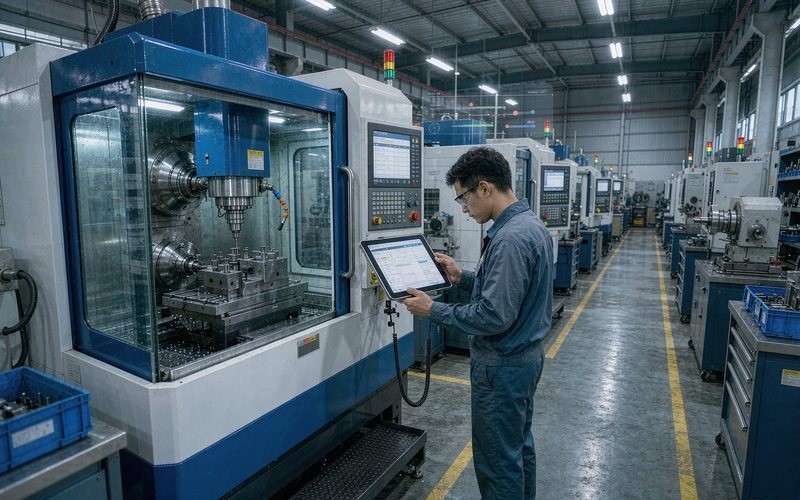
Few variables in custom CNC machining sourcing cause as much friction as lead time. A buyer plans for a 10-day turnaround, the supplier quotes 3 weeks, and suddenly a production milestone slips. The gap is rarely about machine speed — it is about how the lead time clock is defined, how shop queues behave, and how many hidden steps sit between order confirmation and delivery. This guide explains realistic CNC machining timelines in 2026, the pipeline behind every quote, why identical parts take 2–3 weeks longer in busy seasons, and exactly when a rush order premium is worth paying. CNC machining lead time is the total time from order confirmation to finished part delivery. It covers quoting and engineering review, CAM programming and setup, material sourcing, machining, secondary operations, inspection, packaging, and shipping. In practice, machining itself often accounts for only 30–50% of the total — sourcing, finishing, and logistics fill the rest. Ask what the clock starts from. Suppliers quote "5 business days" from different starting points: the moment a purchase order is placed, from drawing approval after a review cycle, from material receipt, or from payment. The same number can mean very different real-world dates. Also confirm whether the quote runs to shipment or to delivery — international transit can add 5 to 40 days on top. This is why comparing lead time numbers between suppliers is meaningless without the same baseline. A disciplined RFQ process that pins down the clock start, the shipping term, and the inspection scope upfront prevents most schedule surprises — see our CNC sourcing guides for the full supplier evaluation checklist. The most useful frame is by order type. Industry averages compiled across 2025–2026 published guides converge on the following ranges, measured from order confirmation and excluding international shipping: For low-volume production runs of 10–100 pieces, 7–14 days is a realistic 2026 benchmark for standard parts, while multi-axis or tight-tolerance parts typically run 10–20 days. Repeat orders are always faster: once fixtures and programs exist, a supplier can often cut lead time by a third or more. Surface treatment adds 2–5 days on top of machining for anodizing, plating, or heat treatment scheduling. To plan properly, break the total into stages. Each stage has its own cost in days, and only some of them can be compressed by a faster machine: The 30/50 insight: when a quote says 4 weeks, roughly half of that is often sourcing, finishing, and logistics. Asking "what is in stock and what is already programmed?" is the fastest way to understand where the time really goes. Lead time is not only a function of the part — it is a function of the shop's load. CNC capacity behaves like a queue: while utilization stays moderate, new jobs slot in quickly and lead times stay flat. Past roughly 80% utilization, effective lead times climb sharply because every new job waits for machines, fixtures, and inspection slots. This is why the same part can quote 2–3 weeks longer in Q4 and early Q1, when most shops run near capacity. For buyers, the practical takeaway is to place production orders early in the quarter and share rough forecasts with suppliers so they can reserve capacity and material. Multi-shift operations help too: 24/7 scheduling cuts pure machining cycle time by roughly 30–40% compared with single-shift shops, which is why export-focused factories with lights-out production can hold tighter schedules. Most CNC order delays are preventable. Across published shop data, the top causes are consistent: The pattern is clear: most delays happen before a chip is ever cut. Design for manufacturability (DFM) reviews catch geometry and tolerance issues while they are still free to fix. Our engineers routinely flag inaccessible features, unnecessary tight tolerances, and non-stocked materials during quoting — cutting both cost and schedule risk for the buyer. Prototypes and production runs flow through a shop in completely different ways. Prototypes spend most of their time on programming, setup, and manual inspection — typically 3–7 days for simple parts. Production runs carry fixed costs like fixtures and first-article inspection, then machine at full speed — typically 3–4 weeks for a 50–500 piece run. A practical pattern used by many engineering teams: order a small prototype batch first, validate fit and function, and run the full production order in parallel. You keep your project moving while the larger run is scheduled. Production lead times also benefit from repeat orders — a supplier that knows your parts, holds your programs, and has tooling on the shelf can often quote 2–4 weeks for volumes that would take 3–6 weeks as a one-time order. Rush machining is real and well defined at most shops. The premium buys overtime shifts, queue-jumping, and a dedicated machine — but it is priced accordingly: Rush premiums of 25–50% are the most commonly quoted range; the top tiers are reserved for truly urgent cases. Paying the premium makes sense when a late part costs more than the fee — a stopped production line, a trade show launch date, a competitive bid deadline, or a design-validation bottleneck where the whole team waits on physical samples. For normal development cycles, optimizing the design and material usually delivers the same schedule gain for free, and building 2–3 days of buffer into every deadline absorbs the occasional rework or shipping hiccup. SOMI Custom Parts runs an ISO 9001:2015 certified precision manufacturing facility built around predictable scheduling. We keep common grades of aluminum, stainless steel, brass, and engineering plastics in stock so the material stage rarely stalls; our engineers review every drawing before quoting and give you DFM feedback while changes are still free; and our in-house CNC turning, milling, and surface finishing departments keep secondary operations inside our own schedule instead of an outside vendor queue. From CNC milling parts and CNC turning parts to surface finishing, we size the schedule around your target date and tell you honestly what is achievable. See our blog for more sourcing guides, or contact our engineering team to discuss your timeline before you commit to an order. Simple prototypes typically take 3–7 business days; complex prototypes with tight tolerances or hard materials run 7–10 days. Standard production runs take 2–4 weeks, and large or complex orders 4–6 weeks — measured from order approval and excluding international shipping. Some shops offer same-day or next-day service for simple parts in stocked materials like 6061 aluminum. The "super rush" tier is typically 24–48 hours for small-batch prototypes, with post-processing limited or skipped and a significant premium applied. Priority service typically adds about 25%, rush service 50–75%, and emergency 24-hour service 100–200%. Rush premiums of 25–50% are the most commonly quoted range for jumping the queue or running additional shifts. The usual culprits are incomplete drawings causing clarification loops, non-stocked materials, secondary operations like anodizing or plating running through outside vendors, and shop capacity spikes in Q4 and early Q1. Freezing the design, choosing stocked materials, and ordering finishing separately are the most reliable fixes. Usually not. Confirm whether a quote runs to shipment or delivery. Express courier adds 2–5 days, air freight 3–7 days, and ocean freight 15–40+ days for international orders — worth clarifying before comparing quotes. Realistic CNC machining lead times in 2026 range from 3 days for a simple prototype to 6 weeks for a complex production order — and the difference is driven less by machine speed than by drawings, materials, finishing, queues, and logistics. Define the clock baseline with every supplier, feed the pipeline with complete documentation and stocked materials, plan around the queue effect in busy seasons, and treat rush premiums as a scarce resource for deadlines that genuinely justify them. If you have a target date in mind, send us your drawings and we will give you an honest, itemized lead time with the factors that could move it flagged upfront. For more guidance on sourcing, quoting, and design, explore our Buyer's Guides series or browse the full range of CNC machined products we deliver.Managing CNC Project Lead Times: Realistic Timelines, Queues, and Rush Orders
What Is a CNC Machining Lead Time?
Realistic Lead Time Benchmarks by Order Type
Order Type Quantity Standard Lead Time Rush Lead Time Simple prototype 1–5 pcs 3–7 business days 1–3 business days Complex prototype (tight tolerance / hard material) 1–5 pcs 7–10 business days 5 business days Small production 10–50 pcs 7–14 business days 1–2 weeks Medium production 50–500 pcs 3–4 weeks 2–3 weeks Large production 500+ pcs 4–6 weeks 3–4 weeks The Lead Time Pipeline: Where the Days Go
Quote & approval (1–3 days): the clock does not start until you approve. Every day you wait to approve is a day added to the schedule.The Queue Effect: Why Identical Parts Take Longer in Busy Seasons
What Causes Delays — and How to Prevent Them
Delay Cause Typical Impact Prevention Incomplete or unclear drawings Days lost to clarification loops — the #1 time killer Submit complete CAD with all dimensions, tolerances, and material callouts Material availability 1–2 weeks for exotic alloys Choose stocked materials like 6061/7075 or confirm stock before ordering Over-tight tolerances Slower cutting plus CMM inspection per part Only specify tight tolerances on functionally critical features Secondary operations Anodize +2–3d, plating +3–5d, heat treat +3–7d Order finishing separately to overlap timelines, or confirm vendor capacity at quote Design changes mid-order Toolpaths redone — the clock resets Freeze the design and use revision control before programming starts Shop capacity Longer queues in Q4 / early Q1 Place orders early; share forecasts for capacity planning Prototype vs. Production: Two Very Different Timelines
Rush Orders: Service Levels, Premiums, and When They Are Worth It
Service Level Timeline Price Premium Standard 5–10 business days None Priority 3–5 business days +25% Rush 1–3 business days +50–75% Emergency ~24 hours +100–200% How SOMI Custom Parts Can Help You Hit Your Deadlines
Frequently Asked Questions
How long does CNC machining actually take?
What is the fastest possible CNC turnaround?
How much does rush CNC machining cost?
Why does my part keep slipping past the quoted date?
Does the lead time include shipping?
Conclusion