Material Deep Dive
Machining Titanium Alloys: Ti-6Al-4V vs Ti-6Al-4V ELI and Best Practices
Grade 5 and Grade 23 are the workhorses of aerospace and medical titanium. Their chemistry differs by tenths of a percent — and the machining decisions that follow determine whether your parts fly, implant, or fail.
$5.8B
Global aerospace titanium machining market in 2026
50–60%
Share of aerospace titanium that is Ti-6Al-4V
30–60 m/min
Cutting speed window for titanium roughing
±0.01 mm
Achievable precision on 5-axis with CMM control
Introduction
Titanium sits at the top of the precision-machining difficulty curve. Its combination of extreme strength, light weight, corrosion resistance, and biocompatibility makes it irreplaceable in aerospace structures, medical implants, marine systems, and high-performance motorsport — yet its low thermal conductivity and chemical reactivity punish every wrong cutting decision. The global aerospace titanium machining market is projected to grow from USD 5.8 billion in 2026 to USD 11.03 billion by 2035 (7.4% CAGR) as commercial airframe backlogs and lightweighting mandates push titanium content per aircraft higher.
For engineers and buyers, the first fork in the road is grade selection: standard Ti-6Al-4V (Grade 5) or extra-low-interstitial Ti-6Al-4V ELI (Grade 23). The second is finding a CNC machining partner that actually understands titanium’s machining behavior. This guide covers both — the science of the two grades, the shop-floor practices that make titanium parts economical, and the standards that prove quality.
What Are Ti-6Al-4V and Ti-6Al-4V ELI?
Both grades share the same base chemistry — 6% aluminum, 4% vanadium, balance titanium — and belong to the alpha-beta alloy family. The difference is locked in the interstitial elements (oxygen, iron, nitrogen, carbon) that occupy gaps in the crystal lattice. The ELI designation stands for Extra-Low Interstitial.
Oxygen is the strongest interstitial strengthener in titanium. Cutting the oxygen limit from ≤0.20% to ≤0.13% trades roughly 8–10% of yield strength for a large gain in fracture toughness and fatigue-crack resistance — the exact property mix that load-bearing implants and fracture-critical airframe parts need.
| Property | Ti-6Al-4V (Grade 5) | Ti-6Al-4V ELI (Grade 23) |
|---|
| Primary specs | AMS 4928 / ASTM B348 / ASTM F1472 | ASTM F136 / ISO 5832-3 / ASTM F3001 (AM) |
| Oxygen max | ≤ 0.20% | ≤ 0.13% |
| Iron max | ≤ 0.40% | ≤ 0.25% |
| Yield strength (min) | ≥ 828 MPa | ≥ 795 MPa |
| Tensile strength (min) | ≥ 895 MPa | ≥ 860 MPa |
| Elongation | ≈ 14% | ≥ 15% |
| Fracture toughness Kₖₛ | 55–75 MPa·√m | 75–100+ MPa·√m |
| Density / modulus | 4.43 g/cm³ / 110–114 GPa (identical) |
Both grades are fully heat-treatable in thin sections (solution-treated and aged), weld similarly (though ELI’s lower nitrogen improves weldability), and — crucially for sourcing — machine with the same tooling and parameter strategy. Grade 23 carries a material premium of roughly 15–40% because of tighter chemistry control, mill certification, and lot traceability.
Key Benefits of Machining Titanium Alloys
Unmatched Strength-to-Weight
Grade 5 delivers steel-level strength at about 60% of steel’s weight. Airframers use titanium precisely because every kilogram removed from a wing or fuselage cuts fuel burn over a 20-year service life.
Corrosion Resistance
A tenacious native oxide film makes titanium immune to seawater, chlorides, and most industrial chemicals — the reason it dominates marine hardware, chemical processing, and coastal infrastructure.
Biocompatibility
Ti-6Al-4V ELI per ASTM F136 is the default metal for hip stems, spine rods, and bone plates, surviving 1–3 million load cycles per year for 15–20+ years inside the human body.
Heat Resistance
Ti-6Al-4V retains useful strength up to ~315°C continuous service — essential for engine bays, landing gear zones, and thermal-management components where aluminum would soften.
Fatigue Endurance
With polished surfaces, Grade 5 reaches ~500 MPa fatigue limit at 10⁶ cycles in air; ELI adds margin precisely where notches and machining marks concentrate stress.
Design Freedom
Multi-axis CNC of titanium produces complex one-piece brackets and housings that would otherwise need heavy multi-part welded assemblies — fewer joints, fewer failure points, less weight.
Ti-6Al-4V vs Ti-6Al-4V ELI: What Actually Changes
The interstitial difference is invisible on the shop floor — both grades machine almost identically — but it is decisive in application performance. Lower oxygen hardens the alpha phase less, producing a softer, more ductile alpha that resists crack propagation. The payoff is a fracture toughness gain of up to 33% or more and a critical crack size roughly 1.7× larger (e.g. ~11.7 mm vs ~20.7 mm for Grade 5 vs ELI at a 350 MPa design stress). For implants with porous coatings that cut fatigue strength 30–50%, ELI is effectively mandatory.
Choose Grade 5 when…
- Part is strength-limited or operating near yield
- Fracture risk is low and failures are inspectable
- Application is general aerospace, industrial, or automotive
- Cost per kilogram matters more than toughness margin
Choose Grade 23 ELI when…
- Part is implanted in the body (ASTM F136 mandated)
- Part is fracture-critical: failure equals a safety incident
- Cyclic loading exceeds ~10⁶ cycles with tight margins
- Part is 3D-printed (PBF) where ELI powder preserves toughness
Never rely on portable XRF to tell the grades apart — XRF cannot measure light elements. ELI must be verified by inert-gas fusion testing for O/N and combustion analysis for C, with a certified mill test report (MTR) and full lot traceability. Grade 5 material mislabeled as ELI is a real, dangerous failure mode in medical sourcing.
The Four Big Challenges of Machining Titanium
Every titanium machining failure traces back to one of four physical realities. Understanding them explains every parameter recommendation that follows.
Heat Concentration
Thermal conductivity is only 6.7–16 W/m·K — about 1/10 of aluminum and 1/3 of steel. 80–85% of cutting heat stays at the tool edge instead of leaving in the chip, so unmanaged heat destroys tooling in minutes.
Chemical Reactivity
At cutting temperature, titanium diffusion-welds to tool materials. It attacks the cobalt binder in carbide and reacts with TiN coatings, PCD, and CBN — restricting you to AlTiN/TiAlN-coated carbide with sharp, positive geometries.
Work Hardening
A tool that rubs instead of cuts work-hardens the surface (bores reach HV 360–420 vs bulk 300–320). Every pass must cut under the previous work-hardened layer — light finishing cuts under 0.1 mm are actively dangerous.
Spring-Back and Deflection
With modulus ~114 GPa (about half of steel), thin walls flex under cutting force and spring back when unclamped. Parts measure correct on the machine and fail CMM inspection off it unless workholding and 5-axis tilt are planned.
Cutting Parameters and Tooling for Titanium
The golden rule: low speed, adequate chip load, high-pressure coolant, and climb milling only. Doubling surface speed can cut tool life by 80%; raising feed within reason extends it because a thicker chip carries heat out of the cut.
| Operation (Ti-6Al-4V) | Cutting speed | Feed | Depth of cut |
|---|
| Turning — roughing | 30–60 m/min | 0.10–0.25 mm/rev | 1–3 mm |
| Turning — finishing | 60–80 m/min | 0.05–0.10 mm/rev | 0.2–0.5 mm |
| Milling — roughing | 40–60 m/min | 0.04–0.08 mm/tooth | 1.5–3 mm axial, 10–20% radial |
| Milling — finishing | 60–120 m/min | 0.05–0.10 mm/tooth | 0.1–0.3 mm radial |
| Drilling | 40–80 m/min equivalent | peck cycles ≥3:1 depth | pre-drill 0.3–0.5 mm undersize |
Tooling That Works
- Micro-grain carbide (K20/K30, 0.2–0.5 µm grain) with AlTiN or TiAlN coating
- Sharp edges, positive rake 8–15°, polished flutes, variable helix to break chatter
- High-feed cutters for roughing: small DOC, high feed — less heat, longer life
- Dedicated fresh finishing tool for tolerance-critical passes
- Thread milling only (M4–M16) — never taps, which break in titanium
- Single-flute CBN boring bars for precision bores (Ra 0.4 µm)
Coolant That Saves Tools
- High-pressure through-spindle coolant at 60–100 bar (300–1000 psi) minimum
- Conventional flood coolant cannot penetrate the steam barrier at the cutting zone
- Water-based coolant carries heat away better than oil-based
- Upgrading from flood to through-tool delivery typically improves tool life 2–5×
- Never machine dry; never interrupt coolant flow
Best-Practice Operations and Workholding
Rough → Stabilize → Finish
After roughing, let the part thermally normalize 20–40 minutes. Residual heat expands the material; finishing a hot part yields parts that measure fine at temperature and drift out of tolerance when cool.
Thin-Wall Strategy
Walls under 2.5 mm flex during cutting. Use 5-axis tilt (10–20°) to shorten effective engagement, leave support ribs, brace walls with PEEK/aluminum inserts, and drop radial engagement to 5–8% on wall finishes.
Spring-Back Compensation
Build empirical compensation offsets into the CAM program for angled features, cut first-off parts and measure before batch release, and prefer orthogonal 5-axis approach angles to shrink the spring-back vector.
Machine Rigidity
Titanium needs low-rpm, high-torque spindles — at least 20 HP with a rigid polymer-concrete or cast-iron frame, vibration-damped workholding, custom soft jaws, and vacuum fixtures for thin sections.
Safety: titanium fines and chips are pyrophoric. Burning titanium cannot be extinguished with water or common extinguishers — dedicated Class D media, controlled chip accumulation, and disciplined grinding-swarf handling are mandatory in any titanium machining cell.
Tolerances, Surface Finish, and Post-Processing
| Specification | Typical capability (Ti-6Al-4V) |
|---|
| Standard machining tolerance | ±0.05–0.10 mm |
| Precision tolerance | ±0.02–0.05 mm (temperature-controlled) |
| High-precision (5-axis + CMM) | ±0.01–0.02 mm per part |
| Ultra-precision (specialized) | <±0.005 mm (jig grinding / hard turning) |
| H7 bore | ±0.008–0.012 mm with CBN boring |
| Surface finish, general | Ra 0.4–1.6 µm |
| Surface finish, medical/aerospace critical | Ra 0.2–0.4 µm (electropolishing if needed) |
Post-processing differs from aluminum: titanium cannot be anodized with the standard sulfuric process. Common specifications include chemical conversion coating per AMS 2486, passivation for wet-service corrosion resistance, shot peening per AMS 2430 to induce compressive residual stress on fatigue-critical surfaces, and electropolishing to remove the disturbed “white layer” left by aggressive cuts — a known fatigue-crack initiation site on implants. Contamination control matters: above ~500°C titanium absorbs oxygen, nitrogen, and carbon from the air, so grinding sparks or overheated cuts can locally destroy the ELI chemistry you paid for.
Standards and Quality Certifications
| Standard | Role in titanium machining |
|---|
| ISO 9001 | Baseline quality management system for any certified titanium CNC shop |
| AS9100 Rev D | Aerospace QMS covering design, manufacture, and inspection of flight components |
| AS9102B | First Article Inspection (FAI) — ballooned drawings, full-dimension records, material certs |
| AMS 4928 | Ti-6Al-4V material spec — chemistry and mechanical property requirements |
| ASTM F136 / ISO 5832-3 | Wrought Ti-6Al-4V ELI for surgical implants |
| ASTM F1472 | Wrought Ti-6Al-4V (standard) for implant applications |
| AMS 2486 / AMS 2430 | Chemical conversion coating / shot peening specifications |
| ISO 13485 / 21 CFR 820 | Medical device quality systems for implant machining |
A trustworthy titanium supplier provides mill test reports with verified interstitial analysis, lot-level material traceability, in-process inspection every 10–20 parts, CMM reports, and NDT (dye penetrant or eddy current) when required. If a quote cannot name its grade verification method, treat it as a red flag.
How SOMI Custom Parts Can Help
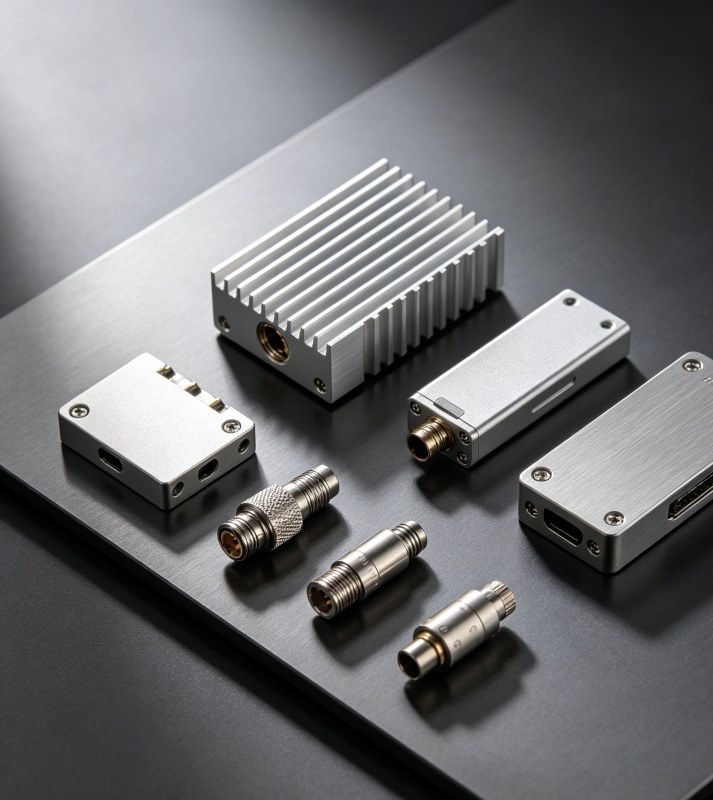
SOMI Custom Parts is a precision manufacturing partner experienced in machining difficult materials, including titanium alloys for aerospace, medical, automotive, and industrial applications. Our engineers apply the discipline this article describes — grade verification through certified material certificates, AlTiN-coated carbide tooling, high-pressure coolant strategies, thermal stabilization between roughing and finishing, and CMM-based dimensional control on critical features.
- 3-axis, 4-axis, and 5-axis CNC milling plus CNC turning for complex titanium geometries
- DFM review of your titanium design before quoting — wall thickness, corner radii, and thread strategy
- Certified material sourcing with traceability for both Grade 5 and Grade 23 ELI
- Surface finishing: chemical conversion, passivation, shot peening, bead blasting, and electropolishing
- Full inspection documentation — dimensional reports, FAI, and material certificates
Browse our full product range, learn more about our company, or read related articles on our blog. Send your CAD files and tolerance requirements through the inquiry page and our engineers will respond with a DFM assessment and a practical machining plan.
Frequently Asked Questions
Why is titanium so difficult to machine compared to steel or aluminum?
Titanium’s thermal conductivity is roughly 1/10 that of aluminum, so 80–85% of cutting heat concentrates at the tool edge, accelerating wear and diffusion bonding. It also work-hardens aggressively and deflects under cutting force because of its low modulus. The remedy is low cutting speeds (30–60 m/min for roughing), adequate chip load, high-pressure coolant, and sharp coated carbide tooling.
What is the difference between Ti-6Al-4V Grade 5 and Ti-6Al-4V ELI Grade 23?
Identical base chemistry, different interstitial limits. ELI caps oxygen at 0.13% (vs 0.20%), iron at 0.25%, and nitrogen at 0.03%. This sacrifices 8–10% of yield strength for up to 33% more fracture toughness and better fatigue-crack resistance. ELI is required for implants (ASTM F136) and preferred for fracture-critical, highly cyclic parts; Grade 5 wins where strength or cost dominates.
What cutting speed should I use for Ti-6Al-4V?
With carbide tooling: 30–60 m/min for roughing and 60–120 m/min for finishing. For milling, that corresponds to roughly 100–200 SFM. Cutting speed is the primary lever on tool life — doubling it can cut tool life by 80%. ELI runs at the lower end of the window.
Can titanium parts be anodized like aluminum?
Not with the standard aluminum sulfuric anodizing process. Titanium uses chemical conversion coating per AMS 2486, passivation, or specialized heat/electrochemical color finishes. Fatigue-critical surfaces are typically shot peened (AMS 2430) and, for implants, electropolished to remove the disturbed surface layer.
How much does CNC machining of titanium cost?
Aerospace-certified Ti-6Al-4V billet runs roughly USD 35–55 per kg — about 10× 6061 aluminum — and machining time is 2–3× slower than aluminum. Expect simple titanium brackets from ~USD 120–350, aerospace components USD 400–1500, and certified medical implants USD 500–3000 depending on complexity, tolerance, and finishing.
Conclusion
Ti-6Al-4V and Ti-6Al-4V ELI are not exotic materials — they are the engineered solution when strength, weight, corrosion, and biocompatibility must coexist. Machining them profitably requires respect for heat, chemistry, and deflection: low speeds, heavy flood or through-tool coolant, sharp AlTiN-coated carbide, climb milling, thermal stabilization, and rigorous inspection against AS9100/ISO standards.
Choose Grade 5 for strength- and cost-driven parts; choose Grade 23 ELI when fracture toughness and cyclic fatigue decide the outcome. Then choose a partner who can prove both — with certified material, documented processes, and CMM-verified results. Contact SOMI Custom Parts or send an inquiry with your CAD files, and we will help you specify, machine, and finish your titanium components right the first time.