Lights-Out Manufacturing: How Automation Is Enabling 24/7 CNC Production
- Share
- publisher
- SOMI Custom Parts
- Issue Time
- Jul 16,2026
Summary
Discover how lights-out manufacturing is transforming CNC machining in 2026. Learn about robotic tending, predictive maintenance, enabling technologies, and how custom parts manufacturers can implement unattended production to boost efficiency and reduce costs.
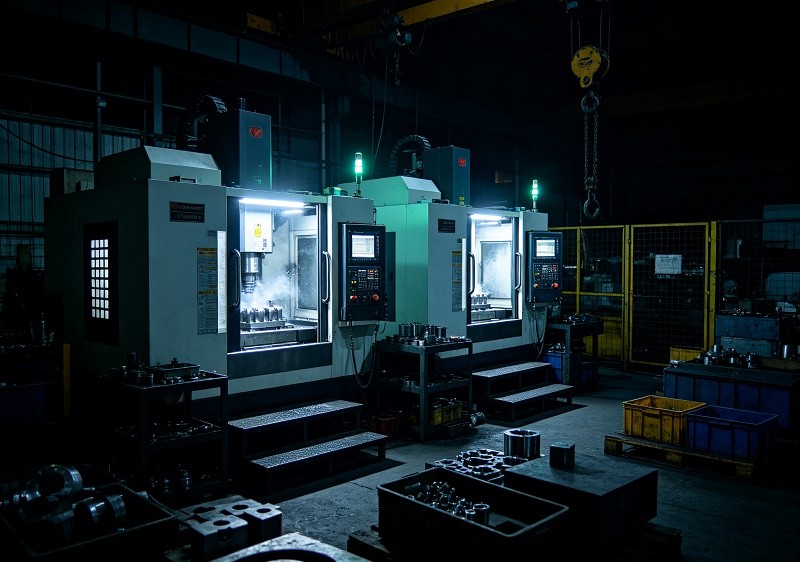
Introduction: The Dawn of the Dark Factory
In 2026, lights-out manufacturing has moved from a futuristic concept to a competitive necessity. The global CNC machine tool market has surpassed $110 billion, and shops that have implemented unattended production are reporting spindle utilization rates jumping from 50% to 85% or higher. As persistent skilled labor shortages and rising operational costs continue to pressure manufacturers, the ability to run CNC machines 24/7 with minimal human intervention is transforming the industry. At SOMI Custom Parts, we are embracing these technologies to deliver faster turnaround times and more consistent quality for our clients' custom non-standard parts.
What exactly is lights-out manufacturing? Also known as dark factory or unmanned manufacturing, it refers to production environments where CNC equipment operates with little to no human supervision. After programs are validated and material is loaded, machines continue running through nights, weekends, or extended unattended shifts. In 2026, this is no longer limited to large corporations — small and medium-sized job shops are increasingly adopting the technology.
What Is Lights-Out Manufacturing?
Lights-out manufacturing is a production approach where facilities operate with minimal or zero human presence. The term originated from the idea that factories could literally run with the lights turned off since no workers need to see. In CNC machining, this means robotic tending, automated pallet changers, in-process probing, tool monitoring systems, and remote supervision working together to enable continuous production.
Key characteristics of a lights-out CNC cell include: robot-tended loading and unloading, automated tool offset compensation, in-process dimensional verification, tool breakage detection with automatic replacement, chip management systems, and remote monitoring dashboards. Together, these technologies allow one technician to oversee multiple machines running simultaneously around the clock.
The Business Case for Lights-Out Machining in 2026
The economic rationale for lights-out manufacturing is compelling. Here are the key drivers:
Spindle Utilization: Traditional shops achieve 30-50% spindle utilization due to setup time, breaks, shift changes, and non-cutting activities. Lights-out operations push utilization to 80-90%, directly increasing throughput without adding floor space or headcount.
Labor Cost Optimization: With one operator capable of supervising 4-6 lights-out cells versus running one machine manually, labor productivity increases by 400-600%. This is critical given that the US manufacturing sector faces a projected 2.1 million job shortfall by 2030.
Consistent Overnight Production: Shops implementing unattended operations report 15-70% gains in overnight throughput. One solo machinist running a one-man shop transformed a single-machine operation into six machines across three facilities — all running unattended — with his longest continuous run reaching 192 hours.
ROI Improvements: Collaborative robot tending systems now achieve payback periods of under 12 months for many applications, down from 24-36 months just five years ago. Increased machine utilization accelerates depreciation and improves overall equipment effectiveness (OEE).
Enabling Technologies Behind Lights-Out CNC
Successful lights-out operations depend on several critical technology layers working in concert:
Robotic Tending with Vision Systems: Collaborative robots equipped with 3D vision now detect part orientation, inspect surface damage, and re-queue defective parts automatically. These systems have replaced simple pick-and-place arms and can handle complex part geometries without pre-programmed positioning.
In-Process Probing and Adaptive Control: Probing cycles feed dimension data directly into offset registers, allowing machines to auto-correct for tool wear and thermal drift. Errors as small as 0.002mm trigger adaptive shift corrections, ensuring parts remain within tolerance even during long unattended runs.
Tool Monitoring and Redundancy: Redundant tool magazines, auto-tool replacement logic, and real-time tool wear monitoring prevent production stops when tools break or wear out of spec. Spindle power monitoring detects anomalies and can automatically stop the process to prevent part scrapping or machine damage.
Edge AI and Machine Learning: Rather than cloud-dependent AI, 2026-era CNC machines run inference locally on edge devices. This means latency drops to milliseconds and reliability increases. Systems like FANUC FIELD, Okuma OSP-AI, and Siemens SINUMERIK One push AI directly into machine logic for real-time decision making.
Real-World Success Stories
FANUC has been quietly operating lights-out factories for decades at the foothills of Mount Fuji in Japan. Several FANUC production lines can run fully autonomously for weeks, including weekends and holidays. Robots build robots, CNC machines produce CNC components, and automated guided systems move parts across the factory floor without any human intervention.
In the small-shop space, Titans of CNC Academy has documented numerous examples of single-machine shops scaling to multi-machine lights-out operations. These success stories demonstrate that the technology is accessible to manufacturers of all sizes — not just industry giants.
China's "dark factories" represent another dramatic example. Facilities like Xiaomi's smartphone plants produce one device every 76 seconds, running 24/7 without interruption. China's robot density has doubled since 2022 to 470 robots per 10,000 workers, overtaking Germany and Japan to rank third globally. Gartner estimates that 60% of global manufacturers will adopt some form of lights-out manufacturing by 2026.
Key Considerations for Implementing Lights-Out Machining
Transitioning to lights-out operations requires careful planning across several dimensions:
Process Reliability: Unattended machining demands reliable processes. Chip control becomes critical — stringy chips can cause crashes in unattended environments, so engineered stainless grades with improved machinability are increasingly used for lights-out runs.
Material Consistency: Conventional materials can vary in machinability from batch to batch. For unattended production, material specifications must be tightly controlled to ensure predictable cutting behavior.
Remote Monitoring Infrastructure: Cameras, vibration sensors, power monitoring, and coolant level sensors feed data into centralized dashboards. Alerts must be configured for anomalies that require human intervention — and the system must be able to safely stop production when needed.
Work-Holding Strategy: Standardized pallet systems, zero-point clamping, and automated work-holding are essential. Parts must be loaded in a way that robots or automated systems can reliably position them.
How SOMI Custom Parts Leverages Automation for Custom Manufacturing
At SOMI Custom Parts, we understand that non-standard custom manufacturing presents unique challenges for automation. Every part is different, which requires flexible automation solutions rather than fixed production lines. Our CNC machining capabilities incorporate advanced probing, tool monitoring, and adaptive control technologies to ensure consistent quality even on complex custom geometries.
For clients requiring high-volume custom parts, we can leverage robotic tending and automated inspection to reduce lead times without sacrificing the flexibility that custom manufacturing demands. Contact our engineering team to discuss how automation can benefit your specific project requirements.
Frequently Asked Questions About Lights-Out Manufacturing
Q: Is lights-out manufacturing suitable for low-volume custom parts?
A: Yes. Modern flexible automation systems are designed for high-mix, low-volume production. Robots with vision systems can handle varying part geometries, and adaptive control systems adjust to changing conditions automatically. The key is investing in versatile work-holding and probing systems.
Q: What is the minimum investment for a lights-out CNC cell?
A: Entry-level robotic tending systems start at $30,000-50,000 for a collaborative robot with gripper and vision system. Combined with a CNC machine equipped with probing and tool monitoring, a basic lights-out cell can be implemented for $120,000-200,000 — with typical ROI under 12-18 months.
Q: How do you handle chip management in unattended operations?
A: Chip conveyors, high-pressure coolant systems (300+ PSI) for chip breaking, and programmed chip-breaking cycles are standard. Some materials require engineered grades specifically designed for chip control in lights-out environments.
Q: What happens when a tool breaks during unattended operation?
A: Modern systems use spindle power monitoring, acoustic sensors, and tool touch-off probes to detect breakage. When detected, redundant tools in the magazine are automatically selected using pre-set offsets. If no redundant tool is available, the machine safely stops and alerts the operator via remote monitoring.
Conclusion: The Future Is Unattended
Lights-out manufacturing is no longer a luxury for large corporations — it is becoming a standard practice for competitive CNC shops of all sizes. In 2026, every idle night shift represents lost revenue, and every unattended hour is a strategic asset. The technology has matured, costs have dropped, and the business case has never been stronger.
As skilled labor shortages persist and customer demand for faster delivery continues to grow, implementing lights-out capabilities will increasingly separate market leaders from the rest. For custom parts manufacturers, the key is selecting the right automation strategy that preserves flexibility while maximizing machine utilization.
Contact SOMI Custom Parts today to discuss how our advanced CNC machining capabilities — including lights-out ready processes — can help bring your custom non-standard parts to market faster and more cost-effectively.