How 3D Printing MJF Parts Suppliers Deliver Durable Custom Components
- Share
- Issue Time
- Apr 29,2026
Summary
This article explains how MJF 3D printing suppliers deliver durable custom components, covering HP MJF technology, material selection, precision, post-processing, scalability and sustainability.
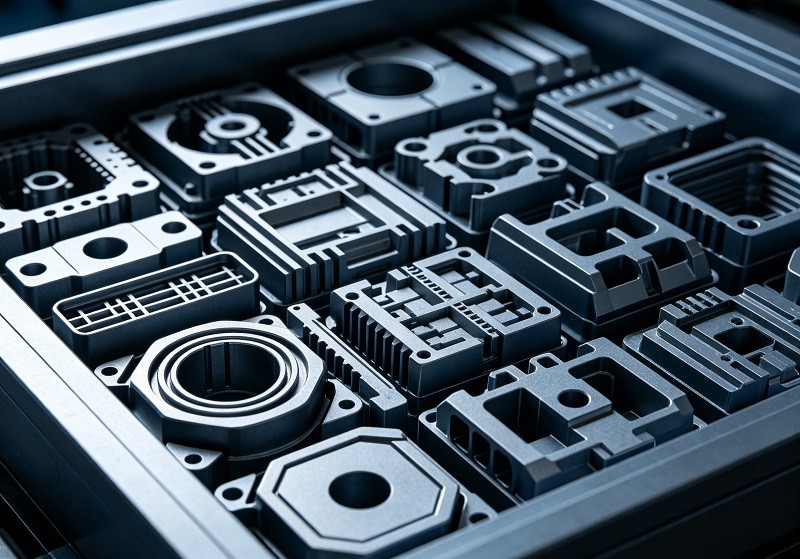
Having spent years in the manufacturing sector, I've witnessed firsthand how 3D printing has fundamentally reshaped the way we create, innovate, and solve complex engineering challenges. It has unlocked unprecedented levels of customization, turning what was once theoretical into tangible reality. Today, I want to delve into a specific technology that is at the forefront of this revolution: Multi Jet Fusion (MJF). We will explore how 3D Printing MJF Parts Suppliers are becoming indispensable partners in delivering durable, custom components that meet and exceed the diverse, demanding needs of modern industries.
The Foundation: How a 3D Printing MJF Parts Supplier Leverages HP's Multi Jet Fusion
The ability to produce strong, reliable parts is the bedrock of any serious manufacturing process. For MJF parts suppliers, this foundation is built upon a sophisticated and powerful technology developed by HP. Understanding this core process is key to appreciating why it has become a go-to solution for industrial-grade components.
What is MJF Technology?
Multi Jet Fusion (MJF) is a revolutionary additive manufacturing technology introduced by Hewlett-Packard (HP) in 2016. It falls under the umbrella of powder bed fusion processes but distinguishes itself with a unique, agent-based approach. Unlike other methods that use a laser to trace and fuse powder, MJF employs an inkjet array, similar to 2D paper printers, to selectively apply agents to a bed of polymer powder.
The process unfolds in a precise, layer-by-layer sequence:
- Powder Deposition: A carriage moves across the build area, distributing a thin, uniform layer of thermoplastic powder, such as Nylon PA12.
- Agent Jetting: An inkjet print head then passes over this powder bed. It selectively deposits two different liquid agents: a fusing agent and a detailing agent. The fusing agent is a heat-absorbent ink applied to the areas that will become the part, while the detailing agent is jetted around the contours to ensure sharp edges and fine details.
- Energy Application: An infrared heating unit sweeps across the entire bed. The areas treated with the fusing agent absorb this thermal energy, causing the powder particles to melt and fuse together into a solid layer. The detailing agent helps to create a thermal barrier, preventing the energy from bleeding into the surrounding powder and ensuring crisp feature definition.
- Repetition: The build platform then lowers slightly, a new layer of powder is applied, and the entire cycle repeats until the object is fully formed.
This entire process occurs within a self-supporting powder bed, which means that complex geometries and interlocking parts can be created without the need for additional support structures that must later be removed. Once the print job is complete, the entire build unit is moved to a processing station where the loose, unfused powder is excavated and can be recycled for future builds, revealing the finished parts within.
MJF's Edge for Durable Components
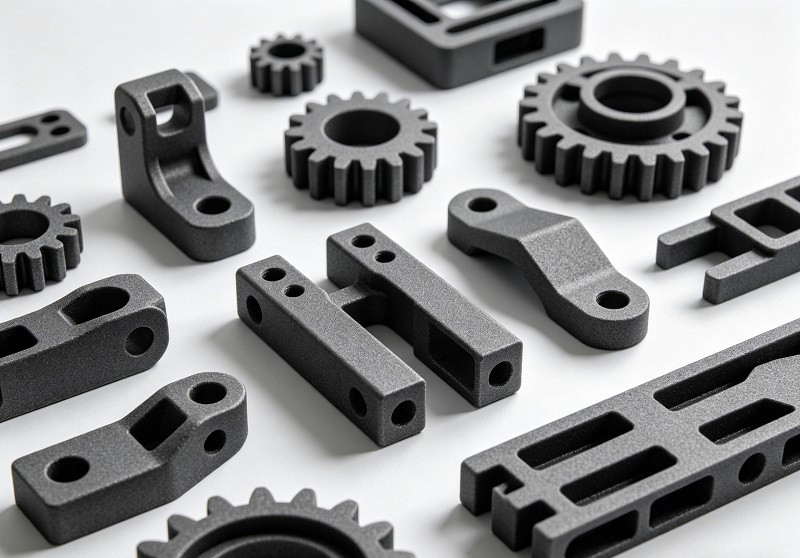
The true genius of MJF lies not just in its speed but in the quality of the components it produces. Parts created using this technology are renowned for their strength and durability, making them suitable for demanding end-use applications, not just prototypes. This durability stems from several key characteristics of the process.
A primary advantage is the production of parts with isotropic mechanical properties. In many 3D printing methods, the bonds between layers (the Z-axis) are weaker than the material's strength along the X and Y axes, creating a directional weakness. MJF, however, achieves near-perfect fusion between layers, resulting in components that exhibit consistent strength and mechanical properties in every direction. This uniformity is critical for functional parts that will be subjected to real-world stresses. For example, parts printed with MJF can achieve a tensile strength of up to 48 MPa (6,960 psi), making them competitive with components made via traditional methods like injection molding.
Compared to its closest technological rival, Selective Laser Sintering (SLS), MJF often yields parts with a higher density and lower porosity. The fusing agent penetrates the powder bed, and the subsequent thermal fusion creates a more homogenous solid. This results in parts that are not only strong but also watertight and airtight, a crucial feature for applications involving fluid or air management, such as manifolds and enclosures.
Furthermore, the layer-by-layer thermal control, enhanced by the detailing agent, ensures excellent feature resolution and surface finish right out of the printer. This precision minimizes the need for extensive post-processing and contributes to the overall robustness of fine features like snap-fits, threads, and pins, which are often weak points in parts made with other additive technologies. This combination of isotropic strength, high part density, and fine detail resolution gives MJF its distinct edge in producing truly durable components.
Precision and Strength: A 3D Printing MJF Parts Supplier's Approach to Durability
A supplier's expertise is truly demonstrated in how they translate the potential of MJF technology into consistently precise and strong components. This involves a masterful combination of material science and process control, ensuring every part not only meets but exceeds customer specifications for both fit and function.
Material Selection for Lasting Performance
The foundation of a durable part is the material it's made from. MJF technology supports a growing portfolio of engineering-grade thermoplastics, and a knowledgeable supplier is adept at guiding clients to the optimal choice for their specific application. While the list of materials is expanding, a few key polymers form the backbone of MJF production due to their exceptional balance of properties.
Nylon PA12 (Polyamide 12): This is the most common and versatile material used in MJF printing. PA12 is a robust thermoplastic known for creating parts with high density, balanced property profiles, and excellent chemical resistance to substances like oils, greases, and hydrocarbons. Its strength and cost-effectiveness make it a go-to choice for a wide array of applications, including complex assemblies, enclosures, and even biocompatible devices for intact skin contact.
Nylon PA11 (Polyamide 11): Derived from renewable castor oil, PA11 is a more eco-friendly choice. It is distinguished by its superior ductility and impact resistance compared to PA12. This makes PA11 the ideal candidate for applications that require high energy absorption and flexibility, such as prosthetics, athletic gear, living hinges, and snap-fit components that will undergo repeated stress.
TPU (Thermoplastic Polyurethane): For applications demanding flexibility and rubber-like elasticity, TPU is the material of choice. MJF-printed TPU delivers parts with high rebound, excellent tear strength, and abrasion resistance. This makes it perfect for producing seals, gaskets, grippers, protective equipment, and footwear components.
Glass-Filled Nylons (e.g., PA12 GB): By reinforcing PA12 with glass beads (typically a 40% fill), the resulting composite material exhibits significantly increased stiffness, dimensional stability, and thermal resistance. This material is excellent for applications that require structural rigidity and must perform under higher temperatures, such as automotive parts and industrial tooling.
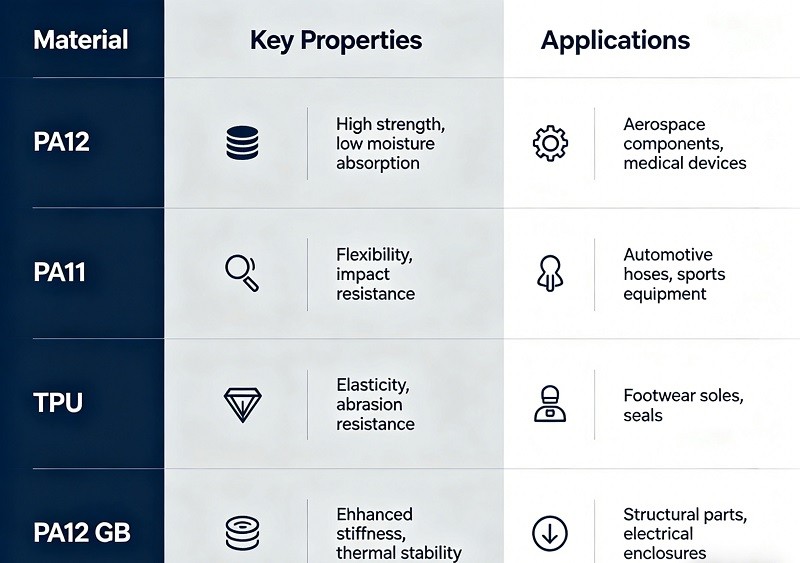
Below is a comparative overview of these common MJF materials:
| Material | Key Characteristics | Best Suited For |
|---|---|---|
| Nylon PA12 | Balanced strength, high density, good chemical resistance | General-purpose prototypes, complex assemblies, housings |
| Nylon PA11 | High ductility, superior impact resistance, flexible | Living hinges, snap-fits, sports equipment, prosthetics |
| TPU | High elasticity, abrasion resistance, rubber-like | Flexible seals, gaskets, protective gear, footwear |
| PA12 Glass-Filled | Increased stiffness, high thermal & dimensional stability | Automotive components, jigs, fixtures, parts under load |
An expert MJF parts supplier not only understands these material datasheets but has practical, experience-based knowledge of how these materials behave in real-world conditions, ensuring the final component performs reliably for its entire service life.
Ensuring Accuracy for Seamless Integration
Durability isn't just about raw strength; it's also about precision. A part that doesn't fit correctly can cause stress, wear, and premature failure in an assembly. MJF technology is renowned for its high dimensional accuracy and resolution, but achieving the tightest tolerances requires meticulous process control.
MJF printers can generally achieve a dimensional accuracy of around ±0.2 mm to ±0.3 mm or ±0.2% to ±0.3% of the part length (whichever is greater). While this is impressive for an additive process, factors like thermal shrinkage during cooling, part orientation in the build chamber, and part geometry can all influence the final dimensions. A top-tier supplier mitigates these variables through careful planning and execution. This includes orienting parts strategically to minimize potential warping and ensure critical dimensions are held to the tightest possible standard.
For features that demand even greater precision, such as bearing fits or press-fit holes, suppliers often recommend designing with post-processing in mind. For example, since holes in MJF can sometimes print slightly undersized due to thermal effects, a common strategy is to design them 0.2–0.3 mm smaller than the target and then ream or drill them to the exact final dimension.
Once the parts are printed and depowdered, a series of post-processing steps are employed to meet final specifications for finish and accuracy:
- Bead Blasting: This standard procedure involves blasting the part with fine media (like glass beads) to remove any residual powder and create a uniform, matte satin surface finish.
- Vapor Smoothing: For a sealed, non-porous, and cosmetically smooth surface similar to that from injection molding, chemical vapor smoothing can be used. This process exposes the part to a vapor that slightly melts the outer surface, eliminating layer lines and creating a glossy finish.
- Dyeing: The natural color of MJF parts is a uniform gray. They can be dyed black or other colors to enhance cosmetic appearance and provide a durable, wear-resistant finish, as the dye penetrates the surface of the part.
- Machining: For critical tolerances that are tighter than what "as-printed" MJF can hold, secondary machining operations like milling, turning, or drilling can be applied to achieve precision on specific features.
By combining the inherent accuracy of the MJF process with a robust suite of post-processing techniques, suppliers can deliver custom parts that integrate seamlessly into larger assemblies, ensuring both fit and long-term durability.
Customization at Scale: The Advantage of a 3D Printing MJF Parts Supplier
One of the most transformative advantages of Multi Jet Fusion is its ability to deliver on the promise of mass customization without the economic penalties of traditional manufacturing. Where conventional methods rely on expensive, fixed tooling like molds and dies, MJF is a tool-less process driven directly by digital files. This gives MJF Parts Suppliers a unique capability to streamline the production of custom parts and make a significant impact across a wide range of industries.
Streamlining Custom Part Production
Traditional manufacturing is built for mass production of identical items. The high upfront cost of creating a mold for injection molding, for example, is amortized over hundreds of thousands or millions of identical parts. This model breaks down when faced with the need for high-mix, low-volume production or true mass customization, where every part can be unique.
MJF completely inverts this economic model. Since there is no tooling, the cost to produce one part is the same as the cost to produce the thousandth part, and the cost to produce a thousand unique parts is virtually the same as producing a thousand identical ones. This is where a skilled MJF supplier shines. They leverage several core efficiencies of the technology to streamline custom production:
3D Nesting Efficiency: MJF printers have a large build volume that can be packed in three dimensions. Using sophisticated software, suppliers can "nest" hundreds or even thousands of different, unrelated parts tightly together in a single build. This maximizes the use of the machine's capacity, dramatically lowering the cost per part. Since the cost is based on the volume of the build chamber used, not the number or complexity of the parts within it, dense packing is key to economic efficiency.
Speed of Production: The MJF process is significantly faster than many other additive manufacturing methods. The print heads deposit agents across the entire build area in one pass, fusing a whole layer at once rather than tracing every detail with a laser point. Once a build is complete, a new, pre-loaded build unit can be rolled into the printer, allowing for near-continuous production while the previous build cools. This rapid iteration cycle is ideal for on-demand manufacturing and quick turnaround of custom orders.
Complexity is Free: With MJF, the cost of a part is determined by the volume it occupies, not its geometric complexity. Intricate internal channels, complex lattice structures for lightweighting, and organic shapes that would be impossible or prohibitively expensive to machine or mold can be produced with no added cost. This frees engineers to design for optimal function, not for manufacturability within traditional constraints.
Digital Workflow: The entire process is digitally driven. A customer can upload a CAD file, receive an instant quote, and have the part enter production often within hours. This seamless digital thread from design to part minimizes administrative overhead and accelerates the entire product development lifecycle, from prototype to end-use component.
Impact Across Industries
The ability to produce durable, complex, and customized parts quickly and cost-effectively has allowed MJF suppliers to make a significant impact across numerous sectors.
Automotive: The automotive industry heavily leverages MJF for everything from rapid prototyping of new component designs to producing end-use parts. Automakers use MJF for creating jigs, fixtures, and lightweight-but-strong interior components like dashboard trims, air ducts, and brackets. Because MJF parts can withstand the vibrations and temperature fluctuations of a vehicle environment, they are increasingly being used for production parts in luxury and high-performance vehicles, as well as for custom elements in race cars.
Medical: In the healthcare sector, customization is not a luxury but a necessity. MJF technology is a game-changer for producing patient-specific devices. Applications include custom prosthetics and orthotics that are perfectly matched to a patient's anatomy for improved comfort and function. Surgeons use highly accurate, sterilizable surgical guides printed with MJF to improve precision during complex procedures like joint replacements. The technology also enables the creation of detailed anatomical models for surgical planning and education, and housings for innovative medical devices.
Consumer Goods: From customized electronics enclosures to unique decorative items, MJF allows for mass customization in the consumer goods market. Companies can offer personalized products tailored to individual user preferences without needing to maintain a vast inventory of different variations. This is also ideal for producing replacement parts for appliances and electronics on-demand, extending the life of products and improving customer satisfaction.
Industrial & Aerospace: In industrial settings, MJF is used to create durable jigs, fixtures, and replacement parts for machinery, reducing downtime. In aerospace, the ability to produce strong, lightweight components with complex internal geometries is crucial for improving fuel efficiency and performance. MJF is used for prototyping and producing non-critical components like ducting, enclosures, and brackets that meet the high standards of the industry.
By breaking down the economic barriers to customization, 3D printing MJF parts suppliers are empowering innovation and agility across every major industrial sector.
Innovation and Sustainability: How a 3D Printing MJF Parts Supplier Shapes the Future
Beyond just producing parts, leading MJF suppliers are vital partners in driving manufacturing forward. They are at the intersection of innovation and sustainability, actively contributing to more eco-friendly production methods while simultaneously pushing the boundaries of what is possible with 3D printing technology.
Advancing Eco-Friendly Manufacturing
In an era of increasing environmental awareness, manufacturing industries are under pressure to adopt more sustainable practices. Additive manufacturing, and MJF in particular, offers significant advantages over traditional methods in this regard.
One of the most powerful environmental benefits of MJF is the high reusability of its powder materials. After a build cycle, the unfused powder that supported the parts is not discarded. It can be collected, sieved, and mixed with a smaller ratio of fresh, or "virgin," powder for the next build. For many materials like HP 3D High Reusability PA 12, the reuse rate can be as high as 70-80%. This closed-loop system dramatically reduces material waste compared to subtractive processes like CNC machining, where a large portion of the initial material block becomes scrap.
Furthermore, 3D printing is inherently a more sustainable production model due to:
- On-Demand Production: MJF enables a "just-in-time" manufacturing strategy, where parts are produced only when needed. This eliminates the need for large physical inventories, which consume resources for storage and often lead to waste when designs become obsolete.
- Reduced Emissions: By enabling localized production closer to the point of need, MJF cuts down on the carbon footprint associated with long-distance transportation and complex global supply chains.
- Part Consolidation and Lightweighting: MJF allows engineers to redesign assemblies that previously consisted of many separate components into a single, complex part. This reduces material usage and eliminates energy-intensive assembly steps. Additionally, the ability to create intricate, internal lattice structures allows for significant weight reduction in parts without sacrificing strength. This is particularly impactful in the automotive and aerospace industries, where lighter components directly translate to improved fuel efficiency and lower emissions during the product's operational life. For instance, replacing a metal part with a lightweight, 3D-printed polymer equivalent can result in substantial reductions in weight and greenhouse gas emissions over the vehicle's lifespan.
Some MJF materials are also developed with sustainability in mind. For example, PA11 is a bioplastic derived from castor oil, a renewable resource. As suppliers and material scientists continue to innovate, the portfolio of eco-friendly materials is expected to grow.
Pushing the Boundaries of 3D Printing
MJF suppliers are not just users of the technology; they are active innovators. Their hands-on experience provides invaluable feedback to machine and material manufacturers, helping to drive the evolution of the entire ecosystem. The future of MJF is being shaped by advancements in several key areas.
Expansion of Materials: While nylons and TPUs are the current workhorses, research into new materials is constant. HP's open-platform approach encourages collaboration with chemical companies to develop new polymers with enhanced properties, such as greater flame retardancy, higher temperature resistance, and novel elastomeric qualities. Looking further ahead, the principles of agent-based jetting could be applied to new classes of materials, including composites and potentially even metals and ceramics, which would vastly expand the application space.
Hardware and Software Enhancements: Newer generations of MJF machines promise increased speed, higher resolution, and greater productivity. Innovations like the HP Jet Fusion 5600 Series have introduced print modes that can boost performance by over 20%. Software is also becoming more intelligent, with AI-driven tools that can automatically optimize part orientation and nesting for the best combination of quality, speed, and cost. There is also progress in "voxel-level control," a concept that would allow for the properties of a material—such as color, texture, or even elasticity—to be varied within a single printed part.
Automation and Scalability: As MJF moves deeper into serial production, automation becomes critical. Suppliers are integrating robotic systems for depowdering, sorting, and post-processing parts to create streamlined, 24/7 production workflows. This not only increases efficiency but also ensures higher consistency and quality control for large-scale manufacturing runs.
By embracing these innovations, 3D printing MJF parts suppliers are not merely service providers but key enablers of the next industrial revolution, making advanced, sustainable, and highly customized manufacturing accessible to all.
From creating intricate designs with unprecedented geometric freedom to producing strong, functional items ready for end-use, 3D Printing MJF Parts Suppliers are making customizable solutions more accessible, reliable, and efficient than ever before. They have become critical partners in the shift from traditional mass production to an agile, on-demand manufacturing paradigm.
The trajectory of this technology is incredibly promising. I believe the ongoing advancements in MJF technology and materials—ranging from new bio-based polymers to more sophisticated hardware and AI-driven software—coupled with a strengthening focus on sustainability, will continue to expand the horizon of possibilities for durable custom components. We are seeing these innovations reshape sectors from automotive and medical to consumer goods, and this is only the beginning. As these suppliers continue to refine their craft and push the boundaries of what is possible, they will unlock even more creative and engineering potential across all industries. I encourage you to see how this technology could transform your own projects and to share the incredible potential of MJF with others in the field.