Everything You Should Know About Low-Volume Custom Injected Parts and 3D Printed Molds
- Share
- Issue Time
- Dec 19,2025
Summary
Low-volume injection molding, particularly when integrated with 3D printing, is transforming the development of custom components from materials like ABS/PC, offering a unique combination of efficiency, cost-effectiveness, and design flexibility.
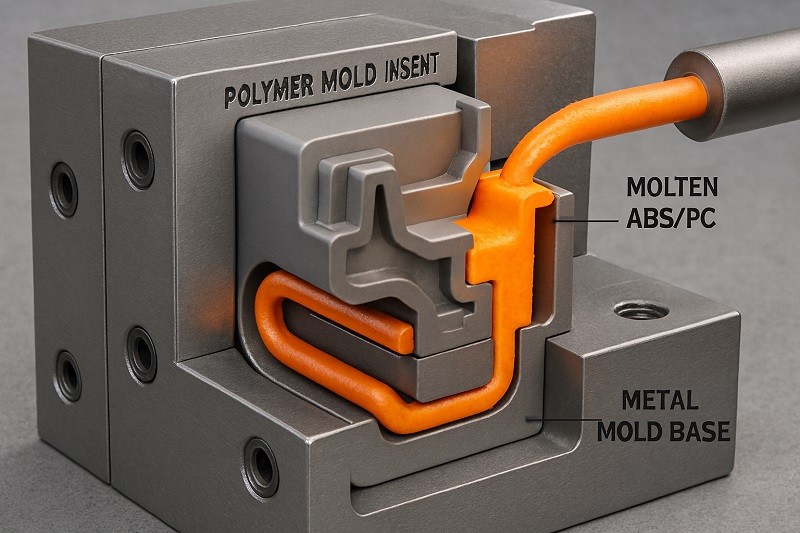
As manufacturing constantly evolves, low-volume injection molding, especially with the integration of 3D printing, has revolutionized how we develop custom components from materials like ABS/PC. This approach offers a unique blend of efficiency, cost-effectiveness, and design flexibility, particularly for the creation of small batches and prototypes. It empowers businesses to innovate faster, rigorously test designs, and bring specialized products to market without the traditional barriers of high-volume manufacturing.
Traditional injection molding, while excellent for mass production, often involves high upfront costs and long lead times for tooling. This can be a significant barrier for projects requiring fewer parts or frequent design iterations. However, by combining the strengths of 3D Printing and low-volume injection molding, we can overcome these challenges and accelerate product development. Leveraging 3D printed molds allows for the rapid creation of tooling, enabling a more agile and responsive manufacturing process that adapts to evolving market demands.
In this comprehensive guide, we'll explore the advantages of low-volume manufacturing for custom injected ABS/PC parts, delve into the game-changing role of 3D printed molds, and discuss key considerations for design and material selection. We'll also compare this innovative approach with traditional methods to help you make informed decisions for your projects, ensuring you can bring your ideas to life efficiently and cost-effectively.
The Strategic Edge of Low-Volume Injection Molding for Custom Part Injected ABSPC
Low-volume injection molding has carved out a crucial niche in manufacturing, offering a strategic pathway for producing high-quality plastic parts in quantities that don't justify the immense investment of traditional mass production. This method is particularly effective for custom components made from materials like ABS (Acrylonitrile Butadiene Styrene) and PC (Polycarbonate) blends, which are valued for their strength, impact resistance, and heat stability. By bridging the gap between prototyping and full-scale production, low-volume manufacturing provides an agile, cost-effective solution for a wide range of applications, from medical devices to consumer electronics and automotive components.
This approach is not just about making fewer parts; it's a fundamental shift in manufacturing strategy. It allows businesses to be more responsive to market feedback, test new product concepts with minimal financial risk, and manage inventory with greater precision. By utilizing more affordable and rapidly produced tooling, such as those made from aluminum or created via 3D printing, companies can bring innovative products to market faster and more efficiently than ever before.
Unlocking Benefits Beyond Traditional Manufacturing
Low-volume injection molding redefines the economics and logistics of producing custom parts, offering distinct advantages that are particularly beneficial in the early stages of a product's lifecycle. It provides a means to manufacture pilot series for market testing without the heavy capital investment typically required for traditional molding. This flexibility allows for the creation of end-use parts that are accurate, repeatable, and high-quality, sidestepping the high fixed costs of conventional methods.
Cost and Time Savings with Low-Volume Custom Part Injected ABSPC
The most significant advantage of low-volume injection molding lies in its remarkable cost and time efficiencies. Traditional high-volume production requires molds made from hardened steel, which are incredibly durable but also expensive and time-consuming to create, with tooling costs ranging from $2,000 to over $100,000 and lead times of four to eight weeks or more. In contrast, low-volume manufacturing often uses molds made from softer aluminum or via 3D printing. Aluminum tooling can be produced at a fraction of the cost and in significantly less time—often within a few weeks—making it an ideal choice for smaller production runs.
This reduction in upfront investment lowers the financial barrier to entry, which is especially beneficial for startups and small businesses. It also means a faster time-to-market, a critical factor in competitive industries. Instead of waiting months for a steel tool, companies can have production-quality parts in hand within days or weeks, allowing them to launch products, gather market feedback, and generate revenue sooner. Furthermore, producing parts "on-demand" helps manage inventory overhead, as parts are only created when dictated by actual demand.
Design Flexibility and Rapid Iteration
Design flexibility is another cornerstone of low-volume injection molding. Because the investment in tooling is substantially lower, making design changes between production runs is both financially and logistically feasible. If initial testing or market feedback reveals a flaw or an opportunity for improvement, the mold can be modified or a new one created without incurring the massive costs associated with altering a hardened steel tool. This agility is crucial for innovation, as it allows engineers and designers to experiment with different geometries, materials, and features.
The process encourages an iterative approach to product development. Teams can produce a small batch of parts, test them in real-world scenarios, and then quickly refine the design based on performance data and user feedback. This cycle of rapid iteration helps perfect the product before committing to mass production, ultimately reducing the risk of costly errors and ensuring the final product meets consumer expectations. This capability is invaluable in industries like medical devices or aerospace, where precision and customization are paramount.
Bridging Prototypes to Production for Custom Part Injected ABSPC
Low-volume injection molding serves as the essential "bridge" between initial prototyping and full-scale mass production. While methods like 3D printing are excellent for creating one-off functional prototypes, they become less economical for producing dozens or hundreds of parts. Conversely, committing to high-volume tooling before a design is fully validated is a significant financial risk. Low-volume production fills this gap perfectly, allowing for the creation of a limited run of parts using production-grade materials like ABS/PC.
These "bridge production" parts are not just high-fidelity prototypes; they are end-use components that can be used for regulatory testing, market launch, or fulfilling initial orders while the high-volume steel mold is being manufactured. This strategy de-risks the entire project by validating both the product design and the manufacturing process at a smaller, more manageable scale. It gives companies the confidence that the part is not only designed correctly but can also be manufactured consistently and efficiently before they invest heavily in mass production tooling.
Understanding Different Production Volumes for Custom Part Injected ABSPC
In manufacturing, the term "volume" refers to the quantity of parts produced, typically within a year, and it's a critical factor that influences the choice of production method, tooling, and overall cost. There isn't a universally strict definition for each volume category, as context is highly important; what's considered low volume for a simple plastic part might be high volume for a complex aerospace assembly. However, a general framework can help in strategic planning.
To better illustrate these distinctions, here is a breakdown of common production volume tiers and their characteristics:
| Production Tier | Typical Annual Volume | Key Characteristics | Best-Suited Manufacturing Processes |
|---|---|---|---|
| Prototyping | 1 – 100 units | Focus on design validation, form/fit testing, and rapid iteration. Cost per part is high, but tooling costs are very low or non-existent. | 3D Printing (SLA, FDM, MJF), CNC Machining, Urethane Casting. |
| Low-Volume Production | 100 – 10,000 units | Balances speed, cost, and quality. Ideal for market testing, bridge production, and custom products. Low tooling costs and short lead times are prioritized. | Low-Volume Injection Molding (Aluminum or 3D Printed Molds), CNC Machining, Thermoforming. |
| Mid-Volume Production | 10,000 – 50,000 units | A transitional phase where efficiency starts to become more critical. May use more robust tooling (e.g., P20 steel) to balance longevity and cost. | Multi-cavity aluminum molds, simpler steel molds, automated CNC machining. |
| High-Volume Production | 50,000+ units | Focus is on minimizing cost per part through economies of scale. Involves substantial investment in hardened steel tooling and highly automated processes. | High-Volume Injection Molding (hardened multi-cavity steel molds), Die Casting. |
Choosing the right production volume strategy is a crucial decision driven by factors like market demand, product complexity, and budget. Low-volume production offers the flexibility to test the market and refine designs without the heavy financial commitment of high-volume manufacturing, making it a strategic choice for innovative products and custom parts like injected ABS/PC components.
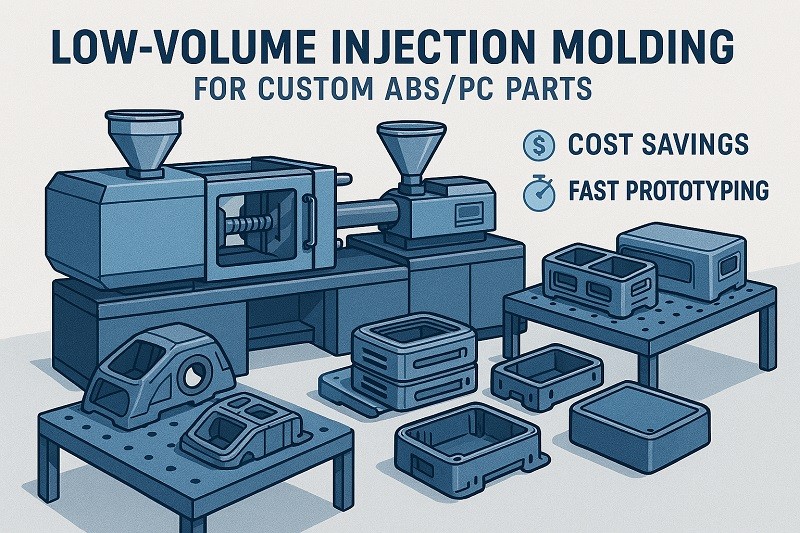
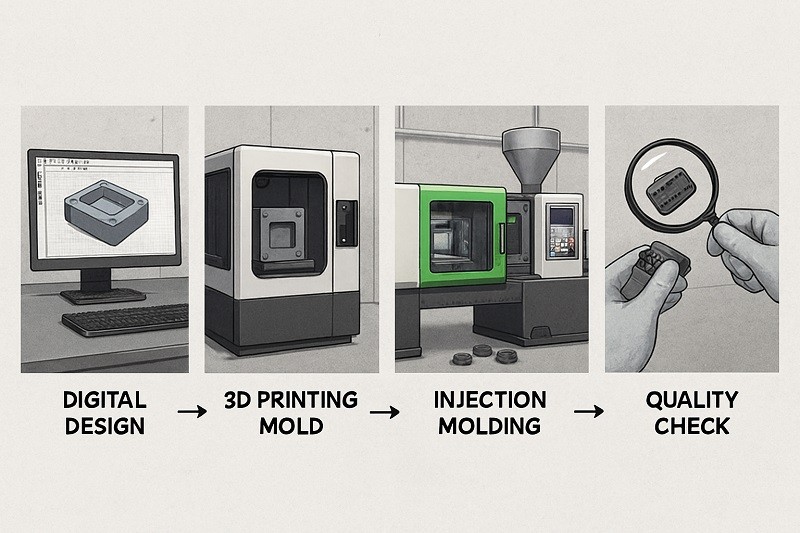
The advent of additive manufacturing, or 3D Printing, has introduced a paradigm shift in how we approach tooling for injection molding. For low-volume production of custom ABS/PC parts, 3D printed molds are not just an alternative; they are a transformative technology. By fabricating molds directly from a digital file, manufacturers can bypass the lengthy and costly process of CNC machining metal blocks. This hybrid manufacturing approach marries the versatility and speed of 3D printing with the robust production power of injection molding, creating a powerful workflow for accelerating product development and reducing costs.
This synergy is particularly impactful for producing anywhere from 10 to 1,000 parts, where traditional tooling is prohibitively expensive. With 3D printed molds, it's possible to go from a final design to holding a batch of production-quality parts in a matter of days, not weeks or months. This agility empowers engineers to test designs with end-use materials, get products to market faster, and adapt to customer feedback with unprecedented speed, all while keeping tooling investments to a minimum.
Why 3D Printed Molds are Revolutionizing Low-Volume Custom Part Injected ABSPC
The use of 3D printed molds offers a powerful solution for fabricating injection molds quickly and at a low cost, right on the factory floor. This technology saves valuable CNC machining time and frees up skilled operators for other high-value tasks. The ability to create complex mold shapes that would be challenging to manufacture traditionally opens up new avenues for innovation, allowing development teams to push the boundaries of part design.
Cost-Effectiveness and Speed in Mold Creation
The primary drivers behind the adoption of 3D printed molds are dramatic reductions in cost and lead time. A traditional CNC-machined aluminum mold for low-to-mid-volume production can cost between $2,000 and $5,000, while a simple 3D printed mold can be produced for as little as $100. This makes it financially viable to create molds for very short runs or even one-off custom parts.
The time savings are equally compelling. While fabricating a metal mold can take anywhere from four to eight weeks, a 3D printed mold can be designed, printed, and ready for injection in just a few days. One case study demonstrated that producing a batch of parts with a 3D printed mold took only three days from start to finish, compared to the projected weeks for a machined mold. This drastic acceleration of the production timeline is a significant competitive advantage, enabling companies to validate designs and launch products faster than ever before.
Enhanced Design Freedom and Complexity
Traditional manufacturing methods like CNC machining are inherently restrictive. They struggle to create highly complex internal geometries, deep cavities with sharp corners, or organic, freeform shapes. 3D printing, as an additive process, builds the mold layer by layer, freeing designers from these constraints. This opens the door to creating molds with incredibly intricate details, such as:
- Conformal Cooling Channels: These are cooling channels that follow the exact contour of the part's surface, rather than being drilled in straight lines. This allows for much more uniform and rapid cooling, which can reduce cycle times and minimize part defects like warping.
- Complex Geometries and Internal Structures: Features like undercuts, hollow interiors, and fine textures can be incorporated directly into the mold design with ease, which would be extremely difficult or impossible with traditional tooling.
- Rapid Design Iteration: The low cost and speed of 3D printing allow designers to experiment with multiple mold designs simultaneously. They can quickly test different gate locations, runner systems, and ejection mechanisms to optimize the molding process without committing to expensive tooling.
This level of design freedom empowers engineers to create better, more efficient molds and, consequently, higher-quality parts.
Choosing the Right Materials for 3D Printed Molds for Custom Part Injected ABSPC
The success of a 3D printed mold hinges on selecting the right material. The mold must withstand the intense heat and pressure of the injection molding process while maintaining its dimensional accuracy over dozens or even hundreds of cycles. Advances in polymer science have led to the development of high-performance resins specifically engineered for these demanding applications.
High-Performance Resins and Their Properties
For creating durable and heat-resistant molds, several specialized resins are available, primarily for Stereolithography (SLA) 3D printing technology, which is favored for its high precision and smooth surface finish. Key material properties to consider are:
- Heat Deflection Temperature (HDT): This measures the temperature at which a material will begin to deform under a specific load. For injection molding, a high HDT is critical.
- Flexural Strength and Modulus: These properties indicate the material's stiffness and ability to resist bending under pressure.
- Hardness: A hard surface ensures the mold can withstand repeated clamping and injection cycles without denting or degrading.
Some of the most effective materials for 3D printed molds include:
| Resin Material | Key Properties | Best For |
|---|---|---|
| Rigid 10K Resin | Extremely stiff (glass-filled), high heat resistance (HDT of 218°C), and dimensionally stable under pressure. | The go-to material for durable, long-lasting molds for materials like ABS and PC. Ideal for intricate shapes and achieving hundreds of shots. |
| High Temp Resin | Very high HDT (up to 238°C), excellent thermal resistance. | Suitable for high-temperature injection materials, but can be more brittle. Works well for parts with thin walls where extreme pressure isn't a factor. |
| Engineering SLA Heavy Duty Resin | Combines high flexural strength (135 MPa) with good heat resistance (128°C). Stiff and durable. | Functional prototyping and mold masters that require a balance of strength and heat resistance. |
| Grey Pro Resin | Lower thermal conductivity but softer and more durable, capable of withstanding hundreds of cycles without cracking. | Molds for less abrasive plastics where extreme heat isn't the primary concern but longevity is. |
These advanced resins enable 3D printed molds to function reliably in a production environment, bridging the gap between prototyping and traditional tooling.
Considering Thermoplastic Compatibility
Not all injection molding plastics are compatible with every 3D printed mold material. The choice depends heavily on the injection temperature and the abrasiveness of the thermoplastic. Materials that melt at lower temperatures are generally easier to work with and extend the life of a 3D printed mold.
- Easy to Process: Materials like Polypropylene (PP), Polyethylene (PE), and Thermoplastic Elastomers (TPEs) have lower melting points and are less abrasive, making them ideal for use with 3D printed molds. It's often possible to get over 100 shots from a single mold with these plastics.
- Moderately Compatible: ABS, a common choice for custom parts, is also compatible. While it requires slightly higher temperatures, a well-designed mold made from a material like Rigid 10K Resin can successfully produce 60+ parts in ABS.
- More Challenging: High-temperature thermoplastics like Polycarbonate (PC) and glass-filled nylons (PA) are more demanding. They require higher injection temperatures and pressures, which can reduce the lifespan of a printed mold. However, with careful process control and the right mold material, successful short runs are still achievable.
A low-viscosity (high-flow) thermoplastic will help reduce the injection pressure needed, which in turn extends the lifetime of the mold.
The 3D Printing Process for Mold Fabrication for Custom Part Injected ABSPC
Creating a functional injection mold using 3D printing involves more than just pressing a button. It's a systematic process that combines careful design, precise printing, and meticulous post-processing to ensure the final tool is robust and accurate. For custom parts made from ABS/PC, where precision is key, every step matters.
Stereolithography (SLA) for Superior Quality
Stereolithography (SLA) is widely considered the best 3D Printing technology for fabricating injection molds. This is because SLA printers produce parts with an exceptionally smooth surface finish and high dimensional accuracy. A smooth mold surface is critical as it directly translates to the final part, reducing the need for post-processing and facilitating easier demolding. Unlike other technologies like Fused Deposition Modeling (FDM), SLA parts are fully dense and isotropic, meaning they have consistent strength in all directions, which is vital for withstanding the pressures of injection molding. When printing the mold, it's crucial to orient the part to minimize supports on critical molding surfaces and to use a small layer height (e.g., 50 microns) to achieve the finest detail and smoothest finish.
Post-Processing and Mold Assembly
Once the mold is printed, it must undergo several post-processing steps to achieve its optimal mechanical properties and longevity. This workflow is critical for performance:
- Washing: The printed mold is first washed thoroughly in a solvent like isopropyl alcohol (IPA) to remove any uncured resin from its surface. This step is essential for a clean finish and proper curing.
- Drying: After washing, the mold must be completely dried before moving to the next stage.
- Support Removal: The support structures generated during printing are carefully removed. This is often done before the final post-cure, as the material is slightly softer.
- Post-Curing: The mold is then exposed to UV light and heat in a curing chamber. This process fully cross-links the polymer chains, maximizing the material's strength, stiffness, and thermal resistance. Some materials, like Rigid 10K Resin, benefit from an additional thermal cure in an oven to further enhance their properties.
- Optional Finishing: For critical features, the mold can be lightly sanded, machined, or bead blasted to improve surface finish or dimensional accuracy.
- Assembly: Finally, the 3D printed mold halves are often placed into a standard metal frame or Master Unit Die (MUD). This frame helps absorb the clamping pressure and heat during injection, which significantly extends the mold's lifespan by preventing it from warping or cracking. A mold release agent is typically applied to the cavity before injection to ensure the part can be removed easily.
By following this comprehensive process, a 3D printed mold can be transformed from a plastic part into a robust, functional tool ready for low-volume production.
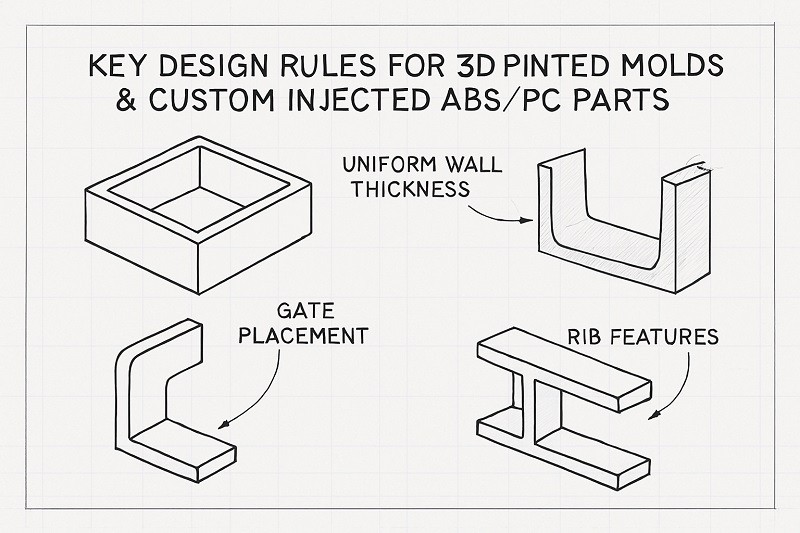
Achieving a high-quality, functional part through injection molding isn't just about the manufacturing process itself; it begins with a robust and well-considered design. This principle, often called Design for Manufacturability (DFM), is doubly important when working with the unique combination of custom ABS/PC parts and 3D printed molds. While the fundamentals of injection molding design still apply, the use of polymer-based molds introduces a new layer of considerations that must be addressed to ensure success.
Optimizing the part design for moldability enhances production efficiency, reduces waste, and improves the final part's performance and durability. It involves a careful balancing act between the desired design intent and the practical realities of how molten plastic flows, cools, and solidifies within the mold. By adhering to established best practices, designers can avoid common defects like warping, sink marks, and incomplete filling, ultimately creating cost-effective and reliable parts.
Optimizing Part Design for Moldability
Whether using a traditional steel mold or a 3D printed one, certain DFM principles are universal. These guidelines are essential for ensuring the molten plastic can fill the mold cavity evenly, cool uniformly, and be ejected cleanly. For materials like ABS/PC, which have specific thermal and flow characteristics, these rules are particularly critical.
Wall Thickness and Corner Radii for Custom Part Injected ABSPC
Uniform wall thickness is arguably the most important rule in injection molding design. Generally, wall thicknesses for injection molded parts range from 1 to 5 mm. More specifically, a common range is between 2 mm and 4 mm. Walls that are too thick take longer to cool, leading to sink marks, voids, and increased cycle times. Conversely, walls that are too thin can be difficult to fill completely, resulting in "short shots" where the part is incomplete. While perfect uniformity is not always possible, thickness variations should be gradual. As a rule, the thickness of one wall should be no less than 40% to 60% of an adjacent wall.
Corner radii are equally crucial for part integrity and mold flow. Sharp corners act as stress concentrators, making the part weaker and more prone to cracking under load. They also impede the flow of molten plastic. By adding rounded corners, or radii, stress is distributed over a wider area, strengthening the part.
- Internal Radii (Fillets): The general rule is to use an inside radius of at least 0.5 times the wall thickness.
- External Radii: The outside radius should ideally be the inside radius plus the wall thickness (or 1.5 times the nominal wall thickness), which helps maintain a consistent wall section around the corner.
This attention to detail ensures a stronger, more aesthetically pleasing part and a more reliable molding process.
Draft Angles and Ejection Mechanics
Draft angles are a slight taper applied to the vertical faces of a part, and they are essential for ensuring the part can be cleanly ejected from the mold. As the plastic cools, it shrinks and grips onto the mold core. Without a draft angle, this friction can cause drag marks, scuffing, or even damage to the part during ejection.
- General Rule: A draft angle of 1 to 2 degrees is standard for most parts made from materials like ABS or PC.
- Texture: If the part has a textured surface, a larger draft angle is necessary. A light texture (PM-T1) may require at least 3 degrees, while a heavier texture could need 5 degrees or more.
- Depth: For every inch of cavity depth, it's a good practice to add an additional degree of draft.
Ejection mechanics refer to the system that pushes the finished part out of the mold. The most common method uses ejector pins. The design and placement of these pins are critical to avoid damaging the part. The ejection force should be distributed evenly across strong, rigid sections of the part to prevent warping, cosmetic blemishes, or fractures.
Surface Finish and Part Integrity
The surface finish of an injection molded part is a direct replica of the mold's surface. Industry standards, such as those from the Society of the Plastics Industry (SPI), define different levels of polish and texture.
- SPI-A (High Polish): Creates a glossy, mirror-like finish, often used for lenses or high-end cosmetic parts.
- SPI-B (Semi-Gloss): A common, cost-effective finish with good aesthetics.
- SPI-C (Matte): A duller finish created with stone polishing, good for hiding fingerprints and minor imperfections.
- SPI-D (Textured): A rougher finish created by sand or bead blasting, which can hide flow lines and sink marks.
A high-quality surface finish is not just for aesthetics; it also contributes to part integrity and functionality. For example, a smooth finish can be crucial for parts that need to create a seal. Achieving the desired finish begins with the mold design and the quality of the mold tool itself.
Specific Considerations for 3D Printed Mold Design for Custom Part Injected ABSPC
While the core principles of DFM apply, designing a mold that will be 3D printed requires additional considerations specific to the additive manufacturing process and the properties of polymer molds.
Minimizing Support Structures and Overhangs
In 3D printing, especially SLA, overhangs beyond a certain angle (typically 45°) require support structures to prevent drooping or failure during the print. These supports, while necessary, can be difficult to remove and can mar the surface finish of the mold.
- Orientation: The primary strategy is to orient the mold design in the printer to minimize the need for supports on critical surfaces, such as the mold cavity itself. Tilting the mold at a 30-45 degree angle can sometimes eliminate support needs on vertical walls.
- Design for Support Removal: When supports are unavoidable, design them to be easily accessible and ensure they are placed on non-critical faces of the mold. Customizing support structures in the slicing software is a powerful technique to control their placement.
By designing with supports in mind, you can ensure a cleaner mold surface, which translates to a higher quality injected part.
Ensuring Dimensional Accuracy and Mold Longevity
Dimensional accuracy in 3D printing refers to how closely the printed object matches the original CAD file. For SLA printing, industrial machines can achieve a tolerance of around ±0.15%, but this can be affected by factors like object size and material shrinkage. To account for this, designers can print a test mold first to measure deviations and then compensate for them in the final CAD model.
Mold longevity is a key concern with 3D printed tools. Unlike steel, polymer molds will degrade with each cycle of heat and pressure. To maximize their lifespan:
- Use a Metal Frame: Placing the 3D printed insert into a rigid aluminum frame is the most effective way to extend its life. The frame absorbs the clamping force, preventing the polymer mold from cracking.
- Process Control: Using the lowest possible injection temperature and pressure for the thermoplastic will reduce stress on the mold.
- Draft Angles: Generous draft angles (2 degrees or more) are even more important for 3D printed molds to reduce friction and wear during part ejection.
A well-designed 3D printed mold can typically last for 30-100 shots or more, depending on the part geometry and the material being injected, making it a highly effective solution for low-volume production.
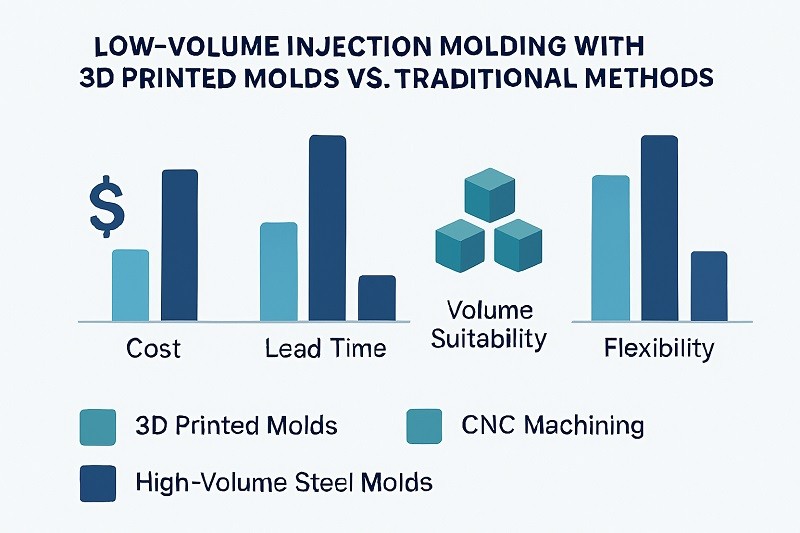
Selecting the right manufacturing process is a critical decision that balances cost, volume, lead time, and material properties. Low-volume injection molding, particularly when enhanced with 3D printed molds, offers a unique set of advantages, but it's important to understand how it stacks up against both traditional high-volume molding and other alternative production methods. Each technique has its own strengths and is best suited for different stages of the product development lifecycle and specific application requirements. By comparing these methods, you can make a more strategic choice for your custom ABS/PC parts.
Low-Volume Injection Molding vs. Traditional Injection Molding for Custom Part Injected ABSPC
The principal difference between low-volume and traditional injection molding lies not in the fundamental process—both involve injecting molten plastic into a mold—but in the tooling and the economies of scale. This distinction has profound implications for cost, speed, and flexibility.
Tooling Costs and Production Volume Breakpoints
Tooling cost is the most significant differentiator.
- Traditional Injection Molding: This method uses molds CNC machined from hardened steel. These molds are incredibly durable, capable of producing millions of parts, but they are also extremely expensive, often costing tens or even hundreds of thousands of dollars. This massive upfront investment is only justifiable for mass production, where the cost can be amortized over a huge number of units.
- Low-Volume Injection Molding: This approach uses more affordable tooling. Molds are typically made from softer aluminum or even high-temperature polymers via 3D Printing. A 3D printed mold can cost as little as a few hundred dollars, while an aluminum mold might cost between $1,500 and $5,000. This drastically lowers the financial barrier for smaller production runs.
The production volume breakpoint is the point at which the lower per-part cost of high-volume molding overtakes the high initial tooling cost.
- For quantities below a few hundred parts, 3D printed molds are often the most economical choice.
- For volumes between approximately 500 and 10,000 units, machined aluminum molds provide a good balance of durability and cost-effectiveness.
- Beyond 20,000 to 30,000 units, the economies of scale heavily favor traditional steel tooling, which becomes the more cost-effective option. Some analyses suggest the breakeven point can be around 13,000 parts, depending on part complexity.
The following table summarizes the cost and volume dynamics:
| Feature | Low-Volume Injection Molding | Traditional Injection Molding |
|---|---|---|
| Tooling Material | Aluminum, Soft Steel, 3D Printed Polymers | Hardened Steel |
| Tooling Cost | $100 - $10,000 | $10,000 - $100,000+ |
| Ideal Volume | 100 - 10,000 parts | 10,000+ parts (often 100,000+) |
| Cost Per Part | Higher at low volumes, but economical for small batches | Extremely low at high volumes, but prohibitive for small runs |
Lead Times and Iteration Cycles
Speed is another area where the two methods diverge significantly.
- Traditional Injection Molding: The creation of a hardened steel tool is a complex, multi-step process that can take weeks or even months to complete. This long lead time can delay product launches and slow down development.
- Low-Volume Injection Molding / Rapid Tooling: Because they use softer materials or additive processes, molds can be produced much faster. Rapid tooling with aluminum can have a lead time of just 2 to 6 weeks, while a 3D printed mold can be ready in a matter of days.
This speed directly impacts the ability to iterate. With traditional tooling, design changes are incredibly costly and time-consuming, as they often require reworking the steel mold or creating a new one entirely. In contrast, low-volume methods allow for rapid and affordable iteration. If a design flaw is found, a new aluminum or 3D printed mold can be produced quickly and cheaply, enabling a more agile and flexible product development cycle.
Alternatives to Low-Volume Injection Molding for Custom Part Injected ABSPC
While low-volume injection molding is a powerful tool, it's not the only option for small-batch production. Several other manufacturing methods offer their own unique advantages and may be better suited for certain applications.
Direct 3D Printing for Custom Part Injected ABSPC
Instead of printing a mold, parts can be 3D printed directly from a CAD file. This method completely eliminates tooling costs and offers the fastest path for producing initial prototypes.
Advantages:
- Speed: A part can be printed in a matter of hours or days, making it the fastest option for one-offs and very small quantities.
- Design Freedom: 3D printing allows for unparalleled geometric complexity, including intricate internal features and organic shapes that are impossible to mold.
- No Tooling Cost: This is ideal for rapid prototyping, as designs can be tweaked and reprinted endlessly with no additional tooling investment.
Disadvantages:
- Higher Per-Part Cost: As volume increases, direct 3D printing quickly becomes more expensive than molding because the cost per part does not decrease significantly with quantity.
- Material and Mechanical Properties: While 3D printing materials have advanced, they may not always match the mechanical strength, durability, and heat resistance of production-grade thermoplastics like injection-molded ABS or PC.
- Scalability: The process is slower for producing larger quantities, making it unsuitable for mass production.
When to choose it: Direct 3D Printing is the best choice for initial form/fit prototypes, highly customized one-off parts, or quantities typically under 100 units where speed and design iteration are the highest priorities.
CNC Machining, Thermoforming, and Polyurethane Casting
Beyond 3D printing, other processes also serve as viable alternatives for low-volume production.
CNC Machining: This is a subtractive process that carves parts from a solid block of material.
- Pros: High precision with extremely tight tolerances, excellent for complex parts under 500 units, and can work with a wide range of production-grade plastics and metals.
- Cons: Can be more expensive per part than molding, especially for simpler geometries, and generates more material waste.
- Best for: Functional prototypes and low-volume end-use parts that require very high precision and strength.
Thermoforming: This process involves heating a sheet of plastic until pliable and then forming it over a single-sided mold.
- Pros: Very low tooling costs and faster lead times compared to injection molding, making it great for large parts with simple geometries like housings or panels.
- Cons: It is a single-sided process, so it offers less design complexity and cannot produce intricate features or sharp details like injection molding can.
- Best for: Large, relatively simple parts in low to medium volumes (250-3,000 units), such as enclosures, trays, and automotive body panels.
Polyurethane Casting (Urethane Casting): This method uses a 3D printed master pattern to create a flexible silicone mold, into which liquid urethane resins are poured.
- Pros: Excellent for producing high-quality, detailed parts that mimic the look and feel of injection molding. It's cost-effective for runs of 1-100 parts and offers very short lead times.
- Cons: Silicone molds have a limited lifespan (typically 25-50 shots). The material selection is limited to polyurethane resins, which simulate but are not identical to production thermoplastics.
- Best for: High-fidelity prototypes, marketing samples, and very low-volume production runs where aesthetic quality is important.
The rise of digital technologies has ushered in a new era for manufacturing, widely known as on-demand manufacturing. This model allows for parts and products to be produced in specific quantities, precisely when they are needed, fundamentally changing the traditional production paradigm. For custom part injected ABS/PC, this approach leverages digital platforms to connect designers and engineers with a network of manufacturing capabilities, streamlining the entire process from design upload to final delivery. It represents a shift from producing for inventory to producing in response to actual demand, offering unparalleled flexibility, speed, and efficiency.
On-demand manufacturing isn't just a process; it's a strategic model that integrates instant quoting, automated DFM (Design for Manufacturability) feedback, and real-time project tracking. This creates a transparent and collaborative ecosystem where innovation can flourish. By eliminating many of the logistical hurdles and high costs associated with traditional manufacturing, it empowers businesses of all sizes to bring custom parts to market faster and more cost-effectively.
The On-Demand Paradigm
The on-demand manufacturing model is built on a foundation of digital automation and supply chain agility. It transforms the linear and often slow procurement process into a dynamic, responsive workflow. Instead of long waits for quotes and communication bottlenecks, designers can receive immediate feedback and pricing, enabling them to make faster, more informed decisions. This paradigm is particularly transformative for low-volume injection molding, where speed and flexibility are paramount.
Real-time Quoting and Order Tracking for Custom Part Injected ABSPC
A cornerstone of the on-demand model is the use of AI-powered digital platforms that provide real-time quoting and analysis. Users can upload a 3D CAD file and, within minutes or even seconds, receive a detailed quote. This quote often includes a comprehensive DFM analysis, which automatically identifies potential manufacturing issues like inadequate draft angles or problematic wall thicknesses. This immediate feedback loop allows engineers to iterate on their designs quickly to optimize for cost and manufacturability before placing an order.
Beyond quoting, these platforms offer a centralized hub for project management. Clients can:
- Track Order Status in Real-Time: From tooling creation to part production and quality inspection, the entire process is transparent.
- Collaborate Seamlessly: Quotes and design feedback can be easily shared with team members, managers, and procurement departments, streamlining communication.
- Manage Revisions: Version control is simplified, with a clear history of design changes and associated costs.
This level of automation and transparency dramatically reduces the friction and delays common in traditional manufacturing, compressing what used to take days or weeks into hours.
Reduced Inventory and Supply Chain Agility
One of the most significant business advantages of on-demand manufacturing is the move away from large, speculative inventory holdings. The traditional model requires producing large batches to achieve a low per-unit cost, often leading to excess inventory that ties up capital and incurs storage costs. This surplus stock also carries the risk of becoming obsolete if market demands shift or a design is updated.
On-demand manufacturing facilitates a "just-in-time" (JIT) approach. Parts are produced in smaller quantities as needed, which offers several benefits:
- Enhanced Cash Flow: By reducing the capital tied up in unsold inventory, businesses can allocate resources to other critical areas like R&D and marketing.
- Increased Agility: The ability to scale production up or down quickly allows companies to respond rapidly to market fluctuations and customer feedback without the burden of excess stock.
- Minimized Risk: Lower inventory levels reduce the financial risk associated with product obsolescence, damage, or storage.
This creates a more resilient and responsive supply chain, which is a major competitive advantage in today's fast-paced market.
Choosing the Right Partner for Custom Part Injected ABSPC Services
The success of any on-demand manufacturing project hinges on the capabilities and reliability of the manufacturing partner. Selecting the right supplier is about more than just finding the lowest price; it's about building a partnership with a company that has the technical expertise, capacity, and quality systems to bring your vision to life successfully.
Capacity, Expertise, and Compliance for Custom Part Injected ABSPC
When evaluating potential partners for low-volume injection molding, several key criteria should be considered:
- Production Volume and Capacity: Ensure the manufacturer specializes in or has dedicated services for low-to-medium volume production (typically under 10,000 parts). A partner that can handle both prototyping and low-volume runs offers the flexibility to scale as your needs evolve.
- Technical Expertise: The supplier should have deep experience with the materials you plan to use, such as ABS and PC. Look for a team with strong engineering support that can provide valuable DFM feedback to optimize your design. A partner with advanced capabilities like 5-axis CNC machining and EDM for mold making can handle more complex geometries with higher precision.
- Industry-Specific Compliance: Different industries have strict quality and regulatory standards. If your part is for a medical, automotive, or aerospace application, ensure the supplier holds the necessary certifications, such as ISO 9001, ISO 13485 (medical), or AS9100 (aerospace).
A partner with diverse market experience is often more stable and brings a broader range of problem-solving skills to the table.
Flexible Services and Quality Assurance
A true manufacturing partner offers more than just production; they provide a comprehensive and flexible service designed to ensure your project's success.
- Flexible Services: Look for a supplier that offers a full spectrum of services, including rapid prototyping, bridge tooling, and on-demand production. This allows for a seamless transition through the different stages of the product lifecycle. The ability to offer multiple manufacturing processes (e.g., 3D printing, CNC, and injection molding) under one roof is a significant advantage, providing a one-stop-shop solution.
- Quality Assurance (QA): A robust QA system is non-negotiable. This goes beyond final inspection and should be integrated throughout the entire manufacturing process. Ask potential suppliers about their quality control procedures, such as in-process monitoring, First Article Inspection (FAI) reports, and the use of precision measurement tools like Coordinate Measuring Machines (CMMs). A commitment to quality ensures that every part meets your specifications, reducing defect rates and enhancing customer satisfaction.
By carefully vetting potential partners based on these criteria, you can establish a strong, collaborative relationship that ensures the consistent delivery of high-quality custom injected parts.
Conclusion
The synergy between low-volume injection molding and 3D printed molds is revolutionizing product development. This powerful combination offers unprecedented speed, design flexibility, and cost-efficiency, making it easier than ever to create high-quality custom injected ABS/PC parts. This approach empowers businesses of all sizes to innovate at a faster pace, test their designs with real-world materials and user feedback, and bring specialized products to market without being hindered by the significant upfront investment and long lead times of traditional high-volume manufacturing. By embracing these advanced manufacturing techniques, companies can achieve rapid iteration cycles, reduce material waste, and produce customized plastic components with greater agility and confidence.
The future of manufacturing for custom parts undoubtedly lies in these smart, adaptable, and digitally-driven solutions that can evolve with shifting market demands. The ability to quickly move from a digital design to a physical, production-quality part is a game-changer, leveling the playing field and fostering innovation across industries. Whether for bridge production, niche market products, or rigorous functional prototyping, this hybrid approach provides a strategic advantage in today's competitive landscape.
At SOMI Custom Parts, a leading 3D Printing factory, we are dedicated to providing cutting-edge solutions for your custom part injected ABSPC needs. We leverage our deep expertise in both 3D printing and low-volume injection molding to bring your innovative designs to life efficiently and cost-effectively, ensuring your vision becomes a reality with the quality and speed you require.