Choosing the Right Wholesale PC ABS for Your Injection Molding Projects
- Share
- Issue Time
- Dec 18,2025
Summary
This article provides a comprehensive guide to selecting and processing wholesale PC ABS for injection molding projects, emphasizing its balanced properties and versatility.
As an expert in the field, I understand that selecting the right material is paramount for the success of any injection molding project. Today, I want to share insights into choosing the best wholesale PC ABS for your specific needs.
PC ABS, a robust thermoplastic blend, offers an exceptional balance of strength, heat resistance, and processability, making it a go-to for numerous applications. But navigating the nuances of wholesale PC ABS injection molding requires a deep dive into its properties and processing.
My goal is to guide you through the critical considerations for leveraging wholesale PC ABS injection molding, ensuring your projects achieve optimal performance and efficiency from concept to completion.
Understanding Wholesale PC ABS in Injection Molding: A Powerful Blend
What is PC ABS and Why Choose It for Wholesale PC ABS Injection Molding?
PC ABS is a high-performance engineering thermoplastic alloy created by blending Polycarbonate (PC) and Acrylonitrile Butadiene Styrene (ABS). This blend ingeniously combines the most desirable properties of both materials. From Polycarbonate, it inherits superior strength, rigidity, impact resistance, and heat resistance. From ABS, it gains excellent processability, surface finish, and flexibility. This synergistic effect results in a material that is tougher than standard ABS and easier to process than pure PC.
The unique balance of properties depends on the specific ratio of PC to ABS in the blend, the molecular weight of the polycarbonate, and any additives used. This allows for the creation of various grades of PC ABS, each tailored for specific performance requirements. By alloying these two polymers, manufacturers can overcome the limitations of each individual material, such as the medium heat and impact performance of ABS. The result is a versatile and powerful material ideal for demanding injection molding applications.
Key Properties and Benefits for Your Wholesale PC ABS Projects
When selecting PC ABS for your wholesale injection molding projects, it's essential to understand the key properties that make it a standout choice. This material provides a well-balanced profile that meets rigorous engineering demands.
Core Benefits of PC ABS:
- High Impact Strength: PC ABS exhibits excellent impact resistance, even at low temperatures. This toughness, derived from both the PC and butadiene rubber in the ABS, makes it ideal for parts that need to withstand significant mechanical stress and potential impacts.
- Good Heat Resistance: The blend inherits the heat resistance of PC, allowing it to maintain structural integrity at elevated temperatures, often with a heat distortion temperature between 95°C and 125°C. This makes it suitable for housings for electronic devices and automotive components exposed to heat.
- Excellent Processability: Compared to pure PC, which can be challenging to mold, PC ABS offers superior flow characteristics. This ease of processing facilitates the creation of complex part geometries and can lead to faster cycle times in mass production.
- Superior Dimensional Stability: The material maintains its shape and dimensions well under various environmental conditions, exhibiting low overall shrinkage. This reliability is crucial for precision components where tight tolerances are required.
- Aesthetic Versatility: PC ABS provides a high-quality, smooth surface finish that is easily colorable, printable, and suitable for electroplating. This gives designers significant freedom to create visually appealing products for consumer-facing applications.
- Good Chemical Resistance: It offers resistance to a range of substances including weak acids, oils, and fats, which is beneficial for parts used in industrial and automotive environments.
To provide a clearer perspective, here is a table summarizing the typical mechanical and thermal properties of a general-purpose PC ABS grade. Note that these values can vary significantly based on the specific blend ratio and additives used.
| Property | Value | Test Method |
|---|---|---|
| Mechanical | ||
| Tensile Strength | 40 - 60 MPa | ISO 527 |
| Tensile Modulus | 1900 - 2800 MPa | ISO 527 |
| Flexural Strength | 68 - 100 MPa | ISO 178 |
| Notched Izod Impact Strength | 40 - 60 kJ/m² | ISO 180 |
| Thermal | ||
| Heat Deflection Temp. (HDT) @ 1.8 MPa | 95 - 125 °C | ISO 75 |
| Vicat Softening Temperature | 109 - 130 °C | ISO 306 |
| Physical | ||
| Density | 1.09 - 1.15 g/cm³ | ISO 1183 |
| Molding Shrinkage | 0.4 - 0.7 % | ISO 294-4 |
Data compiled from various sources for illustrative purposes.
Versatile Applications for Wholesale PC ABS Injection Molding
The exceptional balance of mechanical strength, thermal stability, and aesthetic quality makes PC ABS a highly sought-after material across numerous industries. Its versatility allows it to be molded into everything from robust industrial components to sleek consumer electronics.
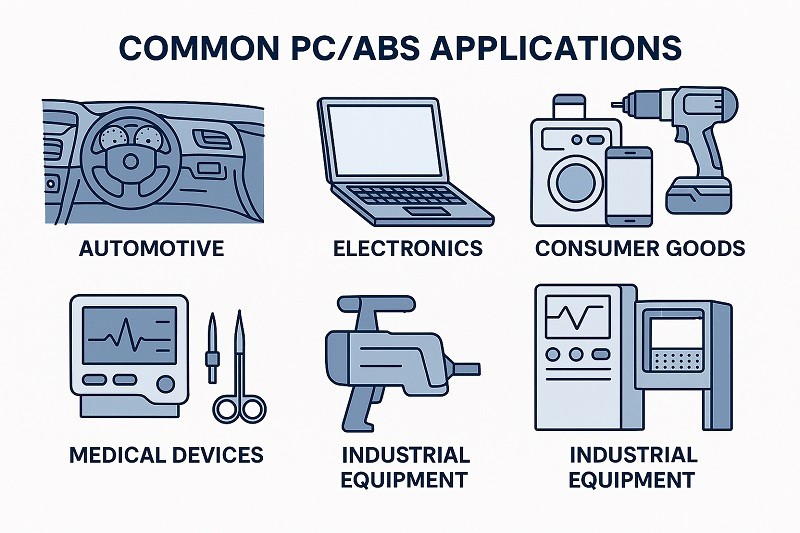
Here are some of the most common applications for wholesale PC ABS injection molding:
- Automotive Industry: PC ABS is extensively used for both interior and exterior automotive components. Its high impact strength and heat resistance are crucial for dashboards, pillars, door panels, consoles, grilles, and trim. The material's ability to withstand harsh conditions and maintain its appearance makes it ideal for these demanding applications.
- Electronics and Electrical: This is another major sector for PC ABS, where it is used for enclosures and housings for laptops, computers, monitors, printers, smartphones, and chargers. Its good electrical insulation properties, durability, and a smooth finish suitable for branding make it a perfect choice. Many grades also offer flame retardancy, which is a critical safety requirement for electronic products.
- Consumer Goods: The aesthetic versatility and toughness of PC ABS lend themselves well to a variety of consumer products. This includes home appliance housings (like washing machines and microwave ovens), power tools, sports equipment, and durable luggage.
- Medical Devices: In the medical field, PC ABS is used for equipment enclosures, housings for monitoring devices, and various surgical instruments. Its chemical resistance and ability to withstand sterilization processes without degrading are key advantages in this sector.
- Industrial Equipment: For industrial machinery, PC ABS is used to create durable housings, protective covers, control panels, and other components that require toughness and resistance to impact.
The widespread use of PC ABS underscores its value as a reliable, high-performance material that can meet the functional and aesthetic requirements of modern manufacturing.
Mastering the Wholesale PC ABS Injection Molding Process
Achieving high-quality results with PC ABS requires a deep understanding and precise control of the injection molding process. From material preparation to the final ejection of the part, each phase plays a critical role in determining the final product's mechanical properties, appearance, and dimensional accuracy. Mastering this process is key to unlocking the full potential of PC ABS for your wholesale projects.
The Four Core Phases of Wholesale PC ABS Injection Molding
The injection molding cycle, regardless of the material, can be broken down into four primary stages. For PC ABS, optimizing each stage is crucial for success.
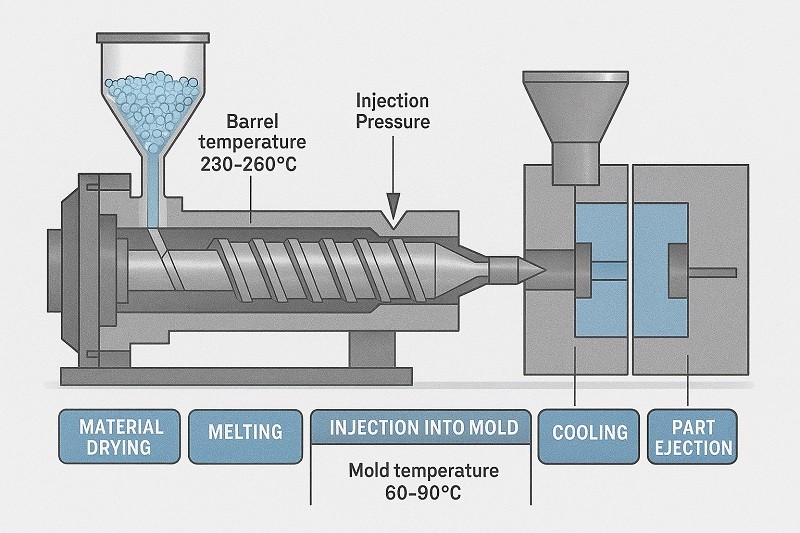
Clamping: Before the molten plastic is introduced, the two halves of the mold must be securely closed by the clamping unit. This unit must apply and maintain sufficient force to keep the mold shut against the high pressures exerted during the injection phase, preventing material leakage (flash).
Injection: In this phase, the melted and plasticized PC ABS resin is forcefully injected into the closed mold cavity under high pressure. The material flows through the runner system and gates, filling the entire space of the cavity to take on the desired shape. This phase requires precise control of speed and pressure to ensure complete and uniform filling.
Cooling: Once the cavity is filled, the cooling phase begins. This is often the longest part of the cycle and is critical for the solidification of the PC ABS. The mold has internal cooling channels through which a fluid (usually water) circulates to dissipate heat from the molten plastic. Proper cooling ensures the part hardens correctly, achieves dimensional stability, and minimizes internal stresses.
Ejection: After the part has cooled sufficiently and solidified, the mold opens, and an ejection system (typically using pins or plates) pushes the finished part out of the cavity. A well-designed ejection process ensures the part is removed without damage or deformation, readying the machine for the next cycle.
Critical Processing Parameters for Successful Wholesale PC ABS Injection Molding
To achieve consistent, high-quality parts with PC ABS, it is essential to dial in and maintain specific processing parameters. These settings directly influence the material's behavior and the final part's properties.
Material Drying: PC ABS is hygroscopic, meaning it absorbs moisture from the air. Processing wet material can cause hydrolysis, leading to significant defects like silver streaks on the part surface and a reduction in mechanical properties. Therefore, pre-drying is mandatory. The resin must be dried to a residual moisture content of less than 0.04%, with some sources recommending as low as 0.02%.
- Drying Temperature: Typically 80°C to 110°C (176°F to 230°F).
- Drying Time: 2 to 4 hours, preferably in a dehumidifying or dry-air dryer.
Temperature Control: Proper temperature management across the barrel and mold is vital for good flow and surface finish.
- Melt Temperature: The actual temperature of the molten plastic should be between 240°C and 280°C (464°F to 536°F). Temperatures that are too high can cause material degradation and discoloration (yellowing), while temperatures that are too low will increase viscosity, requiring higher injection pressures and potentially causing short shots or high internal stress.
- Mold Temperature: A relatively high mold temperature of 70°C to 100°C (158°F to 212°F) is recommended. A warmer mold improves material flow, enhances surface finish, creates stronger weld lines, and helps reduce internal stresses.
Pressure and Speed:
- Injection Pressure: Typically ranges from 80 to 150 MPa (800 to 1500 bar). The pressure should be sufficient to fill the mold completely without causing flash.
- Holding Pressure: Applied after the initial injection, holding pressure (or packing pressure) is usually set to 50-70% of the maximum injection pressure. This helps compensate for material shrinkage as it cools, preventing defects like sink marks.
- Injection Speed: A medium to high injection speed is generally used to ensure the mold fills quickly and evenly. However, excessively high speeds can generate high shear, leading to material degradation or defects like stretch marks.
- Back Pressure: A low back pressure of 5-10 MPa (50-100 bar) is recommended to ensure uniform melting without introducing excessive frictional heat.
Here is a summary table for quick reference:
| Parameter | Recommended Range | Notes |
|---|---|---|
| Drying Temperature | 80°C - 110°C | Ensure moisture is <0.04% |
| Drying Time | 2 - 4 hours | Use a dry-air or dehumidifying dryer |
| Melt Temperature | 240°C - 280°C | Measure with an air shot |
| Mold Temperature | 70°C - 100°C | Higher end for best surface finish |
| Injection Pressure | 80 - 150 MPa | Use enough pressure to fill completely |
| Back Pressure | 5 - 10 MPa | Keep low to prevent overheating |
Overcoming Common Challenges in Wholesale PC ABS Injection Molding
Even with optimized parameters, several common defects can arise during PC ABS injection molding. Understanding their causes is the first step toward finding a solution.
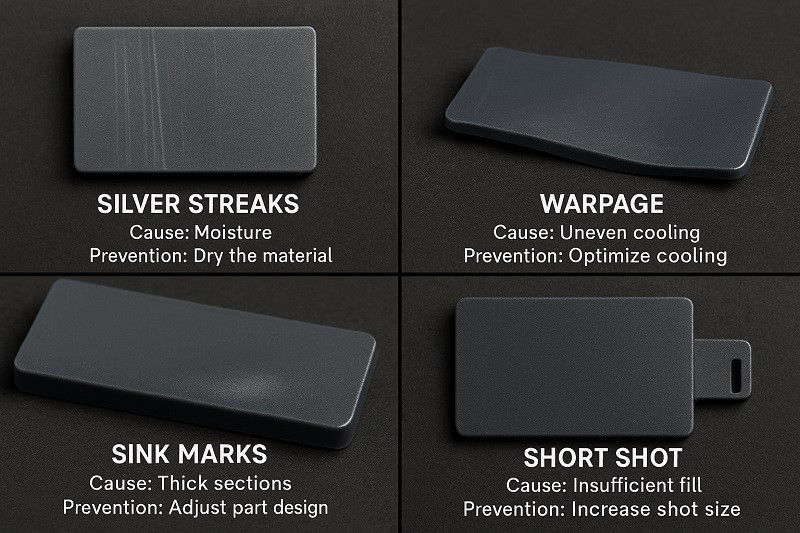
Silver Streaks: These are silvery-white lines on the part surface and are the most common defect for PC ABS. They are caused by gas interference, which can come from moisture in the resin, trapped air, or gas from material decomposition.
- Solution: First and foremost, ensure the material is thoroughly dried. Increasing mold temperature, optimizing venting in the mold, and adjusting injection speed can also help eliminate trapped gas.
Flow Lines: These appear as wavy patterns or lines on the surface and are typically caused by poor material fluidity, where the melt cools too quickly as it flows through the cavity.
- Solution: Increase the melt temperature and/or mold temperature to improve flow. Reducing the injection speed can sometimes allow the flow front to advance more smoothly.
Sink Marks and Voids: Sink marks are surface depressions, while voids are internal bubbles, both caused by insufficient material packing as the part cools and shrinks. They often occur in thicker sections of the part.
- Solution: Increase the holding pressure and/or holding time to pack more material into the mold as it cools. Raising the injection speed and ensuring gates are large enough can also improve packing.
Warpage and Deformation: Warpage is the distortion of the part from its intended shape, caused by non-uniform shrinkage due to differential cooling or high internal stresses.
- Solution: This is often a complex issue related to both part design and processing. Solutions include extending the cooling time, ensuring uniform mold temperature, lowering the injection pressure and speed to reduce molded-in stress, and modifying the part design with uniform wall thickness and added ribs.
Burn Marks: These are black or brown discolorations on the part, typically at the end of the flow path, caused by air being trapped and compressed to the point of ignition (dieseling).
- Solution: Improve the mold's venting by adding or enlarging vents. Reducing the injection speed can give the trapped air more time to escape.
By systematically addressing these challenges, you can significantly improve the yield and quality of your wholesale PC ABS injection molding projects.
Ensuring Safety and Compliance with UL 94 for Wholesale PC ABS
When developing products, especially for the electronics, automotive, and consumer goods markets, safety is a non-negotiable priority. For plastic components, one of the most critical safety standards is UL 94, which evaluates the flammability characteristics of materials. Understanding and specifying the correct UL 94-rated PC ABS is essential for compliance and market acceptance.
What is UL 94 and Its Relevance to Wholesale PC ABS in Injection Molding?
UL 94 is the Standard for Safety of Flammability of Plastic Materials for Parts in Devices and Appliances, developed and published by Underwriters Laboratories (UL). This globally recognized standard provides a definitive method for classifying how a plastic material responds when exposed to a flame. The testing determines the material's tendency to either extinguish or spread a flame after it has been ignited. For products like electrical enclosures, power tool housings, and consumer electronics, using a material with an appropriate UL 94 rating is often a mandatory requirement to prevent fire-related hazards.
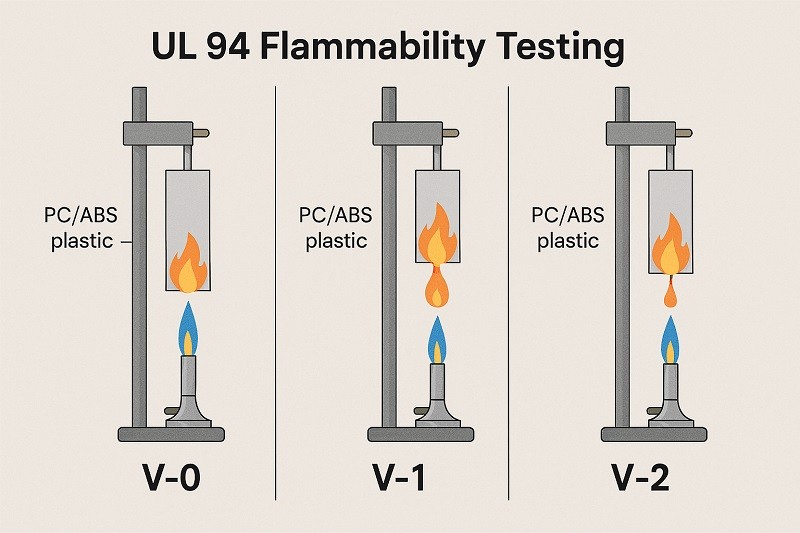
The standard includes several classifications based on the results of small-scale flame tests conducted under controlled laboratory conditions. The main ratings, from least to most flame-retardant, are:
- HB (Horizontal Burn): The material exhibits slow burning on a horizontally positioned specimen.
- V-2 (Vertical Burn): Burning stops within 30 seconds on a vertical specimen; drips of flaming particles are permitted.
- V-1 (Vertical Burn): Burning stops within 30 seconds on a vertical specimen, but only non-flaming drips are allowed.
- V-0 (Vertical Burn): Burning stops within 10 seconds on a vertical specimen, with no flaming drips allowed. This is a superior level of self-extinguishing performance.
- 5VB and 5VA (Surface Burn): These are the most stringent tests, involving a more intense flame source. For both, burning must stop within 60 seconds with no flaming drips. The key difference is that for a 5VA rating—the highest classification—the test plaque cannot have a burn-through (a hole), whereas one is permitted for 5VB.
For many PC ABS applications, especially in electronics, a UL 94 V-0 rating is highly desirable. This indicates that the material will self-extinguish quickly without propagating fire via flaming drips, significantly enhancing product safety.
Impact of Material Thickness and Formulation on UL 94 Ratings for Wholesale PC ABS
A crucial aspect of the UL 94 standard is that a material's rating is always dependent on the thickness of the test specimen. A specific PC ABS grade might achieve a V-0 rating at a wall thickness of 3.0mm but may only qualify for a V-1 or V-2 rating at a thinner wall section of 1.5mm.
Key Factors Influencing UL 94 Ratings:
Material Thickness: Thicker sections generally provide better flame resistance. The increased material mass can absorb more heat and may burn more slowly, making it easier to achieve a higher rating like V-0. When designing parts, it's critical to consider the thinnest wall section, as this will be the limiting factor for the overall part's flammability compliance.
Flame Retardant Additives: Standard PC ABS blends are not inherently flame retardant enough to meet strict ratings like V-0. To achieve this, manufacturers create specific flame-retardant (FR) grades by incorporating additives into the polymer matrix. These are often halogen-free formulations to meet modern environmental standards.
Formulation and Colorants: Even small changes to the material's formulation can impact its flammability rating. Adding certain colorants or other additives can potentially compromise the performance of the flame retardant system. For this reason, any modification to a certified blend requires independent testing and re-certification to confirm its UL 94 rating.
When sourcing wholesale PC ABS, always request the material's UL Yellow Card from the supplier. This document provides official certification of the material's UL rating at specific thicknesses and for specific formulations, ensuring you select a compliant material for your project.
Navigating Environmental Considerations in Wholesale PC ABS Selection
In today's market, sustainability is as important as performance. When selecting a PC ABS material, it's vital to consider its entire life cycle, from production to end-of-life disposal.
Recyclability and Recycled Content: PC ABS is a thermoplastic and is therefore recyclable. The recycling process for blends like PC/ABS can be more complex than for single polymers, but established industrial processes exist to recover and reprocess this material. Many manufacturers are now using post-consumer recycled (PCR) or post-industrial recycled (PIR) PC/ABS to create new compounds. These recycled grades can retain excellent mechanical properties and offer a more sustainable alternative to virgin materials by reducing plastic waste and the carbon footprint associated with production.
Regulatory Compliance (RoHS and REACH): Beyond flammability, materials must also comply with chemical substance regulations designed to protect human health and the environment.
RoHS (Restriction of Hazardous Substances): This EU directive restricts the use of specific hazardous materials found in electrical and electronic products. The list includes lead, mercury, cadmium, and certain brominated flame retardants (PBBs and PBDEs). When selecting PC ABS, especially flame-retardant grades, ensure they are RoHS compliant, which often means opting for halogen-free flame retardants.
REACH (Registration, Evaluation, Authorisation and Restriction of CHemicals): This is another EU regulation that aims to improve the protection of human health and the environment from the risks posed by chemicals. It requires manufacturers and importers to register chemical substances and demonstrate their safe use. Your PC ABS supplier should be able to provide a statement of REACH compliance, confirming that any Substances of Very High Concern (SVHC) are either absent or below the legal threshold.
By choosing PC ABS grades that are recyclable and compliant with RoHS and REACH, you ensure your products are not only safe and high-performing but also environmentally responsible and ready for the global market.
Scaling Up Your Wholesale PC ABS Injection Molding Projects: From Prototype to Production
Transitioning a PC ABS part from a successful prototype to full-scale production introduces a new set of complexities. What works for a single cavity mold or a small batch may not translate directly to a high-volume manufacturing environment. Successfully scaling up requires careful planning around design, material management, and process validation to ensure consistency, quality, and efficiency.
Addressing Design Challenges for Production-Scale Wholesale PC ABS Parts
Design for manufacturability (DFM) is paramount when planning for mass production. A design that is not optimized for high-volume injection molding can lead to a host of problems, including cosmetic defects, structural failures, and long cycle times.
Key DFM Considerations for PC ABS:
Uniform Wall Thickness: This is one of the most critical principles in injection molding design. Maintaining a consistent wall thickness throughout the part ensures uniform cooling and shrinkage, which minimizes the risk of defects like sink marks, voids, and warpage. For PC ABS, a general wall thickness of 1.2mm to 3mm is recommended to avoid issues. If a section must be thicker, it should be hollowed out and supported with ribs.
Ribs and Gussets: To add strength and rigidity to a part without increasing overall wall thickness, incorporate ribs. Ribs should be designed to be 40-60% of the thickness of the wall they are attached to, preventing sink marks on the opposite surface. Gussets can be used to reinforce features like bosses and tall walls.
Draft Angles: A slight taper, or draft, must be applied to all walls oriented parallel to the direction of mold opening. This allows the part to be ejected cleanly from the mold without drag marks or damage. A general rule of thumb is to apply 1 degree of draft for every inch of cavity depth, with more for textured surfaces.
Radii on Corners: Sharp internal corners create stress concentrations, which can lead to part failure under load. They also impede the flow of molten plastic. Designing generous radii (fillets) on all inside corners—ideally with a radius of at least 0.5 times the wall thickness—improves material flow and distributes stress, making the part stronger.
Material Behavior and Management at Production Scales for Wholesale PC ABS
When dealing with wholesale quantities of PC ABS resin, managing the material itself becomes a crucial part of the production process. Consistency and proper handling are key to preventing defects and ensuring every part meets specifications.
Batch-to-Batch Consistency: One of the biggest challenges in high-volume production is ensuring consistency from one batch of raw material to the next. Even slight variations in the PC/ABS ratio, additive levels, or colorant concentration can affect processing parameters and final part properties.
- Solution: Work with reputable wholesale suppliers who can provide certificates of analysis (CoA) for each batch. Using masterbatch colorants, which are highly concentrated pigments mixed into a base resin, can help achieve better color consistency across large production runs compared to manual mixing. Gravimetric blenders at the molding machine can precisely dose the masterbatch, yielding excellent part-to-part consistency.
Inventory Management and Storage: Managing a large inventory of PC ABS resin requires a systematic approach.
- Proper Storage: Resin should be stored in a dry, climate-controlled warehouse to prevent moisture absorption. Pallets should be stacked correctly to avoid crushing boxes, and inventory should be rotated on a first-in, first-out (FIFO) basis to prevent material degradation over time.
- Automated Systems: For very large operations, automated resin inventory management systems that use silo level sensors can provide real-time data, helping to optimize purchasing, reduce carrying costs, and prevent stock-outs that could shut down production.
Material Handling: Contamination is a major risk in a production environment. Dust, foreign particles, or cross-contamination with other polymer types can lead to serious part defects.
- Solution: Ensure that all equipment, including dryers, hoppers, and feeding systems, is thoroughly cleaned between material changes. A closed-loop conveying system can help protect the resin from airborne contaminants as it moves from the dryer to the molding machine.
The Crucial Role of Pilot Production in Wholesale PC ABS Injection Molding
Before launching into full mass production, conducting a pilot production run is an indispensable step. A pilot run is a short, limited-volume run that uses the final production mold, material, and machinery. This bridges the gap between prototyping and mass production, allowing you to validate the entire manufacturing process.
Benefits of a Pilot Production Run:
Process Validation and Optimization: A pilot run is the first true test of the process under real-world conditions. It allows process engineers to fine-tune critical parameters like temperatures, pressures, and cycle times to achieve optimal part quality and efficiency. This validation provides documented evidence that the process can consistently produce parts that meet specifications.
Identify and Correct Defects: Running a few hundred or a thousand parts will reveal potential defects that may not have appeared during single-cavity prototyping. This is the opportunity to identify issues like flash, sink marks, or warpage and implement corrective actions, whether through process adjustments or minor tool modifications, before they impact a large volume of products.
Test Automation and Assembly: The pilot run serves to test not just the molding process, but also any downstream operations. This includes robotic part handling (end-of-arm tooling), assembly jigs, testing stations, and packaging procedures. Ironing out kinks in these processes beforehand prevents bottlenecks during mass production.
Quality Control Confirmation: The parts produced during the pilot run can be used to finalize quality control standards. Inspection methods are tested, and the data gathered can be used to perform statistical process control (SPC) analysis, confirming that the process is stable and capable of meeting the required tolerances on a large scale.
Ultimately, a successful pilot run provides the confidence needed to scale up production. It mitigates risk, reduces the likelihood of costly errors, and ensures a smoother, more efficient transition to manufacturing your wholesale PC ABS parts.
Conclusion: Your Blueprint for Success with Wholesale PC ABS
In summary, selecting the optimal wholesale PC ABS for your injection molding projects involves a comprehensive understanding of material properties, processing intricacies, regulatory compliance like UL 94, and the challenges of scaling production. This engineered thermoplastic offers a unique and powerful combination of strength, heat resistance, and aesthetics, but unlocking its full potential demands a meticulous and informed approach.
By carefully considering the balance of properties in different PC ABS grades, mastering the critical parameters of the injection molding process, ensuring compliance with safety and environmental standards, and strategically planning for the transition from prototype to mass production, you can ensure the successful development and manufacturing of high-quality, durable, and compliant products. This holistic view, from initial design to final part, is the cornerstone of a successful project.
SOMI Custom Parts is a leading wholesale PC ABS injection molding manufacturer, providing high-quality products and OEM services to global clients. If you are ready to leverage the benefits of PC ABS for your next project, our team of experts is here to guide you every step of the way, transforming your concept into a market-ready reality.