CNC Machining Cost Breakdown: Quotes, Setup Fees, and Volume Discounts Explained
- Share
- publisher
- SOMI Custom Parts
- Issue Time
- Aug 29,2026
Summary
Understand every line of a CNC machining quote: raw material, machine time, setup fees, tolerances, finishing, and volume discounts. This 2026 guide shows typical hourly rates and cost multipliers, explains why quotes vary by up to 40%, and teaches you how to read a transparent quotation so you pay a fair price for custom machined parts.
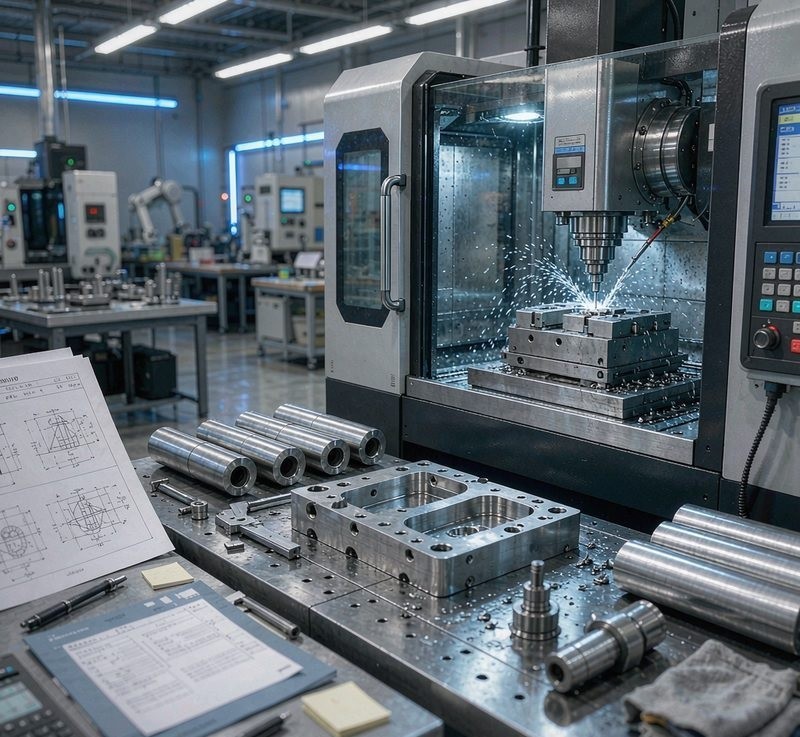
Ask three suppliers to quote the same machined part and you can easily receive prices that differ by 40% or more. The global CNC machining services market was valued at roughly USD 6.24 billion in 2026 and is growing at about 8.2% per year, yet the way that money is priced remains a black box for many buyers. With more than 4.6 million CNC machines operating worldwide and digital RFQ platforms now influencing 44% of sourcing decisions, understanding how a quote is built is no longer a nice-to-have — it is the difference between paying a fair price and funding a supplier's inefficiency. This guide breaks down the CNC machining cost structure layer by layer: raw material, machine time, setup fees, tolerances, finishing, inspection, and the volume discounts that change everything. You will learn what each line item means, what typical market rates look like in 2026, and exactly where the negotiation room actually is. A CNC machining cost breakdown is an itemized list of every charge that makes up the final price of a machined part. A transparent quote shows you exactly what you are paying for: material, machine time, setup, tooling, finishing, inspection, and packaging. A lump-sum quote — one number with no supporting detail — is the first warning sign that costs are being buried somewhere you cannot see. In practice, the per-unit price of any CNC part follows a simple formula: Unit Price = (One-Time Setup Cost ÷ Order Quantity) + Per-Unit Material + Per-Unit Machine Time + Finishing + Inspection + Overhead The setup term is fixed, so it shrinks as quantity grows. This single formula explains almost every pricing surprise buyers encounter — from expensive prototypes to dramatic volume discounts. Regardless of the machine shop or the country, every CNC quote is assembled from the same seven cost layers. Understanding their typical share of the total lets you spot which line items deserve your negotiation attention. Industry pricing benchmarks in 2026 show that machining time and raw material together typically account for 60–70% of the unit cost of a mid-complexity part. That is where the biggest optimization wins live. Setup cost covers CAM programming, tool preparation, fixture installation, and first-article inspection. It is fixed — whether you order 1 piece or 500, the shop performs the same preparation work. This is why prototype quotes look baffling: the part is not difficult to machine, the setup simply has nowhere to spread. Real quoting behavior follows the same curve: with a USD 300 setup charge and USD 15 of variable cost per part, the unit price falls from USD 315 for a single piece to USD 45 at 10 pieces — an 86% drop — and levels out near USD 15–18 at production volume. The steepest savings always happen in the first jump from prototype to small batch. Practical tip: If you are in the prototyping phase, consolidate multiple parts into a single programming session wherever possible. Shops commonly report per-unit cost reductions of 30–50% from batching related parts into one setup. Machine time is the single largest line item in most CNC quotes, and the hourly rate depends heavily on the equipment. A standard 3-axis vertical machining center typically runs at USD 40–75 per hour, while a 5-axis machine commands USD 80–140 per hour, and cleanroom-class precision machines used for medical or semiconductor work can reach USD 150–220 per hour. Cycle time is driven by the volume of material removed, the number of features, the number of setups, and material hardness. A simple aluminum bracket with four holes may machine in 15 minutes; a titanium aerospace component with tight tolerances can require four hours or more. Hard materials demand slower feeds, more passes, and faster tool wear — one reason titanium can cost 3–5× more to machine than aluminum despite similar part geometry. Cost reality check: Moving from a part that needs 4 setups to a design that needs only 2 can cut machining cost by 30–40%. If you specify 5-axis machining for a geometry that a 3-axis machine can produce, you pay for capability you do not use. Keep critical features on the same face whenever possible. Tolerance is where CNC pricing turns exponential. Every step tighter means slower feed rates, extra finishing passes, more careful handling, and more expensive inspection. General-purpose tolerances of ±0.1 mm are the baseline; specifying ±0.005 mm roughly doubles to triples the cost; and micron-level tolerances can multiply the price four to eight times. Inspection is part of the premium. Parts with tight tolerances typically require 100% CMM verification, which adds USD 50–150 per part. Surface finish behaves the same way: standard as-machined surfaces carry no surcharge, but polishing, anodizing, and plating add USD 2–30 per part depending on the process. Where most buyers waste money: As a rule of thumb, 80% of dimensions can use standard tolerances and only 20% genuinely need tight control. A European automotive supplier cut machining cost by 22% simply by relaxing non-critical tolerances from ±0.01 mm to ±0.03 mm. Ask your supplier for a DFM review — it is usually free and typically saves 10–30%. Volume discounts are not a favor the supplier grants you — they are the arithmetic of amortizing fixed costs. Setup, programming, and first-article inspection get divided by the order quantity, and at higher volumes suppliers add bulk material purchasing power and optimized fixture plates on top. The discount curve is steep at the start and flattens quickly: moving from 1 to 10 pieces can slash unit price by 80–86%, while moving from 100 to 1,000 pieces saves only another 10–15%. This is why experienced buyers request tiered pricing — quotes at 1, 10, 50, 100, and 500 units reveal exactly where the price breaks sit for their specific part. Some parts show a dramatic break at 25 units; others do not move until 200+. Smart buying move: Negotiate a blanket order — commit to 500 parts over 12 months and take delivery in monthly batches of 40–50. You lock in volume pricing while avoiding inventory carrying costs, which can consume 20–60% of inventory value per year. Here is a real-world transparent quote structure for a 5 kg 316 stainless steel valve body, quantity 100 pieces, showing exactly where the money goes. Machining is only about 44% of the true unit cost — the rest hides in material, finishing, inspection, and documentation. When a supplier gives you a single number with no breakdown, treat it as a red flag. The same logic applies to suspiciously clean quotes: Always request a fully inclusive quote covering material certificates, inspection reports, finishing, and packaging. Compare total cost of ownership, not the headline number. At SOMI Custom Parts, transparent pricing is part of the engineering service, not an afterthought. Our quoting process begins with a free DFM review: our engineers analyze your drawing, flag over-specified tolerances and costly features, and return an itemized quotation you can actually audit — material, machine time, setup, finishing, and inspection listed separately. Operating an ISO 9001:2015 certified facility with CNC milling, turning, and drilling capabilities plus in-house surface finishing, we deliver machined parts to tolerances as tight as ±0.005 mm with CMM verification and material certificates on every order. Because we control the process chain from raw stock to final finish, there are no surprise line items — and no minimum order quantity. Whether you need a single prototype or a 1,000-piece production run, you will see the same cost structure, with volume discounts applied openly as setup amortizes across your quantity. Browse our CNC milling parts, CNC turning parts, and surface finishing services to see the full range of what we produce, or send us your drawing through our inquiry page for a transparent, line-by-line quotation. Machine utilization, setup strategy, material sourcing, and quality overhead all vary between shops. The gap does not automatically mean someone is overcharging — but it is exactly why you should request an itemized breakdown before signing. Compare line items, not totals. Setup amortization drives most of the drop. The same part moving from 20 to 200 pieces typically falls 40–50% in unit price. From prototype (1–10 pcs) to 1,000+ pcs, the total reduction is commonly 50–70%. Setup is real work — programming, fixtures, and first-article inspection — so it cannot simply disappear. But you can reduce its impact: consolidate multiple parts into one setup, keep features on the same face, and order larger batches. Some shops also waive setup on repeat orders of the same part number. Ask your supplier for a DFM review. A good engineer will identify which tolerances exceed functional requirements. Typically 80% of dimensions can use standard tolerances; tightening only the 20% that matter can reduce the quote by 30–50% with zero impact on performance. CNC machining is usually the most economical choice up to roughly 500–2,000 units for a given part. Beyond that, injection molding or die casting may win on per-unit cost if the geometry and materials fit those processes. For low-volume and medium-volume production, CNC remains the most flexible and cost-effective option. A CNC machining cost breakdown is a tool, not a formality. Every line item — material, machine time, setup, tolerance, finishing, inspection — is a lever you can pull to reduce cost without sacrificing quality. The buyers who get the best prices do not haggle over the total; they understand the structure, request tiered quotes, relax non-critical tolerances, consolidate setups, and negotiate blanket orders that protect cash flow. If you have a drawing ready and want to see what a genuinely transparent quote looks like, send it to SOMI Custom Parts today. Our engineers will review your design for manufacturability, show you where the cost is, and quote you openly — whether you need one part or ten thousand. Request your quote or contact our team to get started.Introduction: Why CNC Machining Quotes Vary So Much
What Is a CNC Machining Cost Breakdown?
The Seven Core Cost Drivers of Every CNC Part
Setup Fees: The Fixed Cost That Scales With Volume
Order size Setup share per part Effect on quote 1 piece (prototype) USD 800–2,000 Setup can exceed the machining cost itself 200 pieces USD 4–10 per part Setup becomes a minor line item 1,000+ pieces Negligible per part Price approaches the variable cost floor Machine Hourly Rates and Cycle Time
Tolerances and Surface Finish: The Cost Multipliers
Volume Discounts: How Quantity Reshapes Unit Price
Volume tier Typical range Cost vs. prototype Prototype 1–10 pcs Baseline — setup dominates Low volume 10–100 pcs 20–35% lower Medium volume 100–500 pcs 40–55% lower High volume 1,000+ pcs 50–70% lower (near cost floor) Anatomy of a Transparent Quote
How SOMI Custom Parts Can Help
Frequently Asked Questions
Why do two quotes for the same CNC part differ by 40%?
How much cheaper does a part get at production volume?
Are setup fees negotiable?
How do I know if my tolerances are over-specified?
When does CNC stop being the cheapest process?
Conclusion