Beyond 3 Axes: How 5-Axis and 6-Axis CNC Machining Forge the Future of Custom Parts
- Share
- Issue Time
- Dec 21,2025
Summary
This guide explores how 5-axis and 6-axis CNC machining surpass traditional 3-axis methods, enabling single-setup production of complex custom parts with exceptional precision, surface finish, and efficiency—ideal for aerospace, medical, and automotive industries
Unlocking Complexity: An Introduction to Multi-Axis CNC Machining
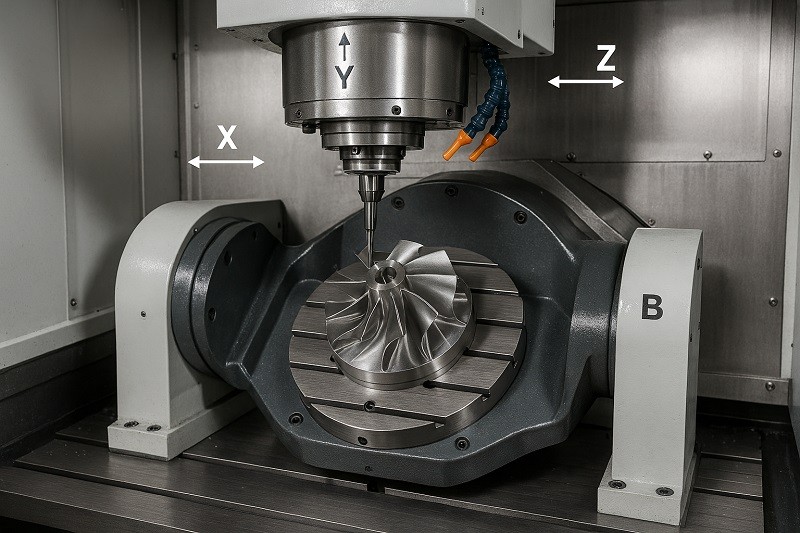
In the world of precision manufacturing, the quest for creating more intricate, durable, and complex custom parts has pushed technology to new heights. While traditional 3-axis CNC machining remains a workhorse for many applications, its limitations become apparent when dealing with complex geometries. This is where multi-axis CNC machining, specifically 5-axis and 6-axis technology, revolutionizes what's possible. These advanced systems introduce rotational axes, allowing the cutting tool to approach a workpiece from virtually any angle in a single setup. This capability significantly reduces the need for multiple setups, which are often a source of error and inefficiency, and opens the door to manufacturing parts previously deemed impossible.
What are the Axes in CNC Machining?
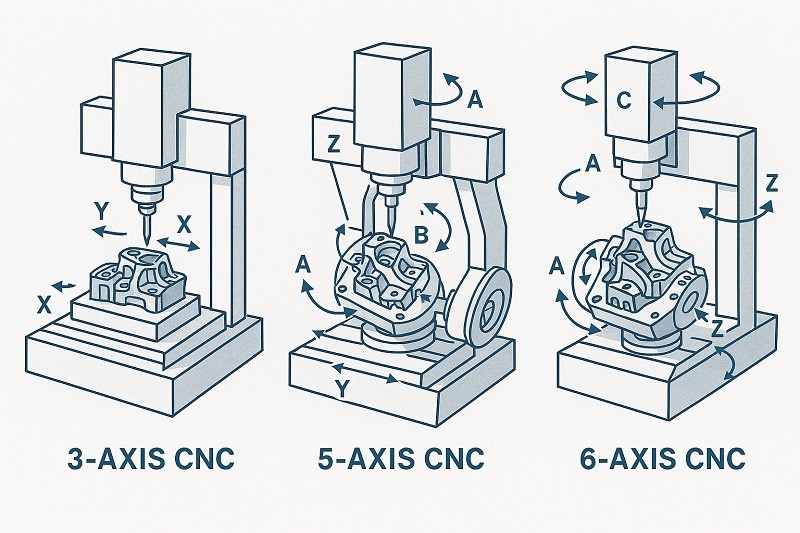
To understand multi-axis machining, we must first define the axes. A standard 3-axis machine operates on three linear axes:
- X-axis: Left-to-right movement
- Y-axis: Front-to-back movement
- Z-axis: Up-and-down movement
Multi-axis machines build upon this foundation by adding rotational axes:
- A-axis: Rotation around the X-axis
- B-axis: Rotation around the Y-axis
- C-axis: Rotation around the Z-axis
This expanded freedom of movement is the key to their advanced capabilities.
The Leap Forward: Understanding 5-Axis CNC Machining
A 5-axis CNC machine utilizes the three linear axes (X, Y, Z) plus two of the three rotational axes. This combination allows the cutting tool to maintain an optimal angle relative to the workpiece surface at all times. By enabling continuous adjustment, it can create complex contours and deep cavities with shorter, more rigid tools. The result is a superior surface finish and higher dimensional accuracy.
Key Benefits of 5-Axis CNC Machining
Opting for 5-axis machining for custom parts offers several distinct advantages over less advanced methods:
- Single-Setup Machining (Done-in-One): The most significant benefit is the ability to machine complex shapes in a single setup. This drastically reduces lead times and eliminates the risk of precision errors that can occur when manually repositioning a workpiece.
- Unmatched Complexity: Parts with complex curves, undercuts, and multifaceted geometries, such as turbine blades or medical implants, can be manufactured with ease.
- Superior Surface Finish: The tool can be held tangentially to the cutting surface, resulting in a smoother finish and reducing the need for secondary polishing operations.
- Shorter, More Rigid Tools: The ability to tilt the tool or workpiece allows for the use of shorter cutting tools. This minimizes tool vibration (chatter), enabling higher cutting speeds and improving accuracy.
The Pinnacle of Precision: What is 6-Axis CNC Machining?
6-axis CNC machining represents the apex of current manufacturing technology. It incorporates all three linear axes (X, Y, Z) and all three rotational axes (A, B, C) simultaneously. The addition of the third rotational axis, often the C-axis, provides complete control over tool orientation and workpiece positioning. This enables the machine to tackle exceptionally complex geometries and transitions with even greater speed and efficiency than a 5-axis machine. Some experts claim 6-axis machining can reduce cutting times by up to 75% compared to its 5-axis counterpart for certain applications.
When is 6-Axis Machining Necessary?
While incredibly powerful, 6-axis CNC is a specialized solution. Its true advantage shines in a few key areas:
- Extreme Geometrical Complexity: For parts that require machining on all six sides or have twisting internal features, like engine blocks or advanced aerospace components, 6-axis is often the only viable solution.
- Maximum Efficiency for High-Volume Production: In industries where speed is critical, the ability of a 6-axis machine to perform more operations without interruption can lead to dramatic reductions in cycle times.
- Versatile Operations: A single 6-axis machine can perform a wide range of tasks, including milling, turning, drilling, and grooving, consolidating multiple processes into one unit.
5-Axis vs. 6-Axis: A Comparative Look
Choosing between 5-axis and 6-axis machining depends heavily on the specific requirements of the custom part. Here is a breakdown to help guide the decision:
| Feature | 5-Axis CNC Machining | 6-Axis CNC Machining |
|---|---|---|
| Axes | 3 Linear (X,Y,Z) + 2 Rotational (A,B or B,C) | 3 Linear (X,Y,Z) + 3 Rotational (A,B,C) |
| Complexity | Ideal for highly complex parts and 5-sided machining. | The ultimate solution for the most extreme geometries and 6-sided machining. |
| Speed | Significantly faster than 3-axis due to single setup. | Potentially much faster than 5-axis for specific, ultra-complex tasks. |
| Cost | High initial investment, but cost-effective for complex parts. | Very high initial and operational costs. |
| Common Use | Aerospace, medical implants, automotive prototypes. | High-end aerospace, specialized engine components, complex turbines. |
Industry Applications of Multi-Axis Machining
The impact of 5-axis and 6-axis technology is felt across numerous high-stakes industries where precision and reliability are non-negotiable:
- Aerospace: Manufacturing of turbine blades, impellers, and complex structural components from lightweight alloys.
- Medical: Creation of custom orthopedic implants, surgical instruments, and prosthetics with intricate, ergonomic shapes.
- Automotive: Prototyping and production of engine components, molds for body panels, and high-performance parts.
- Energy: Machining durable components for the oil and gas industry, including parts for wind turbines and compressors.
The Cost-Benefit Analysis: Is It Worth the Investment?
There's no denying that the initial investment for multi-axis CNC machines is substantial. The cost of a 6-axis machine, in particular, can be significantly higher than a 5-axis setup. Furthermore, operating these machines requires highly skilled programmers and engineers, which adds to the operational costs. However, for the right application, the return on investment can be immense. The reduction in setup times, minimization of human error, lower tooling costs, and faster cycle times often outweigh the upfront expense, especially for producing high-value, complex custom parts.
Choosing the Right Technology for Your Custom Parts
Ultimately, the choice does not come down to which technology is 'better,' but which is 'right' for your project. Ask these questions:
- What is the geometric complexity of my part? Can it be produced with fewer axes, or does it require full 5- or 6-sided machining?
- What are the accuracy and surface finish requirements? Multi-axis machining provides superior quality.
- What is my production volume? For high-volume, complex parts, the speed of 6-axis machining might provide a competitive edge.
- What is my budget? 5-axis machining offers a powerful balance of capability and cost for most complex applications, while 6-axis is reserved for the most demanding and specialized jobs.

The Future is Multi-Axis
As designs for custom parts continue to push the boundaries of engineering, the adoption of 5-axis and 6-axis CNC machining will only grow. These technologies are no longer a niche capability but a crucial tool for innovation. By enabling the creation of stronger, lighter, and more complex components in a single, efficient process, they are paving the way for the next generation of manufacturing excellence across all industries.