A Manufacturer's Guide: Exploring Steel Supply and Sheet Metal Fabrication
- Share
- Issue Time
- Jan 21,2026
Summary
Understanding key sheet metal fabrication techniques (laser cutting, punching, bending, welding, finishing, machining); choosing ideal manufacturers (capabilities, certifications like ISO 9001, pricing/lead times, vendor types); steel supply basics (carbon vs. stainless steel); DFM principles and process synergies.
As manufacturers, we understand that precision, reliability, and efficiency are the cornerstones of modern industrial production. This guide is designed to help you navigate the intricate world of steel supply and identify the best sheet metal fabrication manufacturer for your specific needs. We will explore everything from fundamental fabrication techniques to the critical process of selecting the right partner, ensuring your projects are delivered on time, within tolerance, and at a competitive cost.
Sheet metal fabrication is a sophisticated process that merges artistry with advanced technology, transforming raw metal sheets into bespoke products and components. We will delve into foundational techniques such as cutting, bending, and welding, and understand how they contribute to creating essential parts for nearly every industry imaginable. From industrial machinery and automotive components to intricate architectural elements, steel remains a foundational material in manufacturing. This comprehensive guide will empower you to make informed decisions, understand the nuances of steel supply, and ultimately partner with a reliable sheet metal fabrication manufacturer that upholds the highest standards of quality and efficiency.
Understanding Key Sheet Metal Fabrication Techniques: What Every Manufacturer Should Know
Sheet metal fabrication is the process of transforming flat sheets of metal into specific three-dimensional shapes through a variety of forming, cutting, and assembly methods. This complex process consists of several distinct techniques, including cutting, forming, joining, and finishing, to achieve the final desired component. A thorough understanding of these core processes is essential for any manufacturer looking to optimize their designs for production, ensure quality, and manage costs effectively.
The Art of Cutting and Shearing
The very first step in most fabrication projects is to cut the raw material to the required size and shape. Cutting processes are broadly categorized into two groups: those that use shear force and those that do not. Shearing involves applying a strong mechanical force to cause the material to fail along a straight line, making it a highly economical method for initial sizing. This category includes processes like blanking and punching, which are fundamental to creating the initial part profile from a larger sheet.
The process involves placing the metal sheet between an upper blade (punch) and a lower blade (die). When sufficient force is applied, the material yields and separates cleanly. This method is valued for its speed and for producing minimal waste, as it doesn't create chips like machining does. The primary steps in a typical shearing operation are positioning the material, clamping it securely to prevent movement, applying the shearing force, and then ejecting the finished piece. This foundational technique sets the stage for all subsequent forming and assembly operations.
Laser Cutting: Precision and Complexity
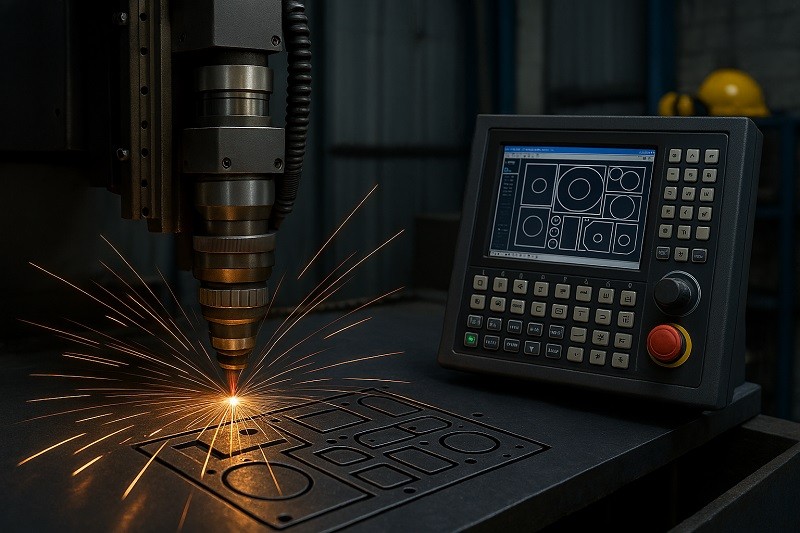
Laser cutting is a thermal process that utilizes a highly focused, high-energy beam of light to melt, burn, or vaporize material with extreme precision. Directed by a Computer Numerical Control (CNC) system, the laser follows a programmed path, allowing for the creation of intricate and complex geometries that would be difficult or impossible to achieve with traditional mechanical cutting methods.
Key Advantages of Laser Cutting:
- High Precision and Tight Tolerances: Laser cutting is renowned for its accuracy, capable of achieving tolerances from ±0.1 mm to ±0.5 mm, which is ideal for complex designs. This precision ensures parts fit together perfectly during assembly.
- Superior Edge Quality: Because the laser melts the material rather than physically cutting it, it produces smooth, sharp, and clean edges with very little burring, reducing the need for secondary finishing operations.
- Versatility: This technique can be used on a vast array of materials, including various grades of steel, stainless steel, aluminum, copper, and brass, at thicknesses ranging from 0.005" to 1".
- Speed and Automation: Automated laser cutting systems can operate at high speeds, significantly reducing labor costs compared to manual methods. The ability to "nest" multiple parts onto a single sheet of metal in the design phase optimizes material usage and minimizes waste.
The process begins with a digital CAD file, which is then programmed into the CNC machine. The operator sets parameters like laser power and speed, and an assist gas (like oxygen or nitrogen) is used to blow away the molten material, ensuring a clean cut. This method is an excellent choice for everything from rapid prototyping to large-scale industrial production runs.
Punching: Efficiency in Repetitive Tasks
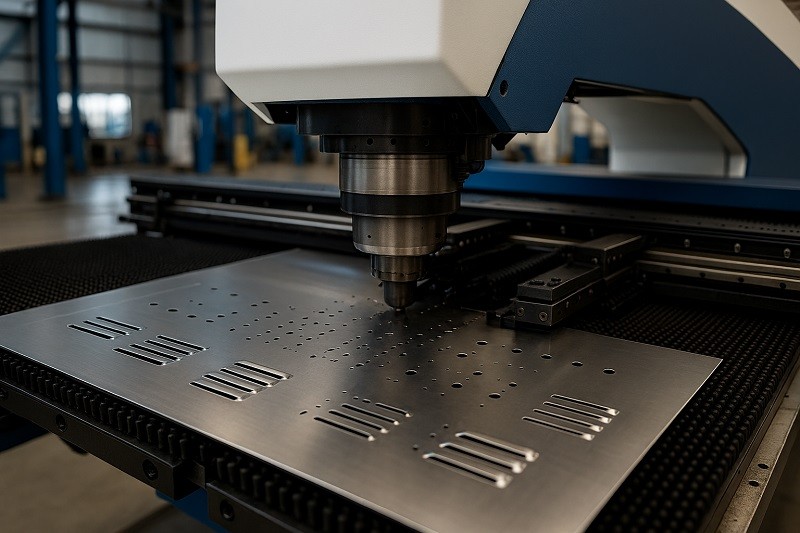
CNC punching is another automated fabrication process that uses a computer-controlled press to create holes, slots, and other forms in sheet metal. A sheet of metal is clamped onto the machine's bed, and the computer directs a punching ram to strike the material with specific tools and dies according to a digital design file. This method is exceptionally efficient for parts that require a large number of standard-shaped holes or repetitive features.
Key Advantages of CNC Punching:
- High Speed and Productivity: CNC punching machines are incredibly fast, with some capable of completing thousands of punches per hour. This high throughput makes it very cost-effective for large production runs.
- Consistency and Repeatability: The automated nature of CNC punching ensures that every part produced is identical, adhering to strict quality standards with minimal chance of human error.
- Versatility in Forming: Beyond simple holes, modern turret punch presses can be equipped with tooling to perform forming operations like creating embossments, flanges, louvers, and even threads directly on the part, consolidating operations and reducing the need for secondary processes.
- Cost-Effectiveness: For designs with many standard features, punching is often more economical than laser cutting because the mechanical action is faster and consumes less energy per feature. The process is ideal for creating components like ventilation panels, electrical enclosures, and mounting brackets.
The process starts with a CAD design that is translated into machine code. The operator loads the sheet, and the CNC system automatically moves the material to position it under the correct tool in the turret for each punch, executing the program with high speed and precision.
Bending and Forming for Diverse Applications
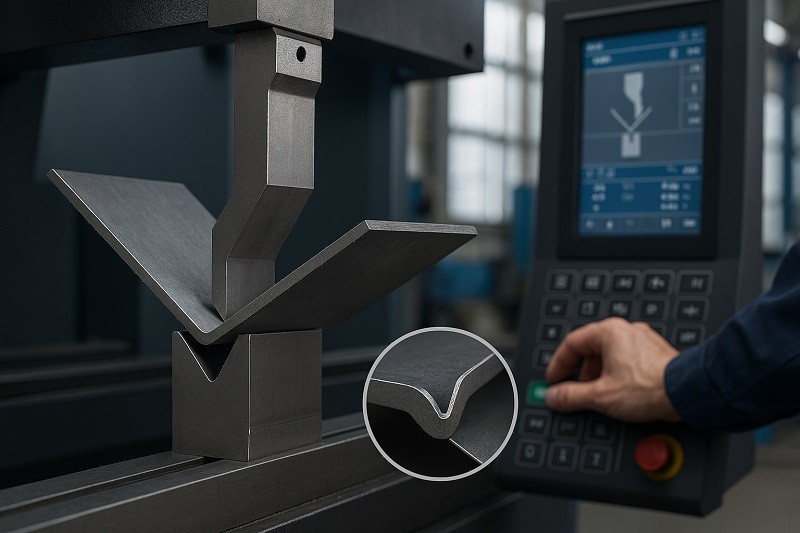
Once a sheet metal part has been cut to its flat-pattern profile, the next step is typically bending or forming it into its final three-dimensional shape. This process, also known as press braking, involves deforming the metal along a straight axis without adding or removing material. It is a foundational technique used to create angles, channels, and complex geometries in everything from small brackets to large enclosures.
The most common machine used for this is the press brake, which applies force to the sheet metal placed between a punch and a die. By carefully selecting the tooling and controlling the force, a fabricator can create a wide variety of bend types:
- V-Bending: The most common method, using a V-shaped punch and die to create a range of angles.
- Air Bending: A versatile technique where the punch does not force the sheet to the bottom of the die. The bend angle is controlled by the punch's depth of stroke, allowing for multiple angles with a single tool set.
- Bottoming and Coining: These methods press the material fully into the die, resulting in high precision and sharp bend radii.
- Roll Bending: This process uses rollers to form large, gradual curves or to create cylindrical and conical shapes.
Sheet metal bending is ubiquitous in manufacturing, with applications in the automotive, aerospace, furniture, and consumer appliance industries. Modern CNC press brakes offer high levels of repeatability and precision, making them suitable for both low-volume prototyping and large-scale production runs.
Welding and Finishing: Bringing Components Together
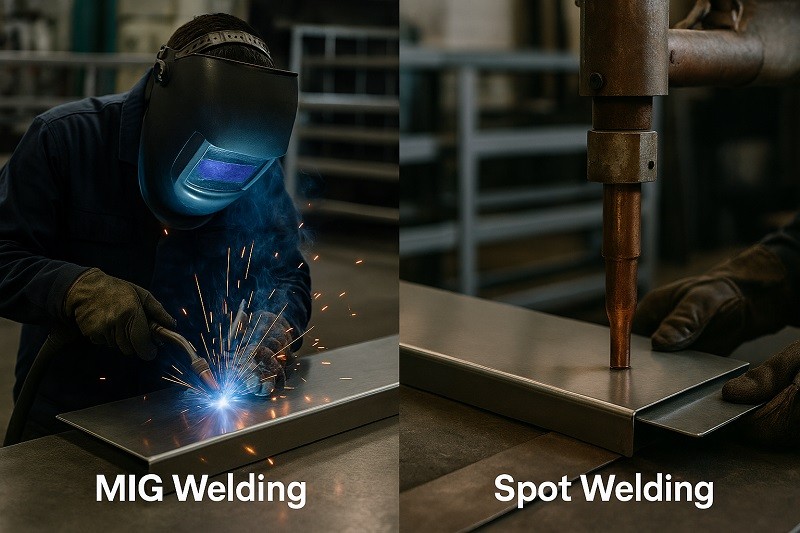
Welding is the primary process used to join separate sheet metal components into a single, robust assembly. It involves heating the edges of the metal parts to their melting point and fusing them together, often with the addition of a filler material to strengthen the joint. A fabrication shop will typically employ several welding methods, each suited for different materials, thicknesses, and application requirements.
Common Welding Techniques for Sheet Metal:
| Welding Method | Description | Best For |
|---|---|---|
| MIG Welding (GMAW) | Uses a continuous wire-fed electrode and a shielding gas. It's known for its speed and ease of use. | Thicker materials, structural components, and applications where speed is a priority. Works well on steel, stainless steel, and aluminum. |
| TIG Welding (GTAW) | Uses a non-consumable tungsten electrode and a separate, hand-fed filler rod. It offers exceptional control and precision. | Thin materials, cosmetic joints, and high-precision applications. It produces very clean, strong welds on stainless steel and aluminum. |
| Spot Welding | A resistance welding process where two copper electrodes clamp metal sheets together and pass a strong electrical current to fuse them at a single "spot." | Joining overlapping sheets of thin metal, common in the automotive industry for its speed in mass production. |
| Laser Welding | Uses a highly concentrated laser beam to melt and join materials. It offers high precision with minimal heat distortion. | Delicate parts, thin materials, and applications requiring minimal heat-affected zones. |
After welding and assembly, most parts undergo finishing processes to improve their appearance, durability, and corrosion resistance. Common finishing options include:
- Powder Coating: A durable and weather-resistant finish applied as a dry powder and then cured with heat.
- Galvanizing: Coating steel with a layer of zinc to provide excellent corrosion protection, especially for outdoor use.
- Anodizing: An electrochemical process primarily for aluminum that creates a hard, corrosion-resistant oxide layer and can be dyed in various colors.
- Passivation: A chemical treatment for stainless steel that removes surface contaminants and enhances its natural corrosion resistance.
Machining for Intricate Details
While sheet metal fabrication primarily involves cutting and forming flat sheets, many components require features that these processes alone cannot create. This is where CNC machining plays a vital complementary role. Machining is a subtractive process that uses cutting tools like drills and end mills to remove material and create precise, intricate features.
In the context of sheet metal, CNC machining is employed to add details after the main forming is complete. This includes:
- Drilling and Tapping: Creating threaded holes for screws and fasteners.
- Countersinking: Creating a conical hole to allow the head of a screw to sit flush with the surface.
- Milling: Cutting slots, pockets, chamfers, and other complex shapes with high precision.
- Boring: Enlarging existing holes to a very tight tolerance.
By integrating CNC machining into the fabrication workflow, manufacturers can produce highly complex parts that combine the strength and lightweight properties of sheet metal with the precision features of a machined component. This hybrid approach is crucial for achieving the tight tolerances and complex geometries required in many modern engineering applications.
 ## Choosing Your Ideal Sheet Metal Fabrication Manufacturer: A Strategic Approach
Selecting the right sheet metal fabrication partner is as critical as the design of your product itself. A good manufacturer acts as an extension of your team, providing valuable expertise, ensuring quality, and helping to optimize costs. While a low price can be attractive, true value comes from a partner’s capabilities, reliability, and commitment to your project's success. A strategic approach to vetting and selecting a manufacturer involves a holistic evaluation of their technical abilities, quality systems, and business practices.
Evaluating Capabilities and Equipment
The first step in choosing a partner is to ensure their capabilities align with your project's specific needs. This goes beyond a simple checklist; it requires a deep dive into their technical expertise, the modernity of their equipment, and the breadth of their services.
Key areas to evaluate include:
- State-of-the-Art Equipment: Does the fabricator invest in the latest technology, such as modern CNC machines, fiber laser cutters, automated press brakes, and robotic welders? Advanced equipment directly translates to higher precision, faster cycle times, and greater efficiency.
- Range of In-House Services: A manufacturer that offers a full suite of services—from initial design and engineering support to fabrication, machining, welding, assembly, and finishing—can act as a one-stop shop. This integration saves significant time and cost by eliminating the need to ship components between multiple vendors.
- Material Specialization: Not all fabricators work with all materials. Confirm that the shop has extensive experience with the specific metals your project requires, whether it's common materials like stainless steel and aluminum or high-strength alloys like titanium.
- Technical Expertise: The skill of the operators and engineers is just as important as the machinery. Look for a team with a proven track record, certified welders, and engineers who can provide valuable Design for Manufacturability (DFM) feedback.
- Production Capacity: Assess whether the shop is a good fit for your order volume. Some are optimized for high-volume production, while others specialize in prototyping and low-volume runs. Ensure their capacity and lead times can meet your production schedule.
Quality Standards and Certifications: The Mark of a Reliable Sheet Metal Fabrication Manufacturer
Certifications are a clear indicator of a manufacturer's commitment to quality, consistency, and process control. They demonstrate that the company's quality management system (QMS) has been independently audited and verified to meet international standards.
The most important certification to look for is ISO 9001:2015. This is the global benchmark for a QMS. An ISO 9001-certified fabricator has established, documented processes for every stage of production, from quoting and material procurement to final inspection and delivery.
Benefits of working with an ISO 9001-certified partner:
- Consistent Quality: The standard ensures strict quality control procedures are followed, reducing a manufacturer's rate of scrap and rework, which in turn lowers production costs. This leads to a more consistent and reliable final product for you, the customer.
- Process Control: ISO 9001 requires a process-driven approach that helps resolve problems quickly and effectively. It brings stability and predictability to the inherent variability of custom fabrication.
- Continuous Improvement: The standard mandates that companies continuously monitor their processes and use data—such as on-time delivery metrics and defect rates—to drive improvements.
- Customer Confidence: Choosing a certified supplier gives you peace of mind, knowing that their quality practices adhere to globally recognized best-practice principles.
Depending on your industry, other certifications may be critical as well, such as AS9100 for aerospace or specific AWS (American Welding Society) or ASME (American Society of Mechanical Engineers) standards for welding-intensive projects. Always ask for proof of current certifications and inquire about their specific quality control processes, including material traceability, in-process inspections, and final product testing.
Pricing, Lead Time, and Transparency
While quality and capabilities are paramount, cost and delivery time are often deal-breakers. It's essential to understand the factors that drive these variables and to look for a partner who offers transparent and realistic estimates.
Key Factors Influencing Cost and Lead Time:
| Factor | Impact on Cost & Lead Time |
|---|---|
| Material | The type and thickness of the metal are primary cost drivers. Special alloys cost more and may have longer procurement lead times. |
| Part Complexity | More intricate designs with complex curves, numerous bends, and tight tolerances require more machine time, specialized tooling, and skilled labor, increasing both cost and lead time. |
| Tolerances | Tighter tolerances often necessitate slower machine speeds or secondary processes like CNC machining, which increases cost and can extend lead times from weeks to months. |
| Production Volume | For processes like stamping, high initial tooling costs are amortized over large quantities, making the per-piece price very low. For smaller batches, processes like laser cutting and bending are more cost-effective. |
| Finishing & Assembly | Secondary processes like powder coating, hardware insertion, and complex assembly add steps to the workflow, increasing both cost and overall lead time. |
A reliable manufacturer will provide a detailed and transparent quote that breaks down these costs. They should also be able to give you a realistic lead time based on material availability, current shop capacity, and the complexity of your project. Be wary of quotes that are significantly lower than others, as they may reflect compromises in quality, or hidden costs that appear later.
Vendor Types: Marketplaces vs. Factory-Direct Sheet Metal Fabrication Manufacturer Options
In today's manufacturing landscape, you have several options for sourcing your fabricated parts. The two primary models are working directly with a factory or using a manufacturing marketplace.
Factory-Direct Manufacturers: These are traditional fabrication shops, ranging from small local businesses to large contract manufacturers. When you work with them, you are communicating and collaborating directly with the people who will be producing your parts.
- Pros: Building a direct relationship fosters better communication, allows for deeper collaboration on design, and often results in higher and more consistent quality. You know exactly who is making your parts and can hold them accountable.
- Cons: Finding and vetting the right factory can be time-consuming. They may have a narrower range of capabilities compared to a large network.
Manufacturing Marketplaces (e.g., Xometry, Protolabs): These are digital platforms that connect you to a vast, distributed network of third-party suppliers. You upload your CAD files, and their AI-powered engines provide instant quotes, then match your job with a supplier in their network.
- Pros: Unmatched speed in quoting, access to a massive range of manufacturing processes and materials, and often competitive pricing, especially for prototypes and small runs. Outsourcing to these platforms can also lead to significant cost savings as they benefit from economies of scale and specialized equipment without you needing to invest in capital.
- Cons: You often don't know which specific shop is making your parts, which can lead to inconsistent quality from one order to the next. You're working through a middleman, which can make communication and problem-solving more difficult. While good for prototypes, they can struggle with scaling to large, complex production orders.
The Best Choice Depends on Your Needs:
- Choose Factory-Direct when you require high quality, consistent production, customized products, and want to build a long-term collaborative partnership. This model is ideal for complex assemblies and scaling to production volumes.
- Choose a Marketplace when you need parts very quickly (especially prototypes), require a process that a trusted local shop doesn't offer, or have a simple, one-off job where price and speed are the top priorities.## Exploring Leading Sheet Metal Fabrication Manufacturer Partners
The on-demand manufacturing industry has revolutionized how companies source custom parts. Digital platforms and specialized manufacturers offer a spectrum of services, from rapid prototyping to high-volume production. Understanding the strengths of these different partners can help you align your project with the right provider, whether your priority is speed, cost, precision, or end-to-end management.
RapidDirect: Speed and Cost-Effectiveness from a Global Sheet Metal Fabrication Manufacturer
RapidDirect has established itself as a significant player in the on-demand manufacturing space, known for its competitive pricing and fast turnaround times for prototyping and low-volume production. Operating primarily from China, the company leverages a combination of in-house factories and a network of suppliers to offer a wide range of services, including CNC machining and sheet metal fabrication.
Customers often praise RapidDirect for its user-friendly online platform, which provides an efficient ordering process. The company is particularly recognized for being substantially more affordable than many domestic alternatives, making it a strong choice for businesses looking to manage costs on lower-value parts or initial prototypes. While they primarily focus on speed and cost, they also maintain stringent quality control measures to ensure final products meet required standards. Their model is well-suited for innovators and companies needing to move from concept to physical part quickly and affordably.
Xometry and Protolabs: Broad Networks and High-Precision Sheet Metal Fabrication Manufacturer Services
Xometry and Protolabs are two of the titans in the digital manufacturing industry, both offering instant quoting and a vast array of services but with different underlying models.
Xometry operates one of the world's largest manufacturing platforms, connecting customers to a global network of over 10,000 vetted suppliers. This distributed model gives them massive capacity and an extensive range of capabilities, from sheet metal fabrication and CNC machining to 3D printing and injection molding. Their AI-powered instant quoting engine simplifies sourcing, making it fast and easy to get pricing for parts in hundreds of material and finish combinations. Xometry is an excellent choice for a wide variety of needs, from low-volume prototypes to high-volume production runs, offering both domestic and overseas fabrication options.
Protolabs is renowned for its incredible speed, often delivering custom parts in as fast as a single day. They achieve this through their own highly automated, in-house manufacturing facilities. This direct control allows them to maintain strict quality standards and offer industry-leading turnaround times, making them a premier choice for rapid prototyping and time-critical projects. While their services can be more expensive than marketplace alternatives, customers who prioritize speed and reliability often find the premium to be worthwhile. Their offerings include CNC machining, injection molding, 3D printing, and sheet metal fabrication.
Fictiv and Hubs: Managed Prototyping from a Trusted Sheet Metal Fabrication Manufacturer
Fictiv and Hubs (now Protolabs Network) operate on a "managed marketplace" model, which blends the breadth of a supplier network with an added layer of quality control and project management.
Fictiv provides access to a highly vetted global network of manufacturing partners, offering a simplified sourcing experience for custom parts. What sets Fictiv apart is its emphasis on guided expertise and quality management. Their platform provides valuable Design for Manufacturability (DFM) feedback during the quoting process, helping engineers optimize their parts for production. They offer a wide range of services, including CNC machining, sheet metal fabrication, and assembly, with a variety of material and finishing options. Fictiv acts as a single trusted partner, managing the entire production process to ensure consistent quality and help teams move from prototype to full-scale production seamlessly.
Hubs, which started as a peer-to-peer 3D printing network, was acquired by Protolabs and rebranded as Protolabs Network. It now serves as Protolabs' network manufacturing arm, complementing their in-house rapid prototyping services. Protolabs Network leverages a global network of over 250 vetted partners to offer more competitive pricing for volume production, tighter tolerances, and a broader range of complex capabilities than what Protolabs' automated factories can provide alone. This hybrid model allows customers to access the speed of Protolabs for prototypes and the expanded capabilities and cost-effectiveness of the network for more demanding production runs, all through a single platform.
Specialized Sheet Metal Fabrication Manufacturer Options: 3ERP, Star Rapid, eMachineShop, and JLC CNC
Beyond the major platforms, numerous specialized manufacturers cater to specific needs, from high-quality prototyping to ultra-low-cost production.
3ERP is a global rapid prototyping company that has built a strong reputation for high quality, fast communication, and reliable service. They offer a range of services including CNC machining, sheet metal, and 3D printing, with a focus on providing personalized support from a dedicated team. Customers praise 3ERP for delivering excellent results on complex parts and for their cost-effective solutions without sacrificing quality.
Star Rapid, based in China, is a world-class facility focused on rapid prototyping, rapid tooling, and low-volume manufacturing. They serve a global clientele, offering a suite of services that includes CNC machining, metal 3D printing, and injection molding. Star Rapid is known for its advanced equipment and for helping innovators turn ideas into reality with high-quality custom parts.
eMachineShop offers a unique approach by providing free proprietary CAD software that allows users to design parts, get instant pricing, and place an order seamlessly. This makes it an accessible option for both novices and experienced engineers. They manufacture a wide range of custom parts with no minimum order quantity and provide services like CNC milling, turning, and sheet metal fabrication.
JLC CNC (part of the JLCPCB family) has gained significant attention for its incredibly low pricing, particularly for 3D printing and prototyping services. Leveraging their massive supply chain experience in the PCB industry, they are able to offer prices that are often a fraction of their competitors'. While shipping from their base in China can take time, their cost-effectiveness makes them a compelling option for hobbyists, startups, and projects where budget is the primary driver.## The Strategic Integration of Steel Supply and Sheet Metal Fabrication for Peak Performance
Achieving excellence in manufacturing isn't just about mastering fabrication techniques; it's about the strategic integration of the entire supply chain, starting with the raw material itself. For a vast number of industries, that material is steel. A holistic approach that considers material science, design optimization, and process synergy is what separates leading manufacturers from the rest. This integration plays a strategic role in reducing assembly times, enabling just-in-time delivery models, and facilitating faster prototyping cycles. By viewing the supply chain as an interconnected system, from steel sourcing to final part delivery, companies can build more resilient and efficient operations.
The Enduring Legacy of Steel in Industry
Steel is more than just a material; it is the backbone of modern civilization and a cornerstone of the global economy. From the towering skyscrapers and sprawling bridges that define our cities to the cars we drive and the household appliances we use daily, steel is ubiquitous. Its widespread adoption stems from its unparalleled combination of strength, durability, and versatility. The development of various steel alloys has been a pivotal factor in human civilization, powering the Industrial Revolution and continuing to drive innovation today.
The steel industry is a massive economic engine, providing direct employment for over 6 million workers and supporting an estimated 40 million additional jobs throughout its global supply chain. In today's economy, steel's role is critical in several key sectors:
- Construction and Infrastructure: Steel's high tensile strength allows it to support massive structures, making it essential for everything from residential homes to bridges and tunnels.
- Automotive and Transportation: The auto industry relies heavily on steel for frames, engines, and other components due to its ability to make vehicles safer and more efficient.
- Energy: Steel is crucial for energy production and distribution, used in the construction of pipelines, power plants, and renewable energy infrastructure like wind turbines.
- Manufacturing and Machinery: The versatility of steel allows it to be used in countless machines, tools, and equipment across every industrial sector.
As the world moves toward more sustainable practices, the steel industry is also adapting with innovations in recycling and greener production methods, ensuring its legacy will continue for generations to come.
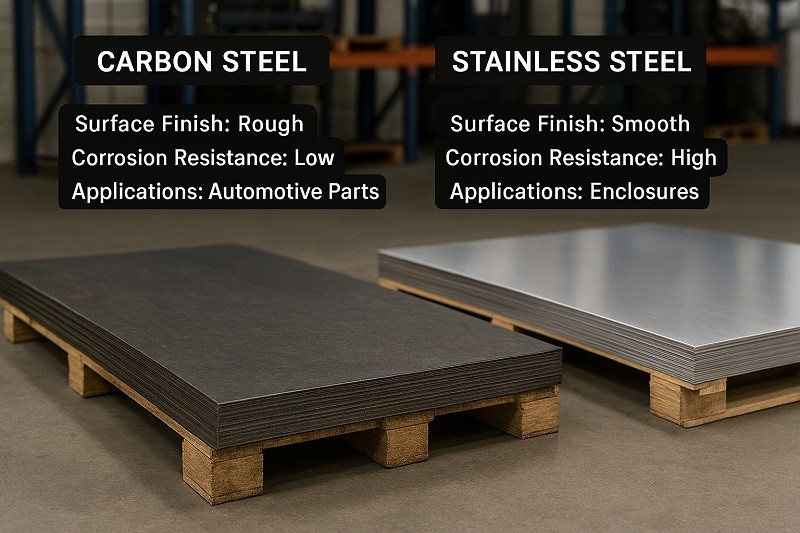
Carbon Steel vs. Stainless Steel: Material Selection for Your Sheet Metal Fabrication Manufacturer
Choosing the right type of steel is one of the most critical decisions in sheet metal fabrication. The two most common families are carbon steel and stainless steel, and their distinct properties make them suitable for very different applications.
Carbon Steel is an alloy of iron and carbon, valued for its strength, ductility, and exceptional cost-effectiveness. Its lower production cost and widespread availability make it a go-to choice for large-scale applications where budget is a key constraint. However, its primary drawback is its vulnerability to rust and corrosion when exposed to moisture.
Stainless Steel, by contrast, is an alloy that contains a minimum of 10.5% chromium. This chromium creates a passive, self-healing layer on the surface that provides excellent resistance to corrosion and rust. While significantly more expensive than carbon steel, its durability and hygienic properties make it indispensable in demanding environments.
Here is a detailed comparison to guide your selection:
| Property | Carbon Steel | Stainless Steel |
|---|---|---|
| Corrosion Resistance | Poor. Prone to rusting and requires a protective coating (e.g., paint, galvanizing) for most applications. | Excellent. The chromium content creates a passive layer that prevents rust. |
| Strength | High tensile and yield strength, making it very strong and resistant to deformation. | Generally has lower yield strength than high-carbon steel, making it "softer" and more prone to denting, but very durable overall. |
| Cost | Significantly more affordable due to lower raw material and processing costs. | Higher initial cost due to the inclusion of expensive alloying elements like chromium and nickel. |
| Appearance | Dull, matte finish that is typically painted or coated. | Can be finished to have a range of appearances, from brushed to a bright, polished finish. |
| Weldability | Generally easy to weld, though higher carbon grades can be more challenging. | One of the easiest metals to weld due to its lower melting point. |
| Common Applications | Structural components, automotive parts, machinery, pipes, and general fabrication where cost is a primary driver. | Medical equipment, kitchen appliances, food processing, marine hardware, and architectural elements where corrosion resistance and appearance are critical. |
Ultimately, the choice between carbon and stainless steel depends on a trade-off between cost and performance. For applications where durability and corrosion resistance are paramount, stainless steel is the superior choice. For cost-sensitive projects that are not exposed to corrosive environments, carbon steel offers excellent strength and value.
Optimizing Design for Manufacturability (DFM) with Your Sheet Metal Fabrication Manufacturer
Design for Manufacturability (DFM) is a strategic design practice focused on creating parts that are easy and cost-effective to produce. By considering the capabilities and limitations of fabrication processes during the design phase, engineers can significantly reduce production time, minimize material waste, and improve overall product quality. Collaborating with your sheet metal fabricator early in the process is key to leveraging their expertise and achieving an optimized design.
Here are some essential DFM principles for sheet metal design:
- Maintain a Uniform Wall Thickness: Since parts are created from a single sheet, a consistent thickness is a fundamental rule.
- Design Generous Bend Radii: The inside bend radius should generally be at least equal to the material thickness. Softer materials can handle tighter radii, while harder materials like stainless steel may need a radius of 1.5 to 2 times the thickness to prevent cracking or distortion. Keeping radii consistent across a single part simplifies tooling and reduces setup costs.
- Position Holes and Slots Carefully: To avoid distortion or bulging, features should be placed away from bends and edges. A common guideline is to place holes at least 2.5 times the material thickness plus the bend radius away from a bend. Holes should also be positioned at least one material thickness away from part edges.
- Use Standard Hole Sizes: Designing with standard tool sizes for holes and slots eliminates the need for custom tooling, which simplifies manufacturing and reduces costs.
- Incorporate Bend Reliefs: When a bend is made close to an edge, stress can cause tearing. Adding small notches, known as bend reliefs, at the ends of a bend line prevents this.
- Simplify to Reduce Operations: The fewer cuts, bends, and welds a part has, the less expensive it will be to produce. Look for opportunities to simplify the design without compromising its function.
Modern digital manufacturing platforms often provide instant DFM feedback, automatically flagging potential issues in a CAD model before it ever reaches the shop floor, which can dramatically shorten development cycles.
The Synergy of Laser Cutting and Punching at Your Sheet Metal Fabrication Manufacturer
While laser cutting and CNC punching are often seen as competing technologies, the greatest efficiency is often achieved by using them together. Each process has distinct advantages: laser cutting excels at complex contours and one-off parts, while punching is unparalleled for speed in creating standard, repetitive features. Advanced manufacturers harness the synergy between these two processes to optimize production for both cost and speed.
A part with both intricate outer profiles and multiple standard holes is a perfect candidate for a combined approach. The workflow might involve using a CNC punch press to quickly create all the standard holes and then moving the part to a laser cutter for the complex external contours.
This synergy is best exemplified by punch-laser combination machines. These highly versatile systems integrate both a CNC turret punch and a fiber laser into a single unit, offering the best of both worlds in one setup.
Advantages of Punch-Laser Combination Machines:
- Flexibility and Efficiency: The machine can seamlessly switch between punching standard holes at high speed and laser cutting complex shapes, all within a single program. This is ideal for parts that have both forming features (like louvers or extrusions) and intricate cutouts.
- Reduced Production Time: By completing multiple processes on one machine, material handling and setup time between separate machines is eliminated, reducing overall production time by as much as 60%.
- Cost Savings: Consolidating operations reduces labor costs and eliminates the need for expensive custom tooling for non-standard shapes, as the laser can cut them directly.
- Improved Material Utilization: The combination allows for highly efficient nesting of parts, reducing scrap material and further lowering costs.
By intelligently assigning features to the most appropriate process—punching for speed, laser for complexity—manufacturers can deliver higher quality parts faster and more cost-effectively.
Conclusion
Navigating the landscape of steel supply and sheet metal fabrication can be a formidable task. However, by arming yourself with a solid understanding of the key fabrication techniques, establishing a strategic framework for evaluating potential partners, and aligning with the right sheet metal fabrication manufacturer, you can confidently steer your projects toward success. The journey from a raw sheet of steel to a finished component is one of precision, and every decision along the way contributes to the final outcome.
Our exploration through the world of sheet metal fabrication has underscored the critical importance of precision, efficiency, and—above all—strategic partnerships. The insights in this guide are designed to empower you, transforming the complex task of sourcing into a strategic advantage. By applying these principles, you are now better equipped to select a sheet metal fabrication manufacturer that not only meets your technical specifications but also functions as a valued collaborator in your manufacturing endeavors. We encourage you to share this guide with your colleagues and use it as a foundation for discussion as you embark on your next project, ensuring you build not just parts, but lasting success.