A Guide to Sourcing High-Performance SLS 3D Printed Parts from China: Materials, Applications, and Quality
- Share
- Issue Time
- Dec 20,2025
Summary
This guide provides a comprehensive overview of sourcing high-performance SLS 3D printed parts from China, covering popular materials (PA12, glass-filled, carbon fiber, TPU), typical applications, post-processing methods, quality control essentials, and supplier selection tips to help businesses efficiently obtain reliable SLS parts.
Unlocking Advanced Manufacturing with Chinese SLS 3D Printing
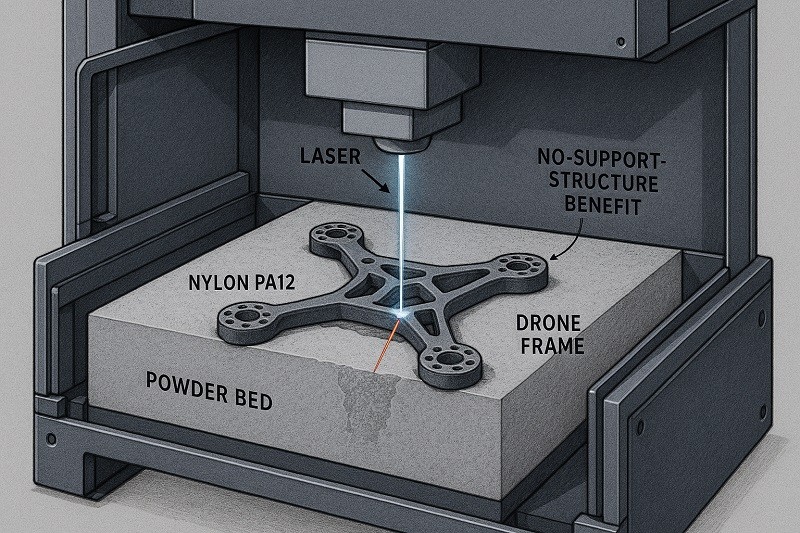
Selective Laser Sintering (SLS) has emerged as a powerhouse technology in the additive manufacturing landscape. It is renowned for its unique ability to produce robust, functional parts with complex geometries that are often impossible to create with traditional methods. By using a high-power laser to fuse powdered polymers layer by layer, SLS builds components without the need for support structures, unlocking unparalleled design freedom. China, with its robust manufacturing infrastructure and technological prowess, has become a global hub for high-quality, cost-effective SLS 3D printing services, catering to industries from aerospace to medical devices.
What Makes SLS the Go-To for Functional Parts?
Unlike other 3D printing methods that may be better suited for visual prototypes, SLS excels in creating durable, end-use components. The process sinters polymer particles together, resulting in parts with excellent, near-isotropic mechanical properties. This means the parts are almost equally strong in all directions, similar to injection-molded components. This strength, combined with high thermal and chemical resistance, makes SLS parts ideal for real-world testing and production applications. The absence of support structures also means faster post-processing and the ability to nest multiple parts in a single build, making it highly efficient for small to medium-volume production runs.
Why Source SLS 3D Printed Parts from China?
China's manufacturing ecosystem offers several distinct advantages for sourcing SLS parts. Service providers in the region leverage state-of-the-art equipment and a vast material supply chain to offer competitive pricing without compromising on quality. Decades of manufacturing experience translate into streamlined processes, rapid turnaround times, and a deep understanding of quality control. Chinese suppliers often provide a one-stop-shop experience, from initial design validation to advanced post-processing and global shipping, making them a reliable partner for companies worldwide.
The Workhorse Material: Nylon PA12
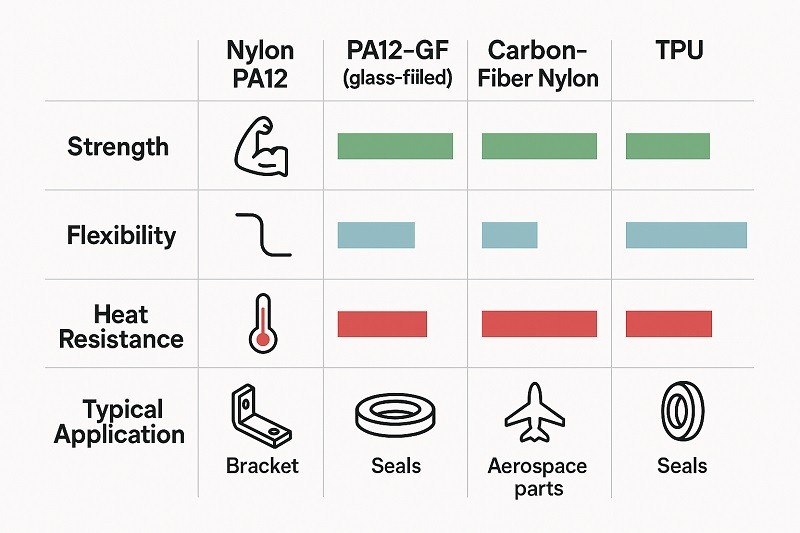
The most common and versatile material in SLS printing is Nylon PA12. It's a true multi-purpose thermoplastic known for its exceptional strength, stiffness, and long-term stability. PA12 offers strong chemical resistance to oils, greases, and various chemicals, making it suitable for a wide array of applications. Its balanced property profile makes it the default choice for everything from durable prototypes to functional machine components.
For Added Strength: Glass-Filled (GF) Nylon
When standard PA12 isn't enough, Glass-Filled Nylon (often PA12-GF) provides a significant boost in stiffness and thermal stability. By reinforcing the nylon powder with glass spheres or fibers, the resulting material offers a higher heat deflection temperature (HDT), reduced warping, and superior dimensional stability. This makes it an excellent choice for parts that operate under load or near heat sources, such as structural housings, jigs, and fixtures.
The Lightweight Champion: Carbon-Fiber (CF) Nylon
For applications demanding the highest strength-to-weight ratio, Carbon-Fiber Filled Nylon is the ultimate choice. This composite material combines the toughness of nylon with the extreme stiffness and strength of carbon fibers. The resulting parts are incredibly lightweight, rigid, and often possess electrostatic discharge (ESD) safe properties. This makes them ideal for high-performance applications in the aerospace, automotive racing, and drone manufacturing industries.
Flexible and Durable: Thermoplastic Polyurethane (TPU)
SLS is not limited to rigid materials. TPU offers a rubber-like flexibility, excellent tear resistance, and high rebound. This makes it perfect for creating flexible prototypes, soft-touch grips, seals, gaskets, and wearable devices. SLS-printed TPU parts are far more durable and functional than flexible parts from many other 3D printing technologies, allowing for the production of end-use elastomeric components.
A Comparison of Common SLS Materials
Choosing the right material is critical for part performance. Chinese SLS providers offer a wide selection, each tailored to specific needs. Here’s a quick overview of the most popular options available.
| Material | Key Properties | Common Applications |
|---|---|---|
| Nylon PA12 | Strong, stiff, good chemical resistance | Functional prototypes, casings, mechanical parts |
| Nylon PA11 | Higher impact strength & ductility than PA12 | Snap fits, living hinges, high-impact components |
| Glass-Filled Nylon | High stiffness, thermal stability, dimensional accuracy | Housings, jigs, fixtures, under-hood components |
| Carbon-Fiber Nylon | Extreme strength-to-weight, high rigidity, ESD-safe | Drone parts, lightweight automotive brackets, robotics |
| Aluminum-Filled Nylon | Metallic appearance, higher stiffness & thermal conductivity | Aesthetic prototypes, jigs requiring machinability |
| TPU | Flexible, rubber-like, high tear resistance | Seals, gaskets, flexible prototypes, wearables |
Key Applications Across Industries
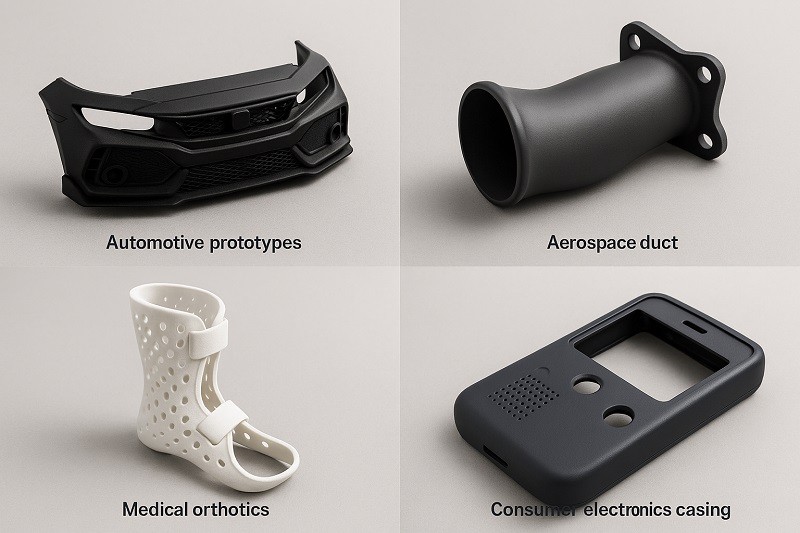
The versatility of SLS materials has led to widespread adoption across numerous sectors. In the automotive industry, it is used for prototyping dashboards, air ducts, and creating custom jigs. The aerospace sector relies on it for lightweight drone components and environmental control system ducting. In the medical field, SLS is used to create patient-specific surgical guides, orthotics, and durable medical device housings. For consumer electronics, it’s a go-to for producing tough, complex casings and internal brackets.
Beyond the Print: Essential Post-Processing Options
Raw SLS parts have a grainy, matte surface finish. To prepare them for end-use, Chinese manufacturers offer a variety of post-processing services:
- Media Blasting: A standard process to remove loose powder and create a smooth, uniform satin finish.
- Dyeing: Parts can be submerged in a hot dye bath to achieve a deep, consistent color, with black being the most common choice for a professional look.
- Vapor Smoothing: A chemical vapor process that melts the outer surface of the part, sealing it and creating a smooth, glossy finish comparable to injection molding. This also improves mechanical properties and makes the part watertight.
- Painting: For specific color requirements or a premium finish, parts can be primed and painted just like traditional plastic components.
Quality and Precision You Can Trust
Leading SLS service providers in China adhere to strict quality control standards to deliver reliable and accurate parts. Typical dimensional accuracy is around +/- 0.3mm, which is suitable for most functional applications. By carefully controlling powder quality, laser parameters, and build chamber temperatures, they ensure consistent mechanical properties and part performance, build after build. When sourcing parts, always inquire about a supplier's quality assurance processes and material traceability to guarantee your components meet your engineering requirements.
The Future is Sintered
As SLS technology continues to advance and a wider range of high-performance materials becomes available, its role in manufacturing is set to expand even further. It is bridging the gap between prototyping and mass production, enabling on-demand manufacturing of complex, customized end-use parts. By partnering with experienced SLS providers in China, businesses can harness the full potential of this transformative technology to accelerate innovation, reduce costs, and bring better products to market faster.