A Comprehensive Guide to Metal 3D Printing: From SLM to Custom Parts
- Share
- Issue Time
- Apr 2,2026
Summary
This guide covers metal additive manufacturing fundamentals, explains Selective Laser Melting (SLM) working principle, compares SLM vs DMLS, lists applicable high-performance metals, and highlights key advantages like design freedom, efficiency, and customization for aerospace, medical, automotive industries.
As we delve into the world of metal 3D printing, we'll uncover the transformative power of Selective Laser Melting (SLM) and its profound impact on modern manufacturing. This guide aims to demystify SLM technology, showing how it's enabling us to create custom parts with unparalleled precision and efficiency, challenging the boundaries of traditional production methods.
Join us as we explore the intricate details of SLM, from its fundamental principles to its wide-ranging applications across industries like aerospace, automotive, and medical. We'll also highlight key considerations for those looking to partner with a reliable 3D Printing SLM Custom Parts Supplier, ensuring you make informed decisions for your next project.
Understanding the Fundamentals of 3D Printing SLM Custom Parts Capabilities
The landscape of manufacturing is undergoing a seismic shift, with metal additive manufacturing leading the charge. This innovative approach is not just a new tool but a complete reimagining of how components are designed, created, and utilized. By understanding its core principles, we can begin to appreciate its full potential and how it stands apart from the production methods that have dominated for centuries.
What is Metal Additive Manufacturing?
Metal Additive Manufacturing (AM), often used interchangeably with metal 3D printing, is a transformative process that builds three-dimensional metal objects directly from a digital file. Unlike traditional methods that cut away material, AM constructs parts layer by layer, fusing fine metallic powders together. This additive approach, guided by a Computer-Aided Design (CAD) model, allows for the creation of components with a level of complexity and structural integrity that was once unimaginable. The technology has matured from a tool for rapid prototyping to a viable solution for producing industrial end-use parts, finding applications in critical sectors like aerospace, medical, automotive, and consumer goods.
Revolutionizing Production: Beyond Traditional Methods
For decades, manufacturing has relied on subtractive and formative techniques. Subtractive methods, such as CNC machining or drilling, start with a solid block of material and remove excess to reveal the final part. Formative methods, like casting or forging, use molds or compressive forces to shape metal. While these processes are reliable and cost-effective for mass production of simple parts, they come with significant limitations.
Traditional manufacturing often struggles with complex geometries, incurs substantial material waste, and requires long lead times for tooling like molds and dies. Any design change can trigger a costly and time-consuming re-tooling process. Metal AM circumvents these challenges entirely. It builds parts directly from a digital blueprint, eliminating the need for dedicated tooling and enabling almost immediate production once a design is finalized. This fundamentally changes the economic equation, especially for complex or custom parts, making it possible to produce them quickly and efficiently even in small batches.
Key Advantages of Metal 3D Printing
The shift towards metal additive manufacturing is driven by a host of compelling advantages that offer a competitive edge across numerous industries. These benefits not only improve existing products but also unlock entirely new design and business possibilities.
- Unparalleled Design Freedom and Complexity: The most significant advantage of metal AM is its ability to produce parts with intricate geometries without the constraints of traditional methods. Designers are free to create complex internal channels for cooling, lightweight lattice structures, and organic shapes that optimize performance and reduce weight. This capability, where complexity is no longer a cost driver, is especially valuable in high-performance sectors like aerospace and custom medical implants.
- Rapid Prototyping and Accelerated Time-to-Market: Metal AM drastically shortens product development cycles. Design iterations that could take weeks or months with traditional prototyping can now be produced and tested in a matter of days. This agility allows companies to innovate faster, refine products more thoroughly, and bring them to market significantly ahead of the competition.
- Cost and Material Efficiency: Additive manufacturing is an inherently efficient process. By building parts layer by layer, it uses only the material needed for the final object, dramatically reducing the waste associated with subtractive methods. For expensive materials like titanium or nickel superalloys, this can lead to substantial cost savings. Furthermore, the ability to consolidate multiple components into a single, complex printed part eliminates assembly steps, simplifies supply chains, and reduces overall production costs.
- Weight Reduction for Enhanced Performance: In industries like aerospace and automotive, every gram matters. Metal AM allows for the creation of structurally optimized, lightweight components that maintain strength and durability. By using less material and employing designs like internal lattices, parts can be made significantly lighter, leading to improved fuel efficiency and overall performance.
- Mass Customization and On-Demand Production: The technology excels at producing highly customized or personalized parts. From patient-specific surgical implants to bespoke automotive components, metal AM can produce unique items without the need for retooling, making mass customization economically viable. This also enables a move towards on-demand production and digital inventories, reducing the need for large physical stockpiles of spare parts.
| Advantage | Description | Impact on Manufacturing |
|---|---|---|
| Design Freedom | Ability to create highly complex and intricate geometries not possible with traditional methods. | Enables part consolidation, lightweighting, and performance-optimized designs. |
| Speed | Drastically reduced lead times from design to functional part, bypassing tooling. | Accelerates product development, prototyping, and time-to-market. |
| Cost Efficiency | Minimized material waste and elimination of tooling costs for complex or low-volume parts. | Lowers total cost of ownership for custom and intricate components. |
| Customization | Economical production of unique, one-off, or personalized parts. | Opens new markets in medical, dental, and high-performance consumer goods. |
| Sustainability | Reduces material scrap and allows for decentralized, on-demand manufacturing. | Leads to a more efficient and environmentally friendly supply chain. |
Diving Deep into Selective Laser Melting (SLM)
Selective Laser Melting (SLM) is a flagship process within the powder bed fusion (PBF) family of additive manufacturing. It is a highly advanced technology celebrated for its ability to produce fully dense, high-strength metal parts with complex geometries directly from a 3D CAD model. Unlike other AM processes that might only sinter particles together, SLM uses a high-power laser to completely melt and fuse metallic powders, resulting in parts with mechanical properties that can be comparable or even superior to those made by traditional casting or forging. This makes SLM a go-to solution for mission-critical applications in demanding fields such as aerospace, medicine, and automotive engineering.
How SLM Works: A Layer-by-Layer Approach
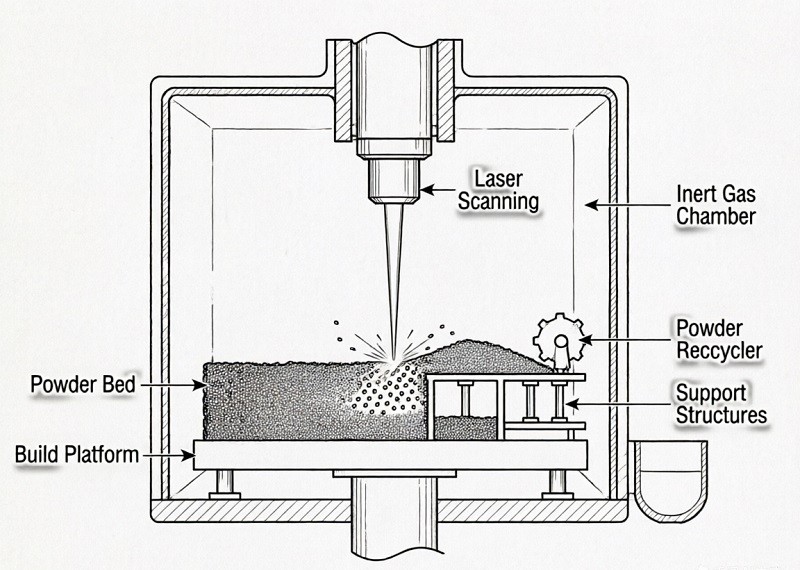
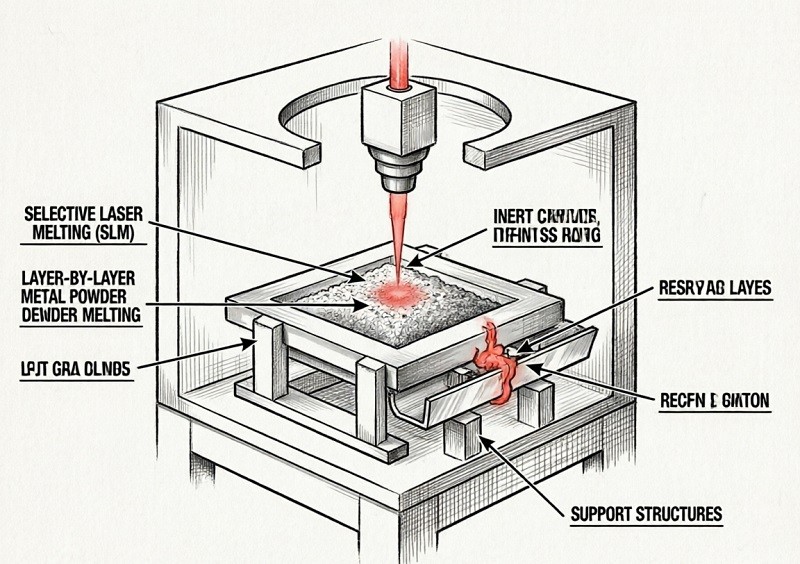
The magic of SLM happens inside a tightly controlled machine chamber. The process is intricate and precise, transforming fine metal powder into a robust, solid object. Here's a step-by-step breakdown of the workflow:
- Digital Preparation: The journey begins with a 3D CAD model of the desired part. This digital file is "sliced" into hundreds or thousands of thin horizontal layers, creating a detailed 2D map for each layer. This sliced file also includes the specific laser scan paths and process parameters needed to build the part.
- Machine Setup: Before printing, the SLM machine's build chamber is flooded with an inert gas, typically argon or nitrogen. This step is critical as it prevents the metal powder from oxidizing at the extremely high temperatures of the melting process, ensuring the final part's material integrity.
- Powder Deposition: A recoater blade or roller sweeps across the build platform, depositing a very thin, uniform layer of fine metal powder, usually between 20 and 100 micrometers thick.
- Laser Melting: A high-power fiber laser, guided by the sliced CAD data, scans the cross-section of the part for that layer. The intense energy of the laser completely melts the powder particles, forming a molten pool that fuses with the layer below it.
- Layer-by-Layer Build: After the layer is scanned and solidified, the build platform lowers by the exact thickness of one layer. The recoater then applies a fresh layer of powder, and the laser melting process repeats. This cycle continues, building the part layer by meticulous layer until the entire object is complete.
- Part Removal and Post-Processing: Once the printing is finished and the part has cooled, it is carefully excavated from the surrounding bed of unused powder. This excess powder can be collected, sieved, and recycled for future builds. The part, which is typically built on a solid base plate and often requires support structures, then moves to post-processing. This can involve stress-relief heat treatment, removal from the build plate, removal of supports, and various surface finishing techniques.
SLM vs. DMLS: Understanding the Nuances
In the world of metal additive manufacturing, the terms Selective Laser Melting (SLM) and Direct Metal Laser Sintering (DMLS) are often used interchangeably, leading to some confusion. While both are powder bed fusion technologies that use a laser to create metal parts, there is a subtle but important historical and technical distinction.
The primary difference lies in the degree of fusion. Historically, SLM was developed to fully melt the metal powder, creating a completely molten pool that solidifies into a dense, homogeneous structure. This process is typically used with single-component metals or pre-alloyed powders like titanium, aluminum, and stainless steel. The complete melting leads to parts with exceptionally high density (often over 99%) and mechanical properties that rival wrought materials.
DMLS, a term trademarked by EOS, was originally described as a sintering process. Sintering heats the powder particles to a point where their surfaces fuse together without reaching a full liquid state. This was particularly useful for processing metal alloys with varying melting points among their constituent elements.
However, in practice, modern DMLS machines often operate at temperatures that also fully melt the powder, blurring the lines between the two technologies. Many experts now consider them largely synonymous, with both capable of producing dense, high-performance parts. The choice between them may come down to the specific machine manufacturer, material compatibility, and desired final part properties. For instance, SLM is often preferred when the absolute highest density and strength are required for a pure or single-alloy metal.
The Materials We Can Use with SLM
One of the greatest strengths of SLM is its compatibility with a wide range of high-performance metals and alloys. This material diversity allows engineers to select the perfect option to meet specific application requirements, whether it's for lightweighting, high-temperature resistance, or biocompatibility.
Here are some of the most common materials used in SLM 3D printing:
- Titanium Alloys: Prized for their remarkable strength-to-weight ratio, excellent corrosion resistance, and biocompatibility, titanium alloys like Ti-6Al-4V are staples in aerospace, high-performance automotive, and medical industries. They are frequently used for manufacturing aircraft components, race car parts, and surgical implants like joints and dental fixtures.
- Aluminum Alloys: Known for being lightweight and having good thermal conductivity, aluminum alloys such as AlSi10Mg are a popular choice for applications focused on weight reduction and heat management. You'll find them in automotive parts, drone components, heat exchangers, and electronics housings.
- Stainless Steels: Versatile and cost-effective, stainless steels like 316L and 17-4PH offer a great combination of high strength, good corrosion resistance, and ductility. Their applications are vast, spanning across medical devices, food-grade equipment, industrial tooling, and marine parts.
- Nickel Superalloys: Materials like Inconel 718 and Hastelloy X are renowned for their exceptional mechanical strength and resistance to corrosion and oxidation at extreme temperatures. This makes them indispensable for parts that operate in harsh environments, such as jet engine components, gas turbines, and chemical processing equipment.
- Cobalt-Chrome Superalloys: These alloys are known for their high strength, temperature resistance, and excellent wear resistance. They are also biocompatible, making them a common choice for medical implants like knee and hip replacements, as well as high-temperature applications in turbines.
- Tool Steels: Valued for their hardness, abrasion resistance, and toughness, tool steels are printed using SLM to create custom tooling, dies, and injection mold inserts with complex internal cooling channels that improve performance and cycle times.
- Copper Alloys: While challenging to process due to high reflectivity and thermal conductivity, SLM can be used with copper alloys to produce parts with excellent electrical and thermal conductivity, such as heat exchangers and electrical components.