A Beginner's Guide to Custom Sheet Metal Stamping: Types and Industrial Uses
- Share
- Issue Time
- Jun 16,2026
Summary
Beginner's guide to custom sheet metal stamping types, processes, and industrial applications for precision manufacturing.
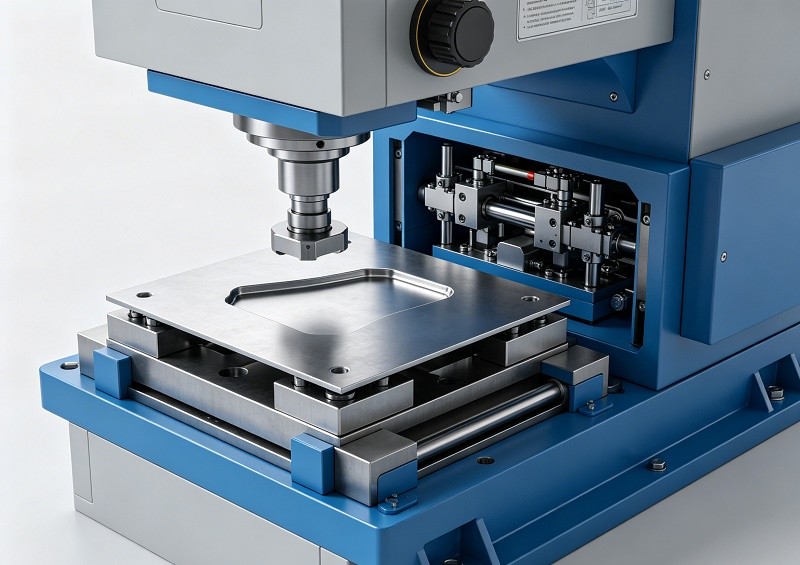
Welcome to the fascinating world of custom sheet metal stamping, a precise manufacturing process that is far more integral to our daily lives than you might imagine. It’s the hidden engine behind countless objects we use every day. Join us as we explore how simple flat metal sheets are expertly transformed into a vast array of functional parts, from common household items to critical industrial components that power our world. This guide will illuminate the different types of custom sheet metal stamping, highlight its extensive industrial applications, and demonstrate why it remains so vital in the landscape of modern manufacturing.
What is Custom Sheet Metal Stamping? Our Process and Core Value
At its core, custom sheet metal stamping is a manufacturing process that shapes and cuts metal sheets into specific, predetermined forms. It’s a method prized for its precision, speed, and cost-effectiveness, especially in high-volume production runs. The "custom" aspect is key; it signifies that every component is engineered and produced to meet unique client specifications, from simple washers to complex automotive body panels.
Defining Custom Sheet Metal Stamping for Beginners
For those new to the concept, sheet metal stamping can be understood as a cold-forming process, meaning it's typically done without applying heat. It involves three primary elements: a stamping press, a die, and a flat sheet of metal (often in blank or coil form). The stamping press is a machine that applies immense force. The die is a specialized tool, typically made from hardened steel, that is custom-built with the negative impression of the desired part.
The process is straightforward in principle: a flat piece of metal, known as a blank, is placed into the stamping press. The press then forces the die into the metal sheet with enough pressure to cut or shape it into the final form. This force is measured in tons and can create everything from simple bends and holes to intricate patterns and deep, cup-like shapes. Though it is a cold-forming process, friction between the die and the metal can cause the finished part to become hot. The result is a highly accurate and repeatable component that matches the design specifications exactly.
Our Fundamental Stamping Project Steps
Bringing a custom stamped part from concept to reality involves a meticulous, multi-stage workflow. Each step is crucial for ensuring the final product meets the highest standards of quality, functionality, and cost-efficiency. Here are the fundamental steps in a typical stamping project:
Design & Engineering: The journey begins with the part design, often created using Computer-Aided Design (CAD) software. During this phase, engineers focus on Design for Manufacturability (DFM), ensuring the part's design is optimized for the stamping process. This involves defining tolerances, material specifications, and features to maximize efficiency and minimize cost. Stamping simulation software may also be used to predict how the metal will behave during forming, allowing for design adjustments before any physical tooling is made.
Tooling Design & Fabrication: Once the part design is finalized, the next step is to create the custom die. This is one of the most critical and investment-heavy stages. Using Computer-Aided Machining (CAM) software, toolmakers fabricate the die from durable tool steel or carbide. The precision of the die directly determines the accuracy and consistency of every part produced.
Material Selection and Preparation: A wide range of metals can be used in stamping, including steel, aluminum, copper, brass, and even exotic alloys. The appropriate material is selected based on the part's required strength, durability, corrosion resistance, and other properties. The metal, often in large coils, is then unwound, straightened, and fed into the press. For some processes, the coil may first be cut into smaller, more manageable blanks in a process called "blanking".
Prototyping and Approval: Before launching into full-scale production, a prototype or a small batch of parts is often produced using "soft dies" or other rapid tooling methods. This allows for testing the part's fit, form, and function. This Zero Defects process is essential for validating the design and tooling, ensuring everything is perfect before mass production begins.
Production Stamping: With the design and tooling approved, full-scale production begins. The prepared metal is fed into the stamping press, which can operate at incredibly high speeds, sometimes making hundreds or even thousands of strokes per minute. The press uses the die to perform operations like punching, bending, and forming, efficiently creating identical parts.
Finishing and Quality Control: After stamping, parts may undergo secondary processes. This can include trimming away excess material, deburring to remove sharp edges, cleaning, and applying coatings like plating or paint for enhanced durability or corrosion resistance. Throughout the entire process, rigorous quality control checks are performed—including visual, dimensional, and functional inspections—to ensure every part meets the specified tolerances and quality standards.
| Project Stage | Key Activities | Primary Goal |
|---|---|---|
| Stage 1: Design | CAD modeling, DFM analysis, material selection. | Create an efficient and manufacturable part design. |
| Stage 2: Tooling | Die design (CAM), tool fabrication from hardened steel. | Build a precise and durable die for production. |
| Stage 3: Prototyping | Soft tooling, first article inspection. | Validate the design and functionality before mass production. |
| Stage 4: Production | High-speed press operation, automated feeding. | Manufacture parts in volume, quickly and consistently. |
| Stage 5: Finishing & QA | Deburring, coating, plating, dimensional inspection. | Ensure parts meet all quality and performance standards. |
Why We Choose Custom Sheet Metal Stamping for Efficiency
Custom sheet metal stamping is a cornerstone of modern manufacturing for several compelling reasons, primarily centered around efficiency and scalability. When industries require large quantities of identical components, stamping provides a solution that is difficult to match in terms of speed, cost, and precision.
The key advantages include:
- High-Speed Production: Automated stamping presses operate at incredible speeds, producing parts much faster than methods like CNC machining or manual fabrication. This high throughput leads to significantly shorter lead times for large orders.
- Cost-Effectiveness at Volume: While the initial investment in custom tooling can be significant, the cost per part becomes extremely low in high-volume runs. The automated nature of the process reduces labor costs, and the high production rate maximizes output, making it highly economical for mass production. Stamping aluminum parts, for instance, can be about five times cheaper than CNC machining for the same part in large quantities.
- Exceptional Precision and Repeatability: The use of hard tooling ensures that every part produced is virtually identical. This high degree of consistency is crucial for industries like automotive, aerospace, and medical devices, where tight tolerances are non-negotiable. Tolerances as tight as +/- 0.005 inches are achievable, with some advanced processes reaching even higher precision.
- Reduced Material Waste: Advanced planning and nesting software allow manufacturers to arrange parts on the metal sheet in a way that minimizes scrap. Compared to subtractive methods like machining, which cut parts from a solid block, stamping is inherently more material-efficient, further reducing costs.
- Enhanced Durability and Strength: The cold-forming process used in stamping can work-harden the metal, often resulting in a stronger, more durable final part compared to components made through other methods. This enhanced strength ensures a longer lifespan for the component, even in rigorous applications.
This combination of speed, precision, and cost savings makes custom sheet metal stamping the go-to choice for manufacturers needing to produce high-quality components at scale efficiently.
Exploring Diverse Types of Custom Sheet Metal Stamping Techniques
Custom sheet metal stamping is not a monolithic process; it's a versatile field encompassing a wide array of techniques, each designed for a specific purpose. By combining these methods, manufacturers can produce parts with stunning complexity and precision. The choice of technique depends on the part's geometry, required features, production volume, and material.
Key Stamping Methods We Utilize for Your Projects
The foundational techniques in metal stamping are used to cut, shape, and form the metal. These core operations are the building blocks for creating almost any stamped component.
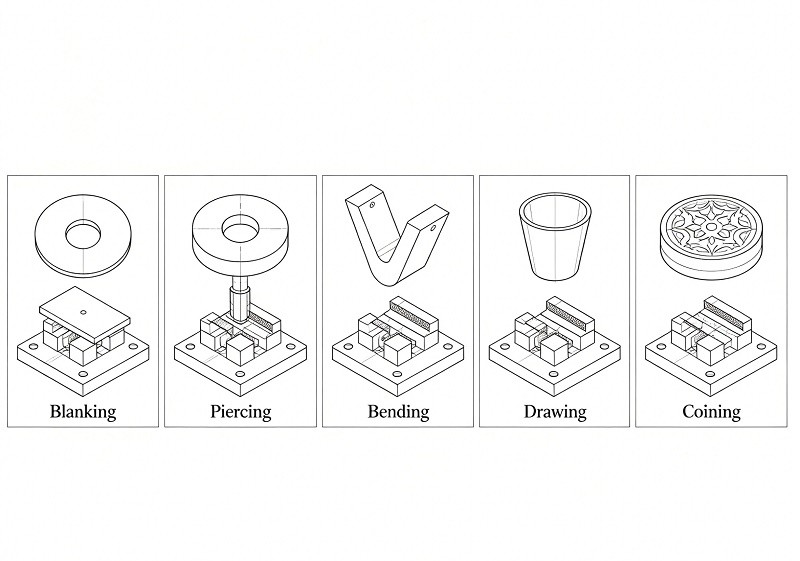
Blanking: This is often the first step in the stamping process. It involves cutting the outer shape of a part from a larger metal sheet. The piece that is cut out is the desired component, known as a "blank," which may then undergo further forming operations. The goal of blanking is to produce a flat part with uniform edges and high dimensional accuracy.
Piercing (or Punching): In contrast to blanking, piercing is the process of creating holes, slots, or other openings within the workpiece. A punch pushes through the metal to create the desired opening, and the material that is removed (the "slug") is considered scrap. This operation is nearly identical to punching, and the terms are often used interchangeably.
Bending: This common forming operation deforms the metal along a straight axis to create angles, V-shapes, U-shapes, or channels without changing the material's thickness. It's essential for creating parts like brackets, enclosures, and structural components.
Drawing: This is a more complex operation used to create deep, recessed, or vessel-like shapes, such as cups, cans, or automotive oil pans. In this process, a metal blank is stretched and pulled into a die cavity by a punch, causing the material to flow and form into a three-dimensional shape. When the depth of the part exceeds its diameter, it is specifically called "deep drawing."
Coining: Coining applies extremely high pressure to a localized area of the metal, forcing the material to flow into the fine details of a die. This technique does not remove material but instead creates highly precise features like embossed logos, sharp edges, or detailed patterns, similar to the process used to mint currency coins.
Embossing: Similar to coining, embossing creates raised or indented designs on the metal surface. However, embossing uses less pressure and deforms the entire metal thickness, creating a corresponding impression on the reverse side of the part. It's often used for decorative purposes or to add logos and lettering.
Specialized Custom Sheet Metal Stamping Techniques Offered
Beyond the fundamental operations, several specialized stamping setups are employed to handle different levels of part complexity and production volumes. The choice among these methods directly impacts cost, speed, and design capability. The primary difference lies in how the part moves (or doesn't move) between operations.
Progressive Die Stamping: This is a highly efficient method ideal for producing small, complex parts in high volumes. A single die contains multiple stations, and a continuous strip of metal is fed through it. At each station, a different operation (like piercing, bending, or coining) is performed sequentially. The part remains attached to the metal strip until the final station, where it is separated. This continuous process allows for incredibly high speeds and excellent repeatability.
Transfer Die Stamping: Best suited for large or deep-drawn parts, transfer die stamping involves moving a separated workpiece from one station to another using a mechanical transfer system. Unlike progressive stamping, the part is not attached to a carrier strip, which provides greater flexibility for complex forming operations. Each station has an independent die, making this process highly versatile for parts that can't be made in a progressive die.
Compound Die Stamping: This technique performs multiple cutting operations, such as blanking and piercing, in a single press stroke at a single station. It is renowned for producing exceptionally flat parts with high dimensional accuracy and tight tolerances, making it perfect for simple, flat components like washers or gaskets. While highly precise, it is generally slower than progressive stamping and less suited for complex geometries.
Here's a comparison of these three primary methods:
| Technique | Best For | Key Advantage | Tooling Cost | Speed |
|---|---|---|---|---|
| Progressive Die | Small, complex parts; high volumes | High efficiency & repeatability | High | Very Fast |
| Transfer Die | Large, deep-drawn, or complex parts | Design flexibility for large items | High | Moderate |
| Compound Die | Simple, flat parts; high precision | Excellent flatness & accuracy | Moderate | Moderate |
Other advanced techniques include Four-Slide or Multi-Slide Stamping, which uses multiple moving tools to form intricate parts with many bends, and specialized processes like Hydroforming and Electromagnetic Forming.
Broad Industrial Applications of Custom Sheet Metal Stamping
The versatility, precision, and cost-effectiveness of custom sheet metal stamping make it an indispensable process across nearly every major industry. From the cars we drive to the devices we use, stamped components form the structural and functional backbone of countless products.
Automotive Industry: This is one of the largest users of stamped metal parts. Components range from large body panels, doors, hoods, and chassis parts to smaller, intricate items like brackets, clips, seat components, and fuel system parts. The process is critical for producing lightweight yet strong components that improve fuel efficiency and safety.
Aerospace and Aviation: The aerospace industry relies on stamping for lightweight, high-strength components that are critical for aircraft performance and safety. Applications include structural elements, brackets, fasteners, engine components, and fuselage sections.
Electronics and Telecommunications: Precision stamping is essential for creating the miniature, highly detailed components used in electronic devices. This includes connectors, terminals, shields for electromagnetic interference (EMI), contact springs, and casings for everything from smartphones to servers.
Medical Devices: The medical field requires components with extreme precision and biocompatible materials. Metal stamping is used to manufacture surgical instruments, diagnostic equipment housings, durable parts for medical machinery, and even components for implantable devices.
Appliances and Consumer Goods: Look inside any household appliance—a washing machine, refrigerator, or oven—and you will find a multitude of stamped metal parts. These include frames, housings, internal brackets, and functional components that must be durable and produced affordably.
Construction and Hardware: Stamped metal parts are fundamental to the construction industry, used in items like structural connectors, fasteners, brackets for paneling, HVAC components, and various types of hardware like hinges, latches, and locks.
Benefits of Partnering for Custom Sheet Metal Stamping Services
While some large companies may handle stamping in-house, many businesses find significant advantages in outsourcing to a specialized manufacturing partner. This strategic decision can lead to cost savings, higher quality, and a more streamlined path from design to production.
Here are the key benefits of partnering with a professional stamping service provider:
Access to Expertise and Advanced Technology: Specialized stamping companies possess deep knowledge refined over years of diverse projects. They have access to state-of-the-art equipment—including various press types, advanced tooling technology, and quality control systems—without requiring you to make a significant capital investment.
Cost Savings and Reduced Overhead: Bringing stamping operations in-house is expensive, requiring investment in machinery, maintenance, and a skilled workforce. Outsourcing eliminates these overhead costs and allows you to leverage the supplier's economies of scale, often resulting in a lower per-part cost, especially with their established material supplier relationships.
Improved Quality and Consistency: Professional stamping manufacturers live and breathe quality control. Their expertise ensures that parts meet stringent specifications and industry standards, reducing defect rates and enhancing product reliability. They are adept at managing complex geometries and tight tolerances.
Faster Time-to-Market: With optimized processes, experienced engineers, and efficient production schedules, a dedicated partner can often deliver parts faster than an in-house operation. This streamlined process reduces lead times and allows you to get your product to market more quickly.
Focus on Core Competencies: Outsourcing non-core activities like metal stamping allows your business to concentrate its resources on what it does best, such as product design, innovation, marketing, and customer service. This strategic focus can ultimately drive business growth and improve your competitive edge.
Conclusion
By now, we hope you've gained a clear understanding of the remarkable versatility and critical importance of custom sheet metal stamping. From its fundamental definition to the diverse array of techniques and specialized processes, it is clear that this manufacturing method is an engineering powerhouse. It’s a foundational process that continuously shapes our world, providing unparalleled precision, efficiency, and scalability across countless industries and products. The ability to transform a simple metal sheet into a complex, functional component is a testament to its enduring value.
The next time you open a car door, use a home appliance, or see a complex piece of industrial machinery, take a moment to consider the intricate network of stamped parts working behind the scenes. Remember the intricate process of custom sheet metal stamping that likely brought it to life! When you need a one-stop solution for turning your designs into high-quality, precision-engineered components, partners like SOMI Custom Parts are here to provide the expertise and technology to make it happen.