5-Axis CNC Machining vs 3-Axis: When to Upgrade and What You Gain
- Share
- publisher
- SOMI Custom Parts
- Issue Time
- Jul 14,2026
Summary
Confused whether to upgrade from 3-axis to 5-axis CNC machining? This comprehensive guide compares precision, setup efficiency, cost implications, and application scenarios. Learn when the investment pays off and how SOMI Custom Parts delivers precision 5-axis machining for aerospace, medical, and industrial applications.
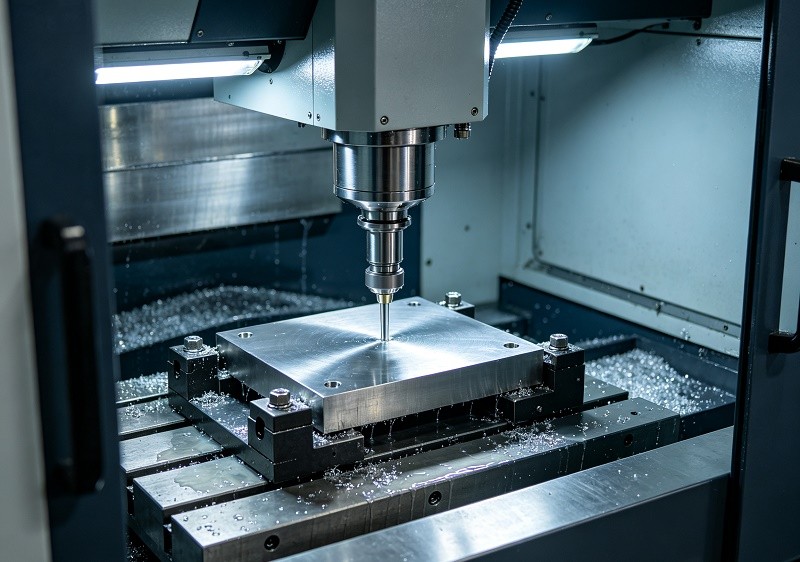
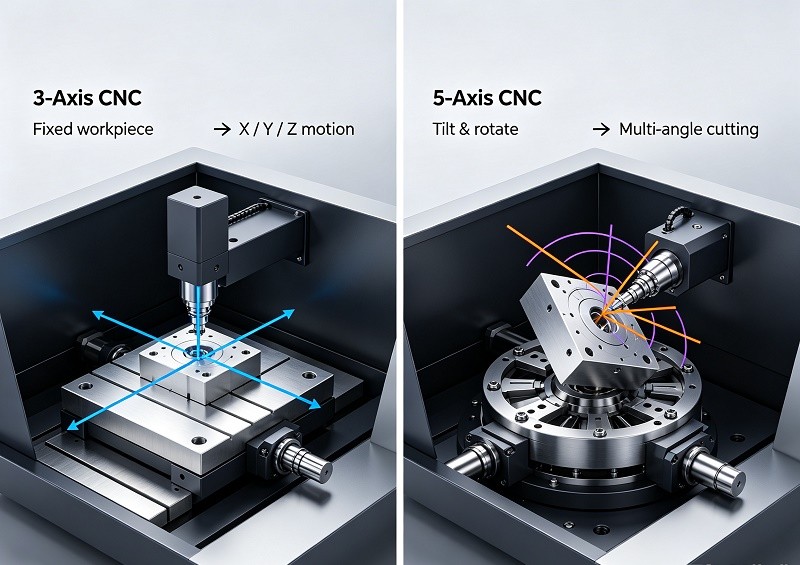
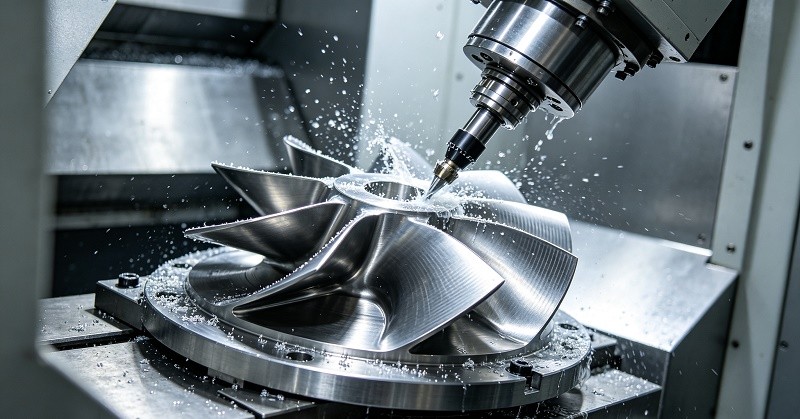
Choosing between 3-axis and 5-axis CNC machining is one of the most consequential decisions in precision manufacturing. While 3-axis machining has been the industry workhorse for decades, 5-axis technology has become increasingly accessible, promising fewer setups, tighter tolerances, and the ability to produce geometrically complex parts that would be impossible—or prohibitively expensive—on conventional equipment. In 2026, the gap between these two technologies continues to narrow. Entry-level 5-axis machines are becoming more affordable, and more contract manufacturers are investing in multi-axis capabilities. Yet 3-axis machining still produces the majority of all CNC parts globally, and for good reason: it is faster to program, simpler to operate, and significantly cheaper per hour. This guide provides a data-driven comparison of 3-axis vs 5-axis CNC machining, covering kinematics, tolerance capabilities, cost analysis, application suitability, and a practical decision framework to help you determine which process is right for your custom parts. A 3-axis CNC machine moves the cutting tool—or the workpiece—along three linear axes: X (left-right), Y (front-back), and Z (up-down). The workpiece remains stationary on the table while the tool removes material from above. To machine features on a different face, the operator must stop the machine, unclamp the part, flip it, re-clamp, and re-zero the program. Each flip introduces setup time and a small risk of dimensional error. 3-axis machining is best suited for simple prismatic parts: flat plates, brackets, housings, manifolds, and enclosures where all critical features are accessible from a single direction or require minimal repositioning. 5-axis CNC machining adds two rotational axes—typically A (rotation around X) and C (rotation around Z), or B and C—to the three linear axes. This allows the cutting tool to approach the workpiece from virtually any angle. In a 5-axis machine, the workpiece can tilt and rotate while the tool moves, enabling complex features to be machined in a single setup. There are two distinct 5-axis modes: The table below summarizes the core technical differences between 3-axis, 3+2 indexed, and full simultaneous 5-axis machining: Despite all the industry buzz around 5-axis, the honest truth is that most CNC parts do not need it. Three-axis machining remains the most cost-effective solution for a wide range of applications. For these parts, a 3-axis machine running a well-designed setup can outproduce a 5-axis machine 3:1 on volume. The lower hourly rate, faster programming, and simpler operation make 3-axis the undisputed champion for straightforward geometries. The rule of thumb: If your part can be machined in 2 or fewer setups on a 3-axis machine, 3-axis is almost certainly the more economical choice. Each additional setup adds 15-30 minutes of operator time and introduces re-fixturing errors of approximately ±0.015-0.030 mm. Five-axis machining becomes the correct—and frequently more cost-effective—choice when part geometry introduces complexity that multiplies 3-axis setup time, or when geometric features are simply impossible to machine in 3-axis. A practical rule for deciding between 3-axis and 5-axis: count the number of unique approach directions your part requires. If a part needs more than three unique approach directions, 5-axis is likely more cost-effective than the equivalent multi-setup 3-axis operation. At 5+ setups on a 3-axis machine, 5-axis almost always wins on total cost when you factor in operator time, fixture costs, rework rates, and tolerance stack-up risk. The most common misconception about 5-axis machining is that it is always more expensive. In reality, 5-axis often reduces total project cost despite higher hourly rates. The key is understanding where the cost savings come from. Industry data shows that for complex parts requiring 4 or more setups, 5-axis machining can reduce total project cost by 30-50% compared to 3-axis, even though the hourly machine rate is roughly double. While 3-axis machining serves most general manufacturing needs, several high-precision industries rely on 5-axis capabilities to meet their demanding requirements: Aerospace components—titanium wing ribs, turbine blades, structural brackets, and engine housings—require machining on multiple faces with tolerances as tight as ±0.005 mm. A single 5-axis setup eliminates the cumulative error that would result from 4-6 separate 3-axis setups. Many aerospace programs require AS9100 certification and Nadcap accreditation, both of which SOMI Custom Parts maintains through rigorous quality systems. Orthopedic implants (spinal cages, tibial trays, dental abutments) and surgical instruments involve organic curves and compound angles that demand full simultaneous 5-axis machining. These parts require ISO 13485 compliance and must meet FDA or CE marking requirements. Surface finishes of Ra 0.4 µm or better are standard for implant-grade components. Electric vehicle manufacturers use 5-axis machining for battery enclosure components, motor housings, and lightweight structural parts. The ability to machine complex aluminum and titanium parts in a single setup reduces lead times and ensures consistent quality across production runs. Robot joint housings, precision linkages, and end-effector components require tight positional tolerances between features on multiple faces. 5-axis machining produces these parts with the repeatability that robotic systems demand. Injection mold cavities and die casting dies feature deep undercuts, complex contours, and fine detail that are only achievable through 5-axis machining. The ability to use shorter, more rigid cutting tools dramatically improves accuracy and surface finish in deep cavity work. At SOMI Custom Parts, we operate a modern fleet of both 3-axis and 5-axis CNC machining centers, allowing us to match the right process to your part geometry. Whether you need cost-effective 3-axis production for simple components or high-precision 5-axis machining for complex aerospace or medical parts, our engineering team provides end-to-end support. Our capabilities include: Our team of experienced CAM programmers and machinists evaluates every part to determine the optimal balance of setup count, cycle time, and tolerance achievement. We do not default to 5-axis when 3-axis will suffice, and we do not compromise quality when 5-axis is the right answer. Explore our CNC machining services to see how we can support your next project, or contact our engineering team for a free consultation and quote. No. On a per-feature basis, both processes can achieve similar tolerances with the right machine and operator (±0.005 mm). 5-axis is more accurate on parts requiring multiple setups because it eliminates re-clamping error. For single-setup parts, 3-axis is equally accurate at a lower cost. Hourly rates for 5-axis machining are roughly 1.5-2x higher than 3-axis ($50-$90 vs $25-$45 in China). However, for complex parts requiring 4 or more 3-axis setups, 5-axis often costs less per part due to reduced setup time, lower fixture costs, and fewer secondary operations. Yes, but it is slower and more expensive for simple geometry. 5-axis machines are universal—they handle 3-axis work too—but the higher hourly rate makes them uneconomical for parts that do not need the extra axes. The best approach is often "right-process-for-right-part." 3+2 (positional 5-axis) locks the rotary axes at a fixed angle during cutting. It accesses multiple faces but cannot produce continuously curved surfaces. Full simultaneous 5-axis moves all axes during cutting, which is required for sculptured surfaces, turbine blades, and complex contours. Specify 5-axis when your part has undercuts, compound angles, features on 5+ faces requiring tight inter-feature tolerances (better than ±0.02 mm), curved 3D surfaces, or thin-wall sections that could deform during re-clamping. When in doubt, send your CAD file to a reputable CNC shop for a free DFM review. Choosing between 3-axis and 5-axis CNC machining comes down to part geometry, tolerance requirements, and total production cost. Three-axis remains the most cost-effective solution for simple, prismatic parts with features on 1-2 faces. Five-axis becomes the right—and often cheaper—choice when part complexity drives 3-axis setup counts to 3 or more, or when geometry demands continuous multi-axis motion. The most strategic manufacturers use both technologies in combination: 3-axis for roughing and simple operations, 5-axis for finishing and complex features. This hybrid approach optimizes both cost and quality across diverse production needs. Ready to discuss your next precision machining project? Send us your inquiry or browse our CNC machining capabilities. Our engineering team will help you choose the optimal process for your requirements. Introduction
What Are 3-Axis and 5-Axis CNC Machining?
3-Axis CNC Machining
5-Axis CNC Machining
Key Differences Between 3-Axis and 5-Axis CNC Machining
Attribute
3-Axis
3+2 Indexed 5-Axis
Full Simultaneous 5-Axis
Linear Axes
X, Y, Z
X, Y, Z
X, Y, Z
Rotational Axes
None
A + C (indexed)
A + C (continuous)
Setups (complex part)
3-6
1-2
1
Achievable Tolerance
±0.025 mm
±0.010 mm
±0.005 mm
Surface Finish
Ra 1.6 µm
Ra 0.8 µm
Ra 0.4 µm
Programming Complexity
Low
Medium
High
Hourly Rate (China)
$25-$45
$50-$70
$50-$90
Best For
Flat plates, simple housings
Multi-face prismatic parts
Complex 3D surfaces, aerospace
When 3-Axis CNC Machining Is the Right Choice
Parts That Belong on a 3-Axis Machine:
When to Upgrade to 5-Axis CNC Machining
Geometric Triggers That Make 5-Axis Necessary:
The Setup Count Decision Rule:
The Cost Analysis: Does 5-Axis Save Money?
Cost Factors to Consider:
Industries That Benefit from 5-Axis CNC Machining
Aerospace
Medical Devices
Automotive (EV and Performance)
Robotics and Automation
Mold and Die Making
How SOMI Custom Parts Can Help
Frequently Asked Questions
Is 5-axis CNC machining always more accurate than 3-axis?
How much more does 5-axis CNC machining cost than 3-axis?
Can a 5-axis machine do everything a 3-axis machine can?
What is the difference between "3+2" and "full simultaneous" 5-axis?
When should I specify 5-axis machining for my parts?
Conclusion